Scientists have developed a groundbreaking communication system that allows medical implants to talk to each other through human tissue.


The medical landscape has long been defined by the isolation of internal devices. For decades, pacemakers, insulin pumps, and neurostimulators have operated as standalone units, often requiring external hardware to relay data or manage settings. This status quo is now facing a radical disruption. A research team at the Georgia Institute of Technology has unveiled a sophisticated networking architecture known as the Smart Wireless Autonomous Networking System, or SWANS. By moving away from traditional radio-frequency communication and toward the use of ionic conduction through body tissue, the researchers have created a blueprint for a truly integrated, interconnected ecosystem of medical implants.
The inherent limitations of legacy wireless protocols
The primary challenge facing modern medical electronics is the reliance on radio-frequency (RF) protocols such as Bluetooth Low Energy (BLE) and Near-Field Communication (NFC). While these technologies are standard in consumer electronics, they encounter significant hurdles when deployed within the human body.
The most critical issue is power consumption. Bluetooth components are inherently energy-intensive. Maintaining a persistent, "always-on" state that allows an implant to respond to medical events within milliseconds is nearly impossible with current battery technology. According to the research published by the Georgia Tech team, activating traditional Bluetooth modules can deplete the limited battery reserves of an implant by as much as 90 percent. This creates a functional paradox: to provide life-saving, real-time monitoring, the device requires a power source that is often too large to be comfortably or safely implanted.
Furthermore, human tissue is a hostile environment for radio waves. Biological matter, composed largely of water and electrolytes, is highly conductive, leading to significant signal attenuation. Engineering studies indicate that radio-based implant communication systems suffer severe performance degradation when signals are required to traverse more than one centimeter of tissue. This forces manufacturers to use larger, more invasive hardware to compensate, often necessitating surgical intervention for implantation. In contrast, devices smaller than three millimeters can typically be delivered via simple outpatient syringe injections.
The birth of SWANS: Bio-inspired engineering
The development of SWANS represents a paradigm shift in how medical engineers approach connectivity. Drawing inspiration from the human nervous system—which manages complex data inputs and outputs through the movement of sodium and potassium ions across cell membranes—the Georgia Tech researchers utilized ionic conduction to transmit information.
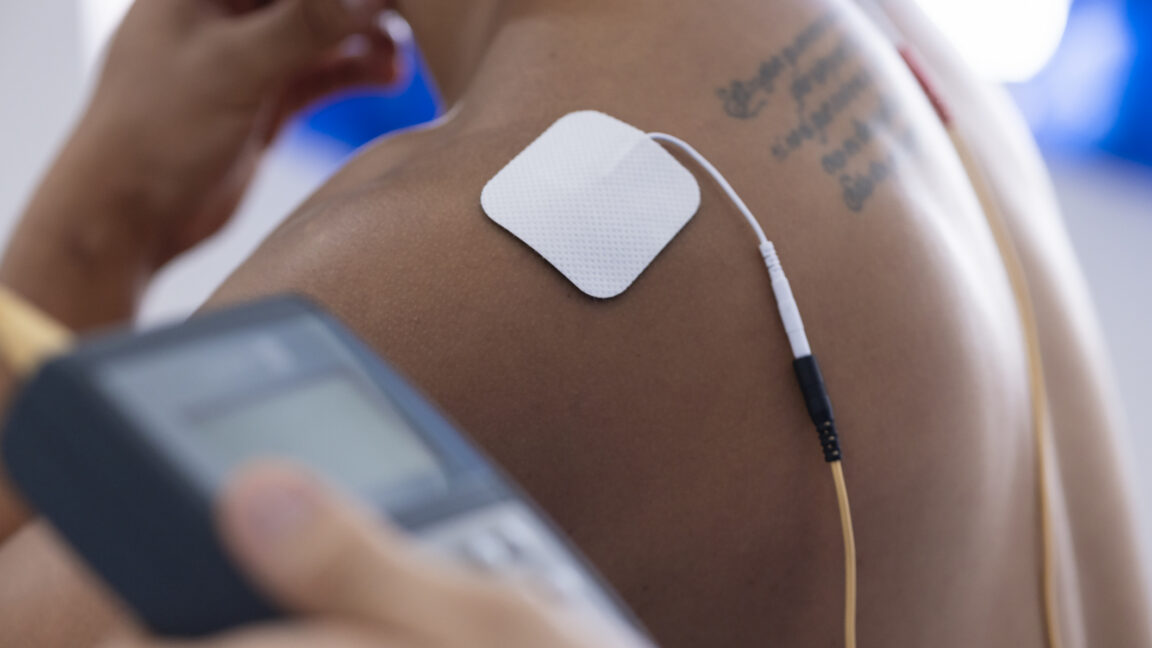
Rather than relying on electromagnetic radiation, SWANS uses the body’s own tissue as a transmission medium for voltage pulses. The system consists of three distinct, modular components: a wearable hub, a microneedle patch, and the injectable implants themselves. The wearable hub serves as the "brain" of the operation, containing the processing power and the battery necessary to run decision-making algorithms. It emits controlled, low-voltage pulses that travel through the body, which are then received by the small, passive implants located throughout the patient’s system.
This design effectively offloads the power-intensive "thinking" tasks to the external hub, allowing the implants to remain minimal. The implants are equipped with transistor switches that only activate when an incoming pulse exceeds a specific voltage threshold. By manipulating internal components like resistors and capacitors, the researchers can program specific implants to respond only to designated signal patterns, effectively creating a private "language" for each device within the network.
A chronology of testing and development
The path to this technology has been one of rigorous iteration. The concept of using ionic conduction for medical data is not entirely unprecedented; the FDA-approved Abilify MyCite system, a "smart pill," utilizes similar principles to signal a skin patch when the medication has been ingested. However, SWANS marks the first instance where this technology has been scaled to support a multi-device, autonomous network.
The team’s validation process involved a series of increasing complexity:
- Initial Benchmarking: The system was tested in ex-vivo biological samples, including chicken breast and porcine (pork) tissue, to determine signal attenuation rates.
- Refinement of Signal Propagation: Researchers found that a 10-volt pulse could create a stable voltage gradient across 30 centimeters of tissue, with a depth penetration of 14 centimeters—a reach tenfold greater than traditional NFC or Bluetooth.
- In-Vivo Pilot Studies: Using laboratory rats, the team demonstrated the system’s ability to operate across different body cavities, including the stomach and abdominal cavity.
- Functional Integration: In the most advanced phase, the team created a "reflex arc" where strain sensors on the rat’s front limb communicated with an implant in the hind leg, triggering a nerve stimulation response upon detecting movement.
Safety and physiological impact
One of the most pressing concerns for any new medical technology is biocompatibility and safety. The Georgia Tech team conducted a two-month longitudinal study on rats to evaluate the long-term impact of the voltage pulses.
The researchers observed that while the body naturally formed a thin layer of scar tissue (fibrosis) around the implants—a common reaction to any foreign object—the system’s communication remained robust. By adjusting the voltage within medically accepted safety margins, the researchers were able to overcome the resistance posed by the scar tissue. Crucially, the pulses were found to have no adverse effect on cardiac rhythms, nor did they trigger unintended nerve stimulation or induce significant oxidative stress at the cellular level. These findings suggest that the technology operates well within the safety parameters already established for existing pacemakers and neurostimulators.

Implications for the future of medicine
The implications of this breakthrough are profound, particularly for the treatment of chronic, multi-systemic conditions. Currently, the medical field suffers from "siloed" treatment modalities. A patient with epilepsy, for example, might have a neurostimulator to manage seizures and a separate, non-connected pump for medication delivery. These systems do not "talk" to one another, preventing the possibility of synchronized, automated therapy.
By creating a platform that is agnostic to the specific type of sensor or actuator, the SWANS protocol could allow for the integration of disparate therapies. A glucose monitor could communicate directly with an insulin pump, or a diagnostic sensor could signal a targeted drug delivery system to release medication only when a specific biological marker reaches a threshold.
However, the team acknowledges that the system is not intended for high-bandwidth data transmission. The primary goal is the exchange of critical, low-data-rate information—such as diagnostic triggers or status updates—between small, low-power devices.
Broader technological and regulatory outlook
While the results in animal models are encouraging, the transition to human clinical trials remains the next significant hurdle. Regulatory bodies like the FDA will require exhaustive evidence regarding the long-term degradation of the stainless-steel microneedles and the stability of the implant electronics over years, rather than weeks.
Furthermore, the requirement for personalized tuning—where voltage thresholds must be calibrated based on an individual patient’s anatomy and implant placement—introduces a new variable into the surgical and post-operative workflow. Doctors will need to be trained not only in the implantation of these devices but also in the calibration of the network’s communication parameters.
Despite these challenges, the work represents a significant departure from the limitations of the last thirty years of medical device engineering. By turning the human body from a barrier into a conduit, the Georgia Tech researchers have proposed a vision of the future where the internal environment is as connected as the digital world outside, potentially ushering in a new era of responsive, autonomous, and highly personalized medicine. As the study moves toward larger animal models and eventual human feasibility studies, the prospect of an "Internet of Bodies" becomes less of a science-fiction trope and more of an engineering inevitability.