Reimagining Laundry: How Carbon Dioxide Technology Could Eliminate Water and Dryers from the Home

The global laundry routine has remained fundamentally unchanged for generations, anchored by a ubiquitous pairing: a washer that consumes copious amounts of water and a dryer that uses intense heat to evaporate it. Together, these two household appliances account for a massive share of residential resource consumption. However, an unexpected cleaning technology originally engineered to scour grease and microscopic debris from aerospace and electronic components is now being seriously evaluated to overhaul the domestic laundry room. This emerging process replaces both water and thermal energy with liquid carbon dioxide ($CO_2$), utilizing the very greenhouse gas that modern climate policy seeks to capture and contain.
Under specific high-pressure conditions, carbon dioxide transitions into a low-viscosity liquid capable of deeply penetrating textile weaves, dissolving oils, and lifting away stubborn grime. Once the cleaning cycle concludes and the chamber is depressurized, the liquid $CO_2$ instantly reverts to a harmless gas, leaving garments simultaneously clean and completely dry. This closed-loop mechanism eliminates wastewater entirely, bypasses the need for conventional tumble-drying, and hints at a future where the traditional household dryer becomes obsolete. Yet, shrinking a complex, room-filling industrial system into a compact home appliance presents unprecedented engineering, economic, and environmental hurdles.
From Aerospace Origins to Industrial Niche
The journey of liquid-$CO_2$ cleaning spans more than three decades, moving slowly from high-tech manufacturing cleanrooms to specialized industrial facilities. The technique was pioneered in 1990 by Hughes Aircraft, which sought an efficient, non-destructive solvent to remove microscopic oil, grease, and manufacturing contaminants from delicate electronic hardware without damaging sensitive components.
Following its aerospace debut, multinational home appliance manufacturer Electrolux explored the technology in the late 1990s and early 2000s as a safer, non-toxic alternative to conventional, chemical-heavy dry cleaning methods that relied on perchloroethylene (PERC). Despite its safety and environmental promise, the initiative stalled due to prohibitive equipment costs, mechanical complexity, and the sheer physical bulk of the necessary high-pressure machinery.
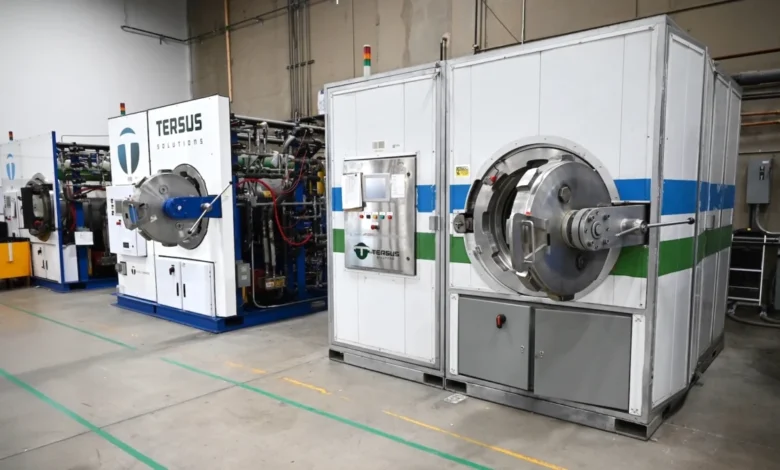
The technology found a more durable commercial foothold in 2009, when Colorado-based Tersus Solutions began refining the process for niche markets. Tersus carved out a successful operational model cleaning specialized outdoor technical apparel, high-performance gear, and personal protective equipment for firefighters laden with hazardous combustion residues. Peter Whitcomb, CEO of Tersus Solutions, describes his company’s current machines as futuristic front-loading washers, though they bear little resemblance to domestic units. These industrial systems dwarf standard laundry machines, requiring approximately a 10-foot cube of space. Their interiors feature thick, submarine-style hatches, rotating drums encased within heavy-duty pressurized chambers, and an intricate network of specialized pumps, pipes, and compressors.
The Mechanics of Waterless Cleaning
Despite the heavy-duty infrastructure required to house the process, the underlying chemical physics inside a $CO_2$ cleaning chamber are remarkably straightforward. Carbon dioxide liquefies when subjected to approximately 900 pounds per square inch (psi) of pressure—roughly one-third of the internal pressure found in a standard scuba diving tank.
Once liquefied and introduced to the sealed chamber, the $CO_2$ circulates through the fabrics, dissolving non-polar soils, body oils, and organic contaminants. Industrial filters continuously capture the extracted grime, which accumulates at the bottom of the system as a thick, viscous sludge destined for safe disposal. A standard cleaning cycle takes approximately 45 minutes. At the conclusion of the cycle, the chamber is depressurized, causing the liquid carbon dioxide to flash back into a gas that is instantly vented away from the clothes, leaving them dry.
Crucially, the system is designed as a closed loop. More than 90 percent of the carbon dioxide is captured, purified, and recycled for subsequent cycles, while only a minor fraction escapes during depressurization. Tersus sources its $CO_2$ directly from nearby ethanol production facilities, where the gas is generated as a natural byproduct of commercial fermentation. By acquiring the gas locally, the company minimizes the carbon footprint associated with long-distance transportation, though the energy required to purify and re-liquefy the gas remains a notable operational factor.
Performance and Environmental Trade-Offs
The ecological allure of liquid-$CO_2$ laundering is underscored by the sheer scale of conventional resource consumption. According to data from the U.S. Environmental Protection Agency’s Energy Star program, the average American family executes approximately 300 loads of laundry annually, consuming thousands of gallons of water. Simultaneously, more than 80 percent of U.S. households own an electric or gas clothes dryer. Academic research published in scientific journals indicates that machine drying alone accounts for roughly 27 million metric tons of carbon dioxide emissions annually in the United States.
By contrast, $CO_2$ cleaning systems operate entirely without water, standard laundry detergents, or thermal heat. Tersus estimates that its larger industrial units save approximately 300 gallons of water per load when compared against conventional commercial washing machines. Furthermore, because the system does not discharge wastewater into municipal sewage systems, it inherently traps shed textile fibers, offering a powerful mechanism to combat the growing crisis of microplastic pollution in global waterways.
The technology is exceptionally effective at removing oil-based and hydrophobic stains. Testing data published in scientific literature demonstrates that $CO_2$ systems achieve an average removal rate exceeding 95 percent for polycyclic aromatic hydrocarbons (PAHs)—hazardous, cancer-causing compounds commonly found embedded in smoke and soot. This makes the technology indispensable for decontaminating the gear of firefighters and industrial workers.
However, water-soluble stains—such as those caused by sweat, sugar, and food—present a distinct challenge. Chris Robbins, chief technology officer at Tersus, notes that these residues are harder for non-polar liquid $CO_2$ to dissolve, occasionally necessitating manual pre-treatment or conventional washing.
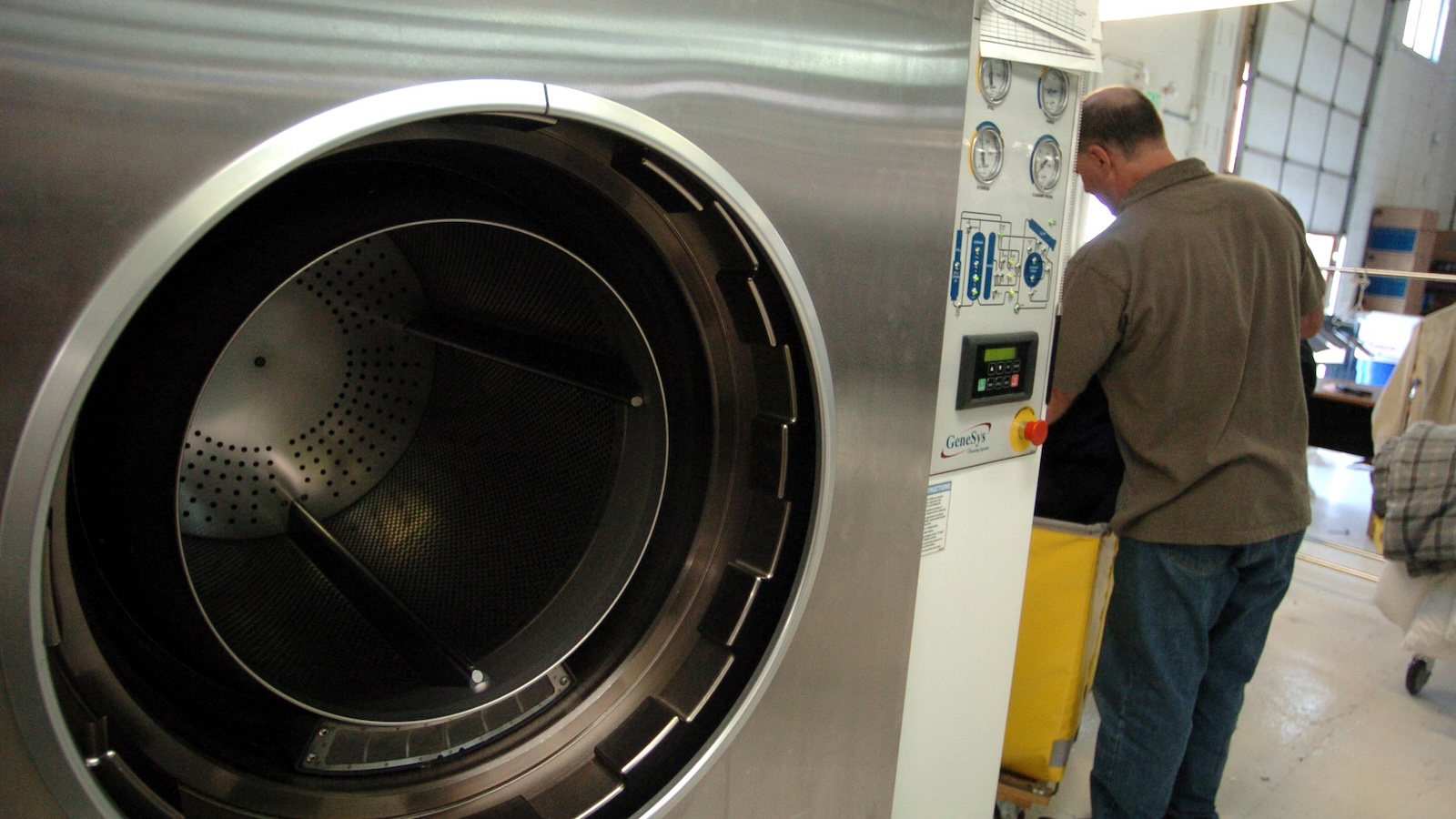
Energy efficiency calculations also present a nuanced picture. A collaborative demonstration project conducted by the California Energy Commission and the U.S. Navy found that commercial-scale $CO_2$ cleaning systems consumed about 15 percent less total energy than smaller commercial washers and dryers combined, though their energy consumption was roughly equivalent to larger industrial laundry systems. While the technology completely avoids thermal drying—typically the most energy-intensive component of traditional laundering—the mechanical work of compressing, cooling, and purifying the carbon dioxide demands substantial electricity.
The Push for Consumer Appliances by LG and Samsung
Recognizing the immense market potential of a waterless household appliance, major appliance manufacturers are investing heavily in research and development. Industry giants LG and Samsung have filed a series of international patents aimed at overcoming the primary barriers to consumer adoption: reducing the extreme operating pressures required for liquefaction and tackling water-soluble stains.
Recent patent filings reveal distinct engineering approaches by the two South Korean electronics leaders. LG’s design incorporates targeted detergents and chemical additives to assist in breaking down water-soluble compounds that resist pure carbon dioxide. Supporting this approach, a recent environmental science study demonstrated that introducing small quantities of isopropyl alcohol and water to liquid $CO_2$ substantially enhanced its ability to dissolve complex organic salts and sugars.
Samsung, conversely, has explored blending carbon dioxide with co-solvents to significantly lower the operating pressure required for the cleaning cycle. By reducing the pressure threshold, engineers can theoretically scale down the thickness and bulk of the internal pressure chambers, making the appliance compact enough to fit standard residential laundry rooms. However, some of these solvent mixtures involve per- and polyfluoroalkyl substances (PFAS), sparking immediate debate among environmental scientists regarding potential chemical trade-offs.
Independent experts caution that miniaturization introduces new mechanical complexities. Eckhard Groll, head of mechanical engineering at Purdue University and an expert in refrigeration systems, notes that while a residential $CO_2$ washer is technologically feasible, outfitting a home appliance with the necessary separation, recovery, and compression equipment could make the unit prohibitively expensive for the mass market.
Similarly, Rainer Stamminger, a household appliance efficiency researcher at the University of Bonn, points out that residential usage patterns differ radically from industrial operations. Because average households run laundry only a few times a week, the continuous cycling, pressurization, and recovery of carbon dioxide could prove highly inefficient for sporadic, single-load use compared to industrial units running continuously.
Economic Realities and Market Adoption Hurdles
Even if engineering obstacles are cleared, consumer economics will dictate the success of any home $CO_2$ washing machine. In North America, where residential electricity and water rates remain relatively low compared to parts of Europe, convincing consumers to absorb a high upfront purchase price for an advanced appliance represents a formidable challenge.
Groll draws a direct parallel to heat pump dryers, which consume roughly half the energy of conventional electric resistance dryers. While heat pump dryers captured 75 percent of new dryer sales in Europe by 2020—accelerated by high electricity prices that offset initial sticker shock—adoption rates in North America have lagged significantly due to low baseline utility costs. If a residential $CO_2$ washer commands a heavy luxury premium, it may struggle to find a broad consumer base.
Recognizing these domestic hurdles, industry leaders like Peter Whitcomb believe the most viable near-term commercial opportunities lie outside the single-family home. Multi-family apartment complexes, commercial laundromats, and institutional facilities offer the higher operational volumes necessary to justify high equipment costs while keeping the machinery running frequently enough to maximize efficiency. Tersus Solutions, for instance, has expanded its operations with a new facility in Calgary, partnering with more than 40 global apparel brands and retailers to provide garment repair, restoration, and resale services that complement its $CO_2$ cleaning systems.
Consumer psychology will also play a decisive role. Gwendolyn Hustvedt, a professor of textiles and consumer sciences at Texas State University who has studied consumer adoption of resource-efficient laundry trends, notes that while water and energy savings appeal to environmentally conscious buyers, upfront costs, convenience, and cleaning performance ultimately dictate market survival.
Yet, residential $CO_2$ cleaning possesses a unique consumer-facing advantage: the complete elimination of wet clothes. Beyond saving time by bypassing the transfer of soaked garments, skipping what Hustvedt describes as "cooking your clothes in a box" could dramatically extend the lifespan of textiles. Eliminating thermal drying and mechanical tumbling drastically reduces fabric shrinkage, fiber degradation, and wear-and-tear, preserving garment quality over years of use.
The Future Horizon of Domestic Chores
The realization of a commercial, consumer-grade carbon dioxide washing machine remains a distant horizon, sitting behind layers of complex patents, high manufacturing costs, and stringent regulatory safety reviews. The familiar pairing of the traditional washing machine and clothes dryer will not be displaced overnight.
Nevertheless, as climate pressures mount and global utility costs fluctuate, the pressure to reform domestic resource consumption is intensifying. If mechanical engineers can successfully scale down the physics of high-pressure fluid dynamics to fit a household footprint without sacrificing economic or environmental viability, the future of laundry may not involve improving the washing machine at all. Instead, it may arrive quietly in the form of one less appliance.
Related posts: