American Professional Basketball Player Da’monte Khiree Greene Arrested at Lagos Airport in Massive 75-Pound Cannabis Smuggling Bust

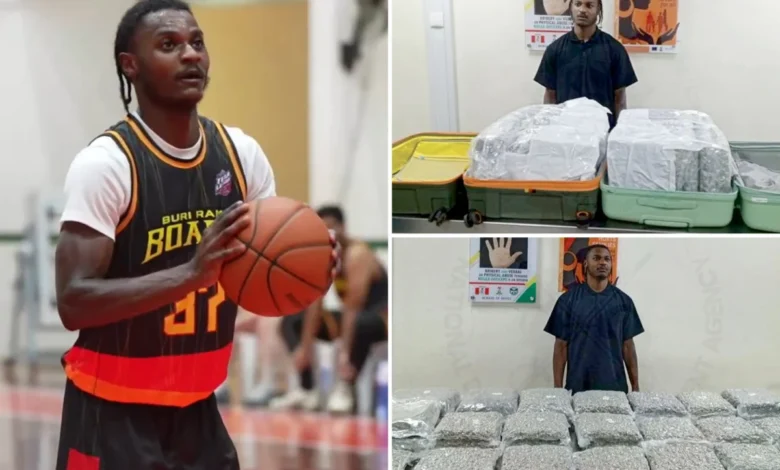
American professional basketball player Da’monte Khiree Greene, a 28-year-old point guard currently playing in the Southeast Asian leagues, was taken into custody by anti-narcotics law enforcement at the Murtala Muhammed International Airport in Lagos, Nigeria. The high-profile arrest occurred after authorities discovered a staggering 75 pounds of high-grade cannabis—locally and internationally referred to as "Loud"—concealed within checked luggage that the athlete allegedly attempted to abandon before exiting the terminal.
The operation, executed by Nigeria’s National Drug Law Enforcement Agency (NDLEA), highlights the persistent challenges international airports face regarding transnational drug trafficking networks. It also places a stark spotlight on the legal vulnerabilities athletes face when operating overseas outside the protective infrastructure of major domestic leagues.
The Arrest and Airport Interception
According to preliminary investigative reports released by the NDLEA, the sequence of events leading to Greene’s apprehension began well before his arrival in West Africa. Greene had traveled to Nigeria on an Emirates flight originating in the United States and routing through Dubai. Operating under the guise of an international athlete looking to build professional networks and explore career opportunities, the Savannah, Georgia native touched down in Lagos with a calculated plan, investigators allege.
However, airport security and tactical surveillance units had already been alerted to his movements based on actionable, credible intelligence gathered prior to his flight. As Greene navigated the arrival terminal, law enforcement officers observed suspicious behavior. Specifically, the professional basketball player checked in two large bags upon his flight’s arrival, but deliberately detached himself from them in the baggage claim area. Attempting to evade scrutiny, Greene separated his checked baggage from his person, retaining only his hand luggage, and proceeded toward the exit to secure transportation in the airport’s main parking facility.
NDLEA operatives swiftly closed in, intercepting Greene in the airport parking lot before he could leave the premises. Concurrently, other security personnel secured the two abandoned suitcases. Upon a physical search of the luggage in the presence of airport officials, authorities uncovered a total of 32 parcels—16 packages packed tightly into each of the two suitcases. Laboratory testing and physical inspections confirmed the contents to be a particularly pungent, high-grade strain of marijuana known as "Loud," totaling 33.95 kilograms (approximately 74.8 pounds).

Further forensic examination of the seized luggage yielded physical evidence that heavily implicated the athlete. Investigators recovered integrated tracking devices and personalized name tags directly linked to Greene. Furthermore, a forensic examination of his mobile phone revealed extensive digital evidence, including text communications, travel itineraries, and logistical coordination pointing directly to his advance knowledge of and active participation in transnational drug trafficking operations.
Legal Ramifications and Strict Nigerian Drug Laws
Greene now faces severe legal repercussions under the stringent judicial framework governing narcotics offenses in Nigeria. The country maintains a zero-tolerance policy regarding the illicit importation, distribution, and possession of controlled substances.
Under the provisions of Nigeria’s Indian Hemp Act, individuals found in possession of cannabis or related derivatives face significant custodial sentences, starting with a mandatory minimum of four years behind bars. However, because the quantity seized from Greene’s luggage far exceeds personal use thresholds and points directly to commercial distribution, authorities are expected to prosecute him under the much stricter National Drug Law Enforcement Agency Act. Under this legislation, charges of international drug trafficking carry the maximum penalty of life imprisonment.
Legal experts and local analysts note that foreign nationals apprehended in Nigeria are subjected to standard judicial proceedings within the Federal High Court system. While foreign embassies, including the United States Department of State and its consular offices in Nigeria, are typically notified of the arrest of American citizens abroad to ensure basic due process and consular access, legal representation will be handled through local counsel or appointed defenders within the Nigerian judicial system.
The Athletic Career and Background of Da’monte Khiree Greene
The unfolding legal crisis marks a dramatic and devastating derailment for an athlete who spent years working his way through the ranks of collegiate and semi-professional basketball circuits across the United States before embarking on an international playing career.
Born and raised in Savannah, Georgia, Greene developed his basketball profile through competitive scholastic pathways. Following his high school tenure, he enrolled at Reinhardt University, a private institution in Georgia, where he redshirted during the 2017-2018 collegiate athletic season. Looking for greater playing time and developmental opportunities, he subsequently transferred to South Georgia Technical College, competing in the National Junior College Athletic Association (NJCAA) ranks for half a season.

As his collegiate eligibility concluded, Greene transitioned into the semi-professional circuit, striving to catch the eye of scouts and international agents. During the 2023-2024 season, he achieved notable individual success as a member of The Georgia Bombers, a prominent regional semi-professional team. According to basketball placement databases and scouting registries, Greene established himself as the team’s primary offensive weapon, leading the squad with an impressive average of 26.3 points per contest.
Capitalizing on his scoring prowess and international scouting connections, Greene successfully transitioned to overseas leagues, a common career path for talented American guards seeking stable professional contracts. His overseas trajectory took him to Southeast Asia, where basketball markets have expanded rapidly in recent years. During the 2025-2026 season, Greene suited up for the Buriram Boars, a competitive franchise in Thailand, before subsequently transitioning to Fully Feared BC.
At the time of his arrest, Greene was officially listed on the roster of the Pattani Raptors, a prominent team competing in the competitive Thai Premier Men’s League. League records indicate that his most recent professional appearance prior to his international travel occurred on November 7, when he took to the court during a hard-fought 102-81 loss against the Buriram Broncos.
Broader Context: American Athletes and Overseas Drug Scandals
Greene’s arrest in Lagos is not an isolated incident involving American basketball players navigating legal perils abroad. The intersection of professional athletes, international travel, and stringent foreign drug laws has frequently resulted in high-profile international detentions.
The most notable recent precedent occurred roughly 18 months prior to Greene’s arrest, when former U.S. college basketball standout Jarred Shaw was apprehended by customs officials in Indonesia. Shaw faced severe legal penalties—including potential exposure to capital charges under Indonesia’s notoriously strict narcotics laws—after authorities intercepted an international mail package containing 132 cannabis-infused gummy candies addressed to his residential apartment.
Similarly, the high-profile detention of WNBA star Brittney Griner in Russia in 2022 underscored the immense geopolitical and legal risks athletes face when transporting cannabis products across international borders, even in jurisdictions where medicinal or recreational use is legal in parts of the United States. While laws regarding cannabis have undergone widespread liberalization across North America and parts of Europe, the vast majority of international jurisdictions—particularly across parts of Africa, Asia, and the Middle East—maintain archaic, uncompromising prohibition frameworks that treat cannabis trafficking on par with hard narcotics like cocaine and heroin.

Implications for International Sports and Future Outlook
The arrest of Da’monte Khiree Greene sends a sobering message to professional athletes competing abroad regarding the critical importance of adhering to local legal frameworks. As sports globalization continues to push players into emerging markets across Africa, Asia, and South America, clubs and leagues are increasingly forced to address the conduct of foreign imports outside of sanctioned team activities.
Representatives for the Thai Premier Men’s League and the Pattani Raptors have not yet issued formal statements regarding Greene’s ongoing detention, though roster adjustments are anticipated as the franchise moves forward without its American guard. Meanwhile, Nigerian federal authorities have signaled that the investigation remains active, with anti-narcotics agents working to determine whether Greene acted as a lone mule or if he was operating as part of a broader, well-financed international syndicate utilizing sports career travel as a cover for cross-continental drug smuggling operations.
As the judicial process unfolds, Greene remains in federal custody in Lagos, facing an uncertain future far removed from the basketball courts where he built his professional reputation.