Federal Judge Kathleen Cardone Halts Border Wall Construction in Big Bend Sector Following Legal Challenge from Conservationists

In a significant legal victory for environmental advocates and local residents, federal judge Kathleen Cardone issued a preliminary injunction on Friday, effectively halting construction of border barrier projects across the vast and ecologically sensitive Big Bend sector of West Texas. The ruling, delivered from the bench in an El Paso courtroom, arrives after four hours of intense testimony, marking a pivotal moment in the ongoing national debate over border security versus environmental preservation.
The injunction mandates an immediate cessation of construction activities, including the installation of 30-foot steel walls and the development of access roads, across the entire Big Bend sector. This region, encompassing Big Bend National Park, Big Bend Ranch State Park, and hundreds of miles of the Rio Grande corridor, is renowned for its profound biodiversity, rugged topography, and status as an International Dark Sky Park. The court’s order will remain in effect while the underlying lawsuit, which was initiated in April, proceeds through the federal court system.
The Legal Framework of the Dispute
The lawsuit, spearheaded by the Center for Biological Diversity, the Friends of the Ruidosa Church, and local river guide Danny Miller Jr., challenges the authority of the Department of Homeland Security (DHS) and Secretary Markwayne Mullin to bypass federal regulations. At the heart of the plaintiffs’ argument is the federal government’s use of broad waivers to circumvent critical environmental and historical preservation mandates, including the National Environmental Policy Act (NEPA) and the Archaeological and Historic Preservation Act.
These waivers, which the government utilized to fast-track construction, essentially permitted the Department of Homeland Security to ignore the standard regulatory scrutiny usually required for large-scale infrastructure projects on public land. By granting the injunction, Judge Cardone acknowledged that the plaintiffs demonstrated a high likelihood of success on the merits of their claims and, crucially, that the continued construction would cause irreparable harm to the ecosystem and the regional landscape that cannot be mitigated after the fact.
A Chronology of Escalation
The friction between the federal government’s security agenda and local stakeholders in West Texas has been building for months. The timeline of this conflict reveals a pattern of rapid development followed by reactive pauses:
- February 2026: Customs and Border Protection (CBP) announces updated plans for border barrier construction, introducing a hybrid model of vehicle barriers for park lands and 30-foot steel walls for private property in the region.
- April 2026: A coalition of conservationists, community members, and legal organizations files a formal lawsuit against the Department of Homeland Security, alleging that the waiver of dozens of federal laws was unlawful and detrimental to the region.
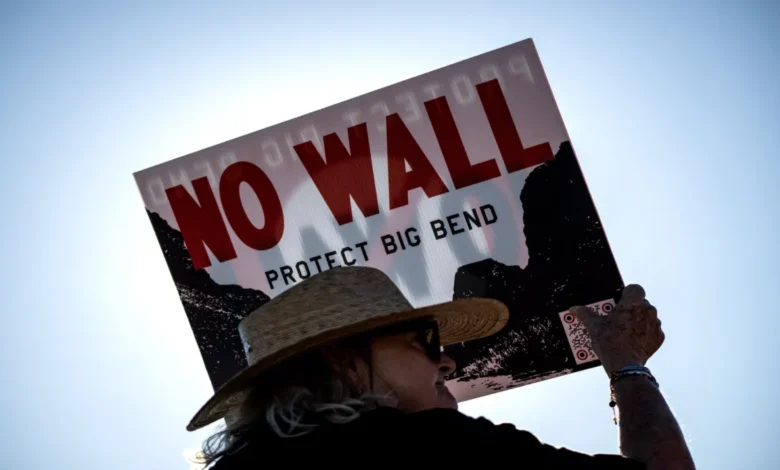
- August 15, 2026: Protests intensify in Study Butte, Texas, as citizens gather to voice opposition to the impending construction, highlighting the unique ecological value of the Big Bend area.
- August 17, 2026: Facing mounting pressure and the initiation of legal proceedings, CBP issues a temporary construction pause within the confines of Big Bend National Park.
- Early October 2026: The temporary pause in the national park is lifted, and construction activities, including the installation of steel barriers in Hudspeth County, commence.
- October 2, 2026: Following a comprehensive hearing in El Paso, Judge Kathleen Cardone issues a preliminary injunction, halting all construction in the Big Bend sector until the government demonstrates compliance with applicable federal statutes.
Data Analysis: The "High Illegal Entry" Contention
A core component of the federal government’s justification for the wall in Big Bend has been the classification of the region as an area of "high illegal entry." However, this narrative was sharply challenged during Friday’s proceedings. Adam Isaacson, an analyst with the Washington Office on Latin America (WOLA), presented testimony supported by data suggesting that the Big Bend sector consistently records the lowest volume of unauthorized border crossings among the nine sectors along the U.S.-Mexico border.
The plaintiffs’ legal team, represented by the Texas Civil Rights Project and the Center for Biological Diversity, emphasized that the government failed to provide granular data to support its claims of high activity specifically within the National Park boundaries. The absence of such evidence weakened the government’s justification for using expedited waivers, which are intended for areas requiring immediate, high-priority security interventions. The "distant last place" ranking in cross-border activity suggests that the imposition of a 30-foot steel wall may be disproportionate to the actual security needs of the region.
The Human and Ecological Cost
The testimony provided by local residents underscored the profound emotional and economic impact of the project. For individuals like Danny Miller Jr., the Rio Grande is not merely a border; it is the lifeblood of the local economy and a heritage site. Miller’s testimony, which moved several attendees to tears, characterized the proposed construction as a "visible scar that will never go away."
Beyond the aesthetic and emotional impact, scientists and conservationists warn of the fragmentation of wildlife corridors. Big Bend is home to diverse species that rely on the connectivity of the river ecosystem, including the black bear, the mountain lion, and various endangered bird species. The physical barrier of a 30-foot wall poses an existential threat to the migration patterns and gene flow of these populations, risks that were not adequately assessed due to the bypassed environmental impact studies.
Official Responses and Government Stance
The Department of Justice, representing the federal government, provided a muted defense in court, declining to call witnesses and offering limited counterarguments. The White House has deferred all inquiries regarding the injunction to the Department of Homeland Security.
In a statement following the ruling, a spokesperson for Customs and Border Protection maintained the agency’s commitment to the project: "We stand by our assessment and remain confident in our legal authorities to secure the border while preserving the unique landscape of the Big Bend region. We are working with the Department of Justice on next steps."
This indicates that while the current construction is halted, the administration is likely to pursue legal avenues to overturn the injunction or narrow its scope, setting the stage for a protracted court battle that could reach the appellate level.
Broader Implications and Future Outlook
The ruling by Judge Cardone carries implications that extend far beyond the borders of West Texas. It challenges the extent to which executive authority can override long-standing environmental protections in the name of national security. If the injunction holds, it may force the federal government to conduct the rigorous environmental impact assessments they previously bypassed, potentially delaying or significantly altering the project’s scope.
For the residents of Terlingua, Marfa, and other small communities along the Rio Grande, the decision offers a temporary reprieve and a sense of validation. However, the legal victory is narrow, focusing on the procedural failures of the waiver process rather than a permanent ban on construction. As the litigation moves forward, the case will likely become a landmark study on the intersection of federal infrastructure mandates and the protection of public lands.
As the legal teams prepare for the next phase of the lawsuit, the region remains in a state of suspended animation. The bulldozers and excavators that were clearing land in mid-August have been forced to stand down, leaving the landscape of the Big Bend for now in its natural, rugged state. Whether this represents a permanent preservation of the wilderness or merely a tactical delay in the face of federal resolve remains to be seen in the coming months of legal discourse.