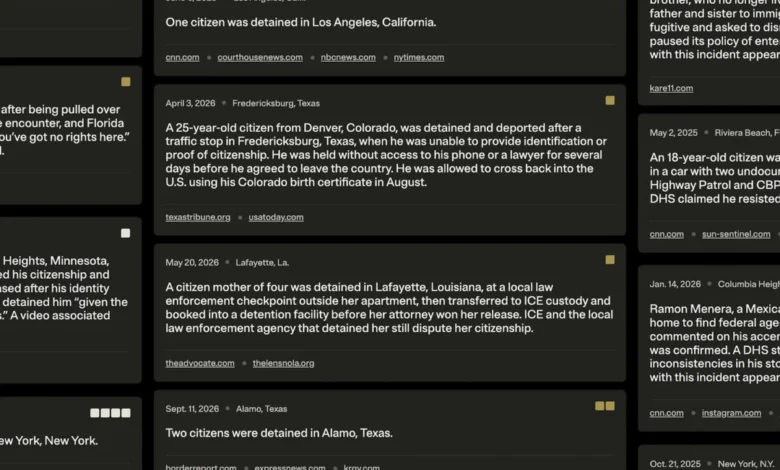
The fundamental protections afforded by the U.S. Constitution, particularly those regarding due process and protection against unlawful seizure, have come under intense scrutiny as reports of U.S. citizens being detained by federal immigration authorities continue to rise. Since the inauguration of the current administration, a rigorous, multi-year investigation has identified at least 519 instances in which U.S. citizens were apprehended, detained, or subjected to physical force by agents of the Department of Homeland Security (DHS) and its sub-agencies, including Immigration and Customs Enforcement (ICE).
This data, spanning from Inauguration Day through October 21, 2026, serves as a stark counter-narrative to official federal policy. Despite persistent denials from the Department of Homeland Security—which maintains that it does not target or arrest U.S. citizens—the evidentiary record compiled through court filings, local police reports, and verified visual media paints a more complex and troubling picture of modern interior immigration enforcement.
The Methodology of Oversight
Because no federal agency maintains a centralized database tracking the detention of U.S. citizens by immigration officers, the task of cataloging these incidents has fallen to independent researchers and investigative outlets. The methodology utilized to compile this tally is stringent: each incident required at least two independent, verifiable sources before inclusion. Sources range from corroborated social media footage and civil rights litigation filings to local law enforcement incident reports.
The resulting list of 519 cases is widely regarded by legal experts and human rights advocates as a significant undercount. In many instances, citizens detained for short periods are released without charges or formal documentation of their apprehension, leaving no official paper trail for researchers to follow. The reliance on publicly available records means that incidents occurring in rural jurisdictions or involving individuals without access to legal counsel are likely missing from the dataset.
A Pattern of Enforcement Escalation
The incidents recorded demonstrate a wide variety of scenarios under which citizens find themselves in the crosshairs of federal agents. These cases often occur in the context of broader immigration sweeps, worksite raids, or routine traffic stops.
In one documented incident in Long Beach, California, a citizen cyclist was tasered and handcuffed following a collision with an ICE vehicle. Video evidence suggested that the federal vehicle was operating against the flow of traffic on a one-way street before swerving toward the individual. While DHS officials contested the account, claiming the citizen had damaged a vehicle mirror—a detail not corroborated by video footage—the encounter resulted in significant injury and the detainment of an individual who held no immigration-related issues.
Similarly, in Evanston, Illinois, a citizen was hospitalized after being detained by ICE agents who were searching for an individual matching his description. The agents held the citizen until his identity was confirmed, leaving a local police officer to report that one of the agents involved had blood on his hands. DHS countered that the individual had failed to comply with "lawful commands," a common refrain in official responses to disputed detentions.
These encounters are not isolated to border states. The data reveals incidents across the nation, including Newark, New Jersey; Boise, Idaho; and Salt Lake City, Utah. The geographic breadth suggests that the systemic issues surrounding identification and detention protocols are not limited to high-traffic border regions but are embedded in the standard operating procedures of federal agents conducting interior enforcement operations.
Official Responses and the Accountability Gap
The Department of Homeland Security has maintained a consistent public stance: immigration agents are tasked with enforcing federal immigration law, and citizens are not the subjects of these enforcement actions. When confronted with specific allegations, the agency frequently cites the need for temporary detention to "safely finish questioning" or claims that the individual in question failed to provide adequate proof of identity.
However, the reality of the experience for those detained suggests a significant lack of institutional guardrails. In a 2026 case in Lafayette, Louisiana, a mother of four was detained at a local law enforcement checkpoint and transferred to an ICE detention facility. Despite providing documentation of her citizenship, she remained in custody until her legal counsel intervened to secure her release. Both the local agency and federal authorities subsequently engaged in a dispute over the validity of her status, highlighting the bureaucratic friction that can lead to the prolonged detention of U.S. citizens.
Legal experts argue that these cases represent an "erosion of rights" that extends beyond the immigrant community. When federal agents operate with limited oversight and a presumption of guilt based on physical appearance or geographic location, the Fourth Amendment protections against unreasonable search and seizure become compromised for all residents, regardless of their legal status.
The Human Cost and Long-term Implications
The psychological and economic impact on those erroneously detained is profound. In one instance, a 25-year-old citizen from Denver, Colorado, was detained following a traffic stop in Texas. Unable to provide immediate documentation, he was processed through the immigration system and eventually deported. He spent several days in custody without access to legal counsel or his family. While he was eventually able to secure reentry using his birth certificate, the ordeal left him with a permanent record of deportation, a circumstance that creates long-term barriers to employment, travel, and legal standing.
The documentation of these 519 cases provides a critical look at the risks inherent in aggressive interior enforcement. For advocates, these numbers are a call for legislative reform. They argue that if federal agencies are to conduct operations within the interior of the United States, they must be subject to the same transparency requirements as local police departments, including mandatory body-worn cameras and standardized, public-facing incident reporting.
Analysis: The Constitutional Crisis
From a constitutional standpoint, the detention of U.S. citizens by immigration authorities creates a precarious legal environment. Unlike the police, who are bound by specific state criminal codes and judicial review processes, federal immigration agents often operate under administrative law, which provides fewer immediate protections for the individual.
The prevalence of these detentions suggests a failure in the intelligence-gathering and target-identification phases of immigration enforcement. When agents operate on the basis of "matching descriptions" or "reasonable suspicion" without robust verification, the risk of violating the rights of innocent citizens increases exponentially. The use of force—including tasers and physical restraint—against individuals who are later found to be citizens further complicates the legal liability of the federal government.
Looking Ahead
As the data continues to grow, the pressure on Congress to hold hearings on the conduct of DHS and ICE is expected to mount. While the administration continues to frame these incidents as administrative errors or necessary precautions in the interest of public safety, the sheer volume of cases—and the visual evidence supporting many of them—is becoming impossible to ignore.
The 519 documented cases are not merely statistics; they are individuals who have been caught in a dragnet designed for a different purpose. As the U.S. continues to navigate the complexities of immigration policy, the fundamental question remains: can a nation maintain an aggressive interior enforcement regime without systematically undermining the civil liberties of its own citizens? Based on the evidence collected over the past several years, the answer appears to be an urgent, systemic challenge that demands immediate oversight, accountability, and reform.
The project to track these detentions remains ongoing, as investigators continue to scrape court dockets, interview victims, and press the government for records that should have been public from the start. Until such time as federal authorities acknowledge the scope of these errors, the responsibility for oversight will continue to rest with the media and the public, serving as a check on a power that has, by all accounts, overreached its authority.