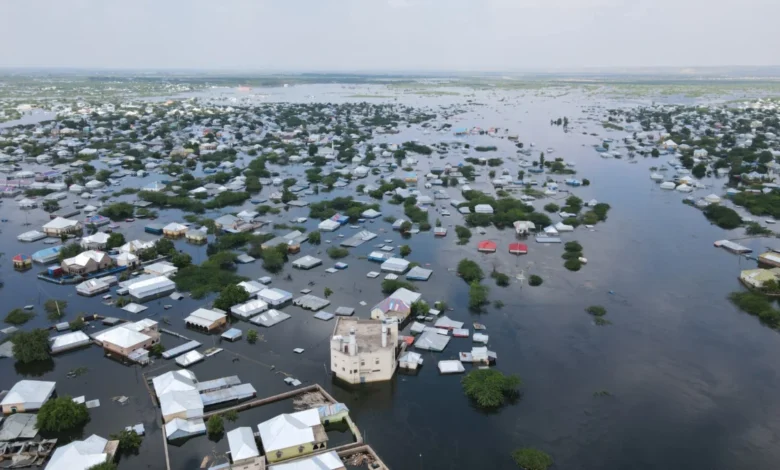
The humanitarian crisis in southern Somalia has reached a harrowing inflection point as a convergence of intensified military operations and the onset of a severe El Niño weather pattern threatens to displace and endanger hundreds of thousands of civilians. Reports emerging from the Juba River valley suggest that a sustained campaign of airstrikes against al-Shabaab militants is effectively pinning the civilian population against the riverbanks, trapping them in flood-prone zones just as the region braces for what meteorologists predict will be an extreme deluge.
For residents of Jilib, the de facto capital of the Islamist insurgent group al-Shabaab, the experience is described as a two-front struggle for survival. As the waters of the River Juba rise to record levels, the constant presence of aerial drones and the subsequent strikes are forcing families to abandon higher ground, pushing them into low-lying areas where the risk of drowning becomes a statistical certainty.
A Chronology of Escalation and Climate Impact
The current situation is the culmination of months of deteriorating conditions. Since the transition into the 2026 autumn season, Somalia has faced a "super-charged" El Niño event, a climate phenomenon characterized by irregular warming of surface waters in the Pacific, which historically triggers catastrophic rainfall in East Africa.
- Mid-2025: The United States, through the Africa Command (AFRICOM), intensified its air campaign in the Jubbaland region following a strategic shift in counter-insurgency efforts.
- Late 2025: The abrupt cessation of USAID programs in the region left a massive vacuum in food security and emergency disaster response infrastructure, leaving vulnerable populations without a safety net.
- September 2026: Meteorological models confirmed that the looming El Niño would be significantly more intense than the 2023 event, which had already displaced 1.2 million Somalis.
- October 2026: Reports from the ground indicate that the frequency of airstrikes has coincided with the arrival of heavy seasonal rains, effectively closing off escape routes for thousands of families attempting to move toward humanitarian centers in Kismayo.
The Weaponization Allegation: Humanitarian Concerns
The central controversy involves the tactical use of intelligence data. Humanitarian agencies typically utilize sophisticated mapping technology to identify flood-prone areas to ensure that aid, shelter, and evacuation efforts are prioritized away from these danger zones. Critics and independent researchers now argue that the military strategy of targeting al-Shabaab strongholds—many of which are situated in these same flood-prone river basins—is essentially using the threat of natural disaster as a tactical lever.

Jethro Norman, a senior researcher with the Danish Institute for International Studies, has characterized this as a "reversal of process." By utilizing humanitarian remote-sensing data to track insurgent movements, the military may be inadvertently or intentionally driving non-combatants into areas where the environmental hazard is high. The result is a "cumulative impact," where the physical destruction of infrastructure by airstrikes is compounded by the inability of survivors to reach aid, leading to a higher mortality rate than either factor would produce in isolation.
Official Responses and the Stance of AFRICOM
In response to these allegations, United States Africa Command has maintained a firm stance. A spokesperson for the command stated that AFRICOM does not target civilians, nor does it conduct operations for the purpose of displacing populations. The official communication asserts: "Africom targets lawful military objectives and takes feasible measures to mitigate civilian harm. We do not use weather or flooding as a method of warfare."
However, the disconnect between official records and eyewitness testimony remains stark. While AFRICOM publicizes a limited number of airstrikes—confirming only 11 strikes between August and October 2026—local residents in the Juba Valley report near-daily drone activity. This discrepancy has fueled speculation among international observers regarding the existence of "black" or unannounced operations, or perhaps the involvement of third-party regional actors—such as Turkey—who have increasingly utilized drone technology in the Somali theater without disclosing operational details.
Data on the Ground: A Growing Crisis
The human cost of this conflict is reflected in the statistics gathered by healthcare providers on the front lines. The International Committee of the Red Cross (ICRC) has reported a 43 percent increase in the treatment of "weapon-related" injuries at its facility in Kismayo this year. Simultaneously, the nutritional status of the population has reached a critical threshold.
- Malnutrition Rates: Child malnutrition rates in the region have risen by 40 percent in the last ten months.
- Displacement Mortality: Estimates suggest that as many as 6,000 people may have perished in displacement sites surrounding Kismayo since the withdrawal of USAID, with deaths attributed to a combination of exposure, lack of medical supplies, and acute malnutrition.
- Resource Gap: The humanitarian aid budget for Somalia, which once stood at $2.2 billion in 2023, has plummeted to approximately $300,000, severely limiting the capacity of local authorities to provide boats, temporary shelters, or life-saving supplies to those trapped in the Juba floodplain.
The Strategic Dilemma of Urban Counter-Insurgency
The difficulty of the conflict lies in the nature of al-Shabaab’s presence. The group is deeply embedded within the social and economic fabric of towns like Jilib. Conventional ground warfare is deemed too risky by local and international forces, leading to an over-reliance on air power. However, this reliance creates a "collateral damage" trap. When strikes destroy homes or infrastructure in a town of 100,000, the population is forced to move. If they move toward the river, they enter a zone that is increasingly becoming a natural graveyard as the climate shifts.

Analysts at New America, a Washington-based think tank, suggest that the lack of transparency in strike reporting serves to undermine the credibility of the counter-terrorism mission. "When there are strikes without clear attribution or consistent public reporting, it creates a vacuum of information where narratives of intentional harm take root," says analyst David Sterman. This ambiguity further complicates the efforts of humanitarian organizations trying to negotiate access for aid convoys, as they must operate in an environment where the distinction between a "military objective" and a "humanitarian space" is effectively erased.
Implications and Future Outlook
The outlook for the remainder of the year is grim. With the Juba River basin designated a high-risk zone by the UN, and the local administration reporting that only half of the at-risk regions have received flood warnings, the probability of a large-scale casualty event is high.
The lack of preparedness within al-Shabaab-controlled territory—where no significant flood defenses have been established—means that when the peak of the rainy season hits, the civilian population will be left to rely on rudimentary earthworks that have already proven insufficient against the 2023 floods.
Ultimately, the situation in Somalia underscores a burgeoning global concern: how the international community addresses counter-terrorism in the age of climate change. As extreme weather events become more frequent and severe, the intersection of military operations and climate vulnerability will likely become a recurring flashpoint. Without a coordinated effort to prioritize the protection of civilians over purely kinetic objectives, the ongoing conflict in Somalia risks becoming a case study in how the lack of humanitarian coordination during climate crises can lead to catastrophic, preventable loss of life. For families like those in Jilib, the choice between the terror of the drone and the rising of the river is a choice between two forms of destruction, with little room left for survival.
Related posts: