Long Shadows in the Mountains: How Hurricane Helene’s Stalled Recovery is Reshaping North Carolina’s Midterm Elections

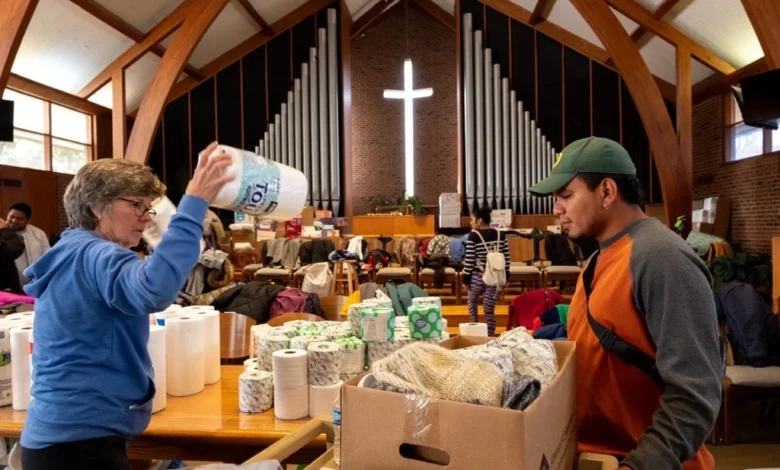
The lunch hour hummed with quiet urgency at the Haywood County Public Library in Canton, North Carolina, where voters trickled in to cast their early ballots. Yet, even as citizens weighed the traditional party lines on October 19 during a high-stakes midterm cycle, the shadow of climate-driven catastrophe hung heavier over the mountain community than any political debate. Two years after Hurricane Helene tore through the scenic Blue Ridge region, flattening towns and displacing families, physical recovery remains agonizingly slow. For lifelong residents like Sandra Moody, a dedicated straight-ticket Republican voter, the recurring deluges have upended a lifetime of mountain logic.
"Well, we’re not weather people," Moody remarked, letting out a hoarse, weary laugh. "But these floods that keep coming — they’re supposed to be 500-year floods. You’re like, ‘What is going on?’"
Moody’s bewilderment is shared across the battered landscape of western North Carolina. As voters head to the polls, the staggering toll of Helene—and the deeply divisive political fallout surrounding its sluggish remediation—has transformed what should have been standard legislative races into referendum battles over competency, institutional trust, and the tangible impacts of extreme weather.
The Scale of Destruction and the Unmet Need
Hurricane Helene struck the southeastern United States with catastrophic force, but its impact on the mountainous interior of North Carolina was unprecedented. Swelling rivers washed away interstate highways, isolated entire communities, and destroyed homes that had stood untouched for generations.
According to state and federal assessments, the storm inflicted nearly $60 billion in total damage and long-term recovery needs across the region. In the intervening years, roughly $10 billion in federal assistance has been channeled to the state through various emergency relief bills and agency allocations. Yet, even after factoring in incoming state-level appropriations and private insurance payouts, state economists peg the current unmet need at an astounding $41 billion.
This financial gap has translated into a profound crisis of public confidence. Public opinion data highlights a stark disconnect between Washington’s assurances and the grim reality on the ground. A comprehensive poll commissioned by regional television stations WRAL and WSOC revealed that half of all North Carolinians are dissatisfied with the government’s overall disaster response, while only 37 percent express satisfaction. In western North Carolina, which bore the brunt of the storm’s wrath, the disillusionment is even more acute: a mere 5 percent of respondents reported being "very satisfied" with how officials are managing the crisis.
Shifting Political Winds: From 2024 Outrage to 2026 Reckoning
The political optics of the Helene recovery have undergone a dramatic transformation since the disaster struck in the autumn of 2024. In the immediate aftermath of the hurricane, Republican campaigners weaponized the disaster, fiercely hammering the Biden administration over what they characterized as a lethargic and inadequate federal response.
Two years later, the political pendulum has swung entirely. The Republican Party now controls the White House, both chambers of Congress, and the specific federal agencies—including the Federal Emergency Management Agency (FEMA)—tasked with executing long-term disaster recovery.
This shift has placed GOP candidates in an awkward defensive posture, particularly given the high-profile involvement of figures like Michael Whatley. Appointed by President Donald Trump as his designated recovery czar, Whatley’s administrative oversight has become a central lightning rod in North Carolina’s high-profile U.S. Senate race.
Whatley is currently locked in a competitive battle against Democrat Roy Cooper, who was serving as North Carolina’s governor when Helene made landfall. Cooper has maintained a persistent double-digit lead in public opinion polls, capitalizing on widespread voter frustration. However, the race has been defined by accusations and counter-accusations. Whatley’s campaign insists he helped "deliver more aid for Hurricane Helene than any other natural disaster" in state history. Conversely, Cooper’s camp argues that Whatley "completely failed in his role as federal recovery czar," pointing to data showing the state has received only a fraction of its required funding.
Adding to the nationalized tension, President Trump drew direct lines between disaster relief and electoral outcomes during a series of campaign stops. Trump memorably joked during a rally that he might withhold additional aid to North Carolina if Whatley failed to secure victory, echoing similar conditional rhetoric used during campaign swings in Wisconsin and Ohio. While the White House has repeatedly denied that disaster relief decisions are politically motivated, the episodes underscore a troubling reality: politicians are treating human suffering and infrastructural reconstruction as electoral leverage.
Down-Ballot Turmoil in North Carolina’s 11th Congressional District
While the Senate race captures national headlines, the battle for North Carolina’s 11th Congressional District (NC-11) offers a granular look at how grassroots voters are processing the crisis. Encompassing 16 largely rural, mountainous counties alongside the solidly progressive enclave of Asheville, NC-11 has long been a Republican stronghold. Donald Trump carried the district by 9.5 points in 2024, and its voters have historically favored conservative representation, sending figures like Mark Meadows, Madison Cawthorn, and Chuck Edwards to Washington in succession.
Yet, the current race is deadlocked. Republican Jennifer Balkcom, who entered the contest just three months ago after Edwards abruptly withdrew, is running neck-and-neck with Democrat Jamie Ager. The race has grown so unpredictable that a pro-Trump political action committee recently canceled more than $1 million in television advertising previously earmarked to support Balkcom, reducing the contest to a pure toss-up.

For voters in NC-11, the storm’s legacy extends beyond physical rebuilding into the realm of ideological polarization. Maggie Panther, a Democratic early voter in Canton, noted that Helene served as a stark confirmation of her fears regarding accelerating climate change.
"I hate to sound totally partisan, but I know that there’s one party that’s trying to do something about climate change, and there’s one party that is denying it," Panther said. "And so, I vote accordingly."
Conversely, Ager—a fourth-generation local farmer whose grandfather famously served three terms in Congress—has steered his campaign away from abstract climate debates and toward the immediate economic pain of his neighbors. He emphasizes the countless residents still waiting on bureaucratic FEMA reimbursements and struggling to keep their livelihoods afloat.
"We were trying to do everything we could to get back up on our feet here at the farm and everywhere else," Ager reflected. "As time kept dragging on and recovery was clearly insufficient, [we were] hearing from neighbors and folks in the community about their frustrations."
The Transparency Gap: Investigations and Accountability
The political vulnerability of incumbents tied to the Helene recovery has been exacerbated by aggressive local journalism and investigative reporting. A scathing investigation published by the Asheville Citizen-Times revealed a glaring lack of active communication between Michael Whatley and federal emergency management officials during the critical two-year window following the hurricane. Documented records showed a sparse paper trail—including a mere six text messages and five phone calls between Whatley and the primary state official coordinating hurricane relief.
These revelations have severely damaged the narrative of proactive federal leadership. Recognizing the mounting liabilities, the Senate Leadership Fund, a major Republican super PAC, quietly pulled its financial investments from the North Carolina Senate race, leaving local candidates to navigate a disillusioned electorate largely on their own.
Despite the monumental scale of the disaster, political scientists note an unexpected paradox: Hurricane Helene has featured less prominently in direct campaign advertising and mailers than many analysts initially projected.
Chris Cooper, a political science professor at Western Carolina University (no relation to the former governor), suggests that neither party sees a clear advantage in dwelling on an unmitigated public relations disaster.
"One reason why Hurricane Helene hasn’t come up quite as much during this election is because both candidates have some experience that might allow folks to blame them for what almost everyone agrees was a poor response," Professor Cooper explained. He pointed out historical polling trends indicating that voters almost universally penalize the party in power following a natural disaster, regardless of how complex the logistical hurdles might be.
"I cannot think of a single disaster in North Carolina or elsewhere, where afterward public opinion was, ‘Boy, we really got this recovery right,’" he added.
Economic Implications and the Broader Political Calculus
The intersection of disaster recovery and voter behavior is a heavily studied field in modern economics and political science. Penny Liao, an economist at the Washington-based think tank Resources for the Future, explains that while disasters inherently damage an incumbent’s standing, a swift, transparent, and generously funded recovery can mitigate political fallout.
"The disaster itself is usually not very good news for the incumbent, but if there is large aid or a timely response, generally the incumbent can potentially benefit from it," Liao noted. Conversely, she warned that systemic administrative failures or visible negligence "is not going to be rewarded" at the ballot box.
In North Carolina, political responsibility for the Helene response is exceptionally fragmented. A Democratic administration occupied the White House when the storm initially struck; a Republican administration subsequently assumed federal oversight of the protracted recovery; and within the state itself, power is divided between a Democratic executive branch and a deeply entrenched, Republican-controlled General Assembly in Raleigh.
This overlapping web of jurisdiction makes it easy for politicians to point fingers, but it leaves voters bearing the ultimate cost. As the midterm elections reach their climax, the true political price of Hurricane Helene remains to be fully calculated. What is certain is that the collective trauma of the Blue Ridge mountains has forged a skeptical, exhausted electorate—one that views political promises through the lens of un-repaired bridges, delayed relief checks, and the looming threat of the next unseasonal flood.
Related posts: