Virgin Galactic Moves Its Future Into Position With The Arrival Of The Delta Class Spaceship Apeiron

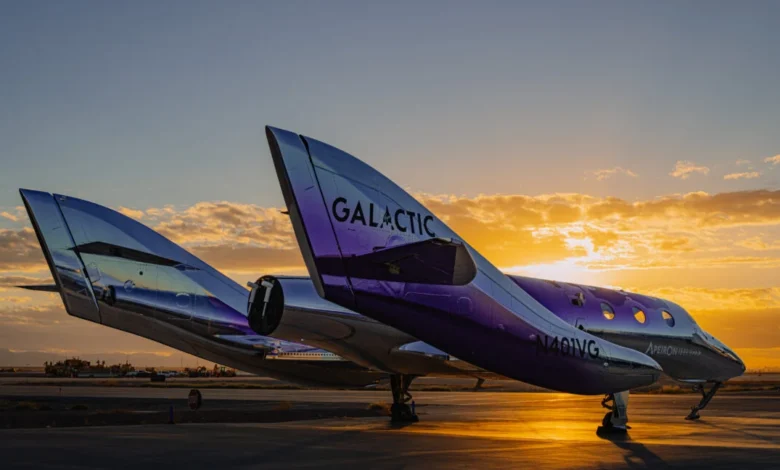
The arrival of the first Delta-class spacecraft, christened Apeiron, at Spaceport America in New Mexico marks a definitive pivot point for Virgin Galactic. After months of anticipation and manufacturing progress at the company’s Mesa, Arizona facility, the vehicle’s transit signifies the commencement of a high-stakes transition from development to integration and testing. For a company that has navigated significant technical hurdles, leadership changes, and a volatile public market valuation, the successful deployment of Apeiron is not merely a logistical milestone; it is the physical manifestation of a business model that promises to revolutionize suborbital tourism.
Michael Colglazier, chief executive officer of Virgin Galactic, expressed the company’s sentiment regarding the naming of the vessel. “We’re proud that the lead ship in Virgin Galactic’s spaceship fleet will carry a name chosen by the people who share our excitement for what comes next,” Colglazier stated. The name Apeiron, derived from the Greek concept of the boundless or infinite, underscores the company’s ambition to move beyond the limitations of its earlier Unity-class vehicles and achieve a consistent, scalable cadence of flight operations.
A Chronology of the Delta Transition
The journey to this moment has been a decade in the making, defined by a shift from research and development to the industrialization of space travel. Virgin Galactic’s history is marked by the iterative design of its suborbital vehicles, beginning with the VSS Enterprise, moving through the VSS Unity, and now arriving at the Delta class.
The Delta-class design represents a departure from previous iterations, prioritizing durability, rapid turnaround, and a higher capacity for passenger throughput. Following the retirement of the VSS Unity, which completed its final commercial flight in mid-2024, the company consolidated its resources toward the production of the Delta line.
The current timeline for Apeiron involves a methodical, phased integration process:
- Late October 2024: Transport of the Apeiron chassis from the Mesa manufacturing facility to Spaceport America via the VMS Eve mothership.
- Q4 2024 – Q4 2025: Finalization of avionics integration, flight software calibration, and comprehensive ground-based testing.
- Early 2026: Commencement of captive carry tests, where the vehicle remains attached to the mothership to validate aerodynamics and systems in flight.
- Mid-2026: Unpowered glide flights (drop tests) to verify landing systems and pilot handling characteristics.
- Late 2026: Powered flight tests reaching altitudes above 80 kilometers (the recognized boundary of space according to the U.S. government).
- Q2 2027: Projected window for the inaugural commercial flight carrying private passengers.
Technical Evolution and Operational Challenges
The Delta class is engineered specifically to address the primary criticism leveled at the Unity class: a lack of operational efficiency. While Unity was a pathfinder, it required extensive maintenance intervals that constrained flight frequency. Apeiron and its sister ships are designed to support a significantly higher flight rate—target projections suggest up to eight flights per month per ship.
To achieve this, the engineering team has integrated modular components that allow for faster inspections and repairs. The avionics suite is more robust, and the flight software is designed to provide greater autonomy, reducing the human error margin during the critical boost and re-entry phases. However, the transition to this new vehicle is fraught with technical risks. Aerospace engineering is notoriously unforgiving, and the leap from a prototype-heavy fleet to a high-cadence commercial fleet requires perfection in manufacturing quality control.
Market Realities and Financial Context
The optimism surrounding the arrival of Apeiron stands in stark contrast to the company’s recent financial trajectory. In 2021, when space tourism was the darling of the retail investment community, Virgin Galactic reached an all-time high share price of $1,118 (adjusted for subsequent reverse stock splits and equity dilution). As of late 2024, the stock has traded in the $2.50 range, reflecting deep investor concern over the company’s ability to generate sustained positive cash flow.
The skepticism is rooted in the high cost of operations versus the current customer base. To make space tourism a viable, long-term industry, Virgin Galactic must bridge the gap between "experimental exploration" and "routine transport." This requires more than just successful flights; it requires the company to demonstrate a safety record that justifies the high ticket prices while simultaneously lowering operational overhead through scale.
The company’s current liquidity, bolstered by recent capital raises and reduced operating expenses, provides a runway to reach the 2027 commercial deadline. Analysts from major financial institutions have noted that while the technology is proven in principle, the "burn rate" of the company remains a critical variable. Whether the market rewards the company for its technical progress will depend entirely on the consistency of the testing phase leading up to the 2027 launch.
The Broader Implications for Space Tourism
The success of the Delta-class program has ramifications that extend well beyond Virgin Galactic’s balance sheet. As the first entity to attempt high-frequency commercial suborbital flight, Virgin Galactic is essentially drafting the playbook for the industry. Other players in the sector, such as Blue Origin, have taken different approaches—Blue Origin utilizes a vertical-launch rocket architecture, whereas Virgin Galactic relies on air-launch technology.
If Apeiron succeeds, it validates the air-launch model as a sustainable, lower-energy path to the edge of space. If it encounters delays or technical setbacks, it may lead to a broader reassessment of the viability of the entire suborbital tourism market. Industry observers suggest that the coming 18 months are "make or break" for the suborbital sector. The ability to fly paying customers with "unprecedented durability" is the litmus test for the industry’s maturity.
The Path Forward: Expectations and Reality
While the company has publicly targeted the second quarter of 2027 for the first commercial mission, industry veterans often advise treating such projections with extreme caution. Aerospace timelines are routinely impacted by supply chain constraints, regulatory review processes with the Federal Aviation Administration (FAA), and unforeseen findings during the ground-test phase.
Nevertheless, the movement of the physical hardware to the flight line at Spaceport America is a tangible sign that the project has moved out of the abstract. For the team in New Mexico, the priority is now the "mating" of the vehicle to the mothership—a process that will test the structural integrity of the new interface.
As the industry looks toward the next decade, the role of Virgin Galactic appears solidified as a primary gatekeeper for private space access. Even amidst the skepticism of Wall Street and the rigorous demands of flight safety, the company remains the most visible entity in the suborbital space. The arrival of Apeiron is not just the delivery of a new machine; it is the arrival of a new era of risk and opportunity in the private space sector. Whether this era proves to be as "boundless" as the name implies remains the central question for the future of space tourism.
For the foreseeable future, the eyes of the aerospace community will remain fixed on the high desert of New Mexico, monitoring the progress of the technicians and engineers who are now tasked with bringing Apeiron to life. If they succeed, the flight manifest for 2027 will not just represent a list of passengers; it will represent a milestone in the human expansion into the final frontier.