Gritt Emerges from Stealth with $26 Million to Accelerate Solar Deployment Through AI-Powered Robotics

The global race to deploy solar energy and battery storage, a cornerstone of achieving energy independence and mitigating climate change, is encountering a significant bottleneck: a persistent labor shortage for installation. Addressing this critical challenge, Gritt, a startup co-founded by Carnegie Mellon-trained roboticists Puneet Puri and Vishal Dugar, has officially emerged from stealth, announcing a successful $26 million Series A funding round. This infusion of capital, led by Obvious Ventures with participation from Union Square Ventures and Active Impact Investment, brings Gritt’s total funding to $34 million and aims to unleash the power of advanced AI models to revolutionize solar infrastructure build-out.
The Unprecedented Demand for Solar Energy and its Labor Challenge
The imperative for a rapid transition to renewable energy sources, particularly solar, has never been more pressing. Governments and corporations worldwide are committing to ambitious decarbonization targets, with solar photovoltaic (PV) installations at the forefront of this transformation. According to the International Energy Agency (IEA), solar PV is projected to account for more than half of all new renewable capacity additions over the next five years, driven by decreasing costs, technological advancements, and supportive policies. The U.S. alone aims to decarbonize its electricity sector by 2035, with solar energy playing a pivotal role. This aggressive expansion, however, hinges on the ability to physically construct vast solar farms at an unprecedented pace.
Paradoxically, while the "green economy" promises job creation, the sheer scale of solar deployment is straining existing labor markets. The solar industry faces a growing demand for skilled installers, electricians, and construction workers, a demand that often outstrips supply. Manual solar panel installation is a labor-intensive, physically demanding, and often hazardous task. Workers must repeatedly lift heavy, fragile solar panels—which can weigh upwards of 50-70 pounds, and sometimes over 100 pounds for larger formats—and precisely position them on elevated racking structures, often under challenging outdoor conditions. This not only slows down projects but also contributes to worker fatigue and a higher risk of injuries, making it difficult to attract and retain labor, especially in remote project locations. The U.S. Bureau of Labor Statistics projects a significant growth for solar photovoltaic installers, indicating a consistent need for solutions that augment human labor.
AI as the Game Changer for Unstructured Environments
For decades, industrial robots have excelled in controlled, structured factory environments, performing repetitive tasks with precision. Their application in chaotic, unpredictable outdoor construction sites, however, has remained a formidable challenge. The variability of terrain, weather, lighting, and the dynamic nature of a construction site rendered traditional robotic programming ineffective. This historical limitation has been a major barrier to automating many aspects of infrastructure development.
The advent of the latest generation of AI models, particularly in machine learning, computer vision, and reinforcement learning, has fundamentally altered this equation. These advanced AI systems possess the ability to perceive, interpret, and adapt to unstructured environments in ways previously unimaginable. They can learn from vast datasets, recognize patterns, make real-time decisions, and even improve their performance over time through experience. This technological leap is the "driving idea" behind Gritt, enabling robots to move beyond the factory floor and into the real-world complexities of construction.
Gritt’s Vision: Intelligent Systems for Accelerated Infrastructure
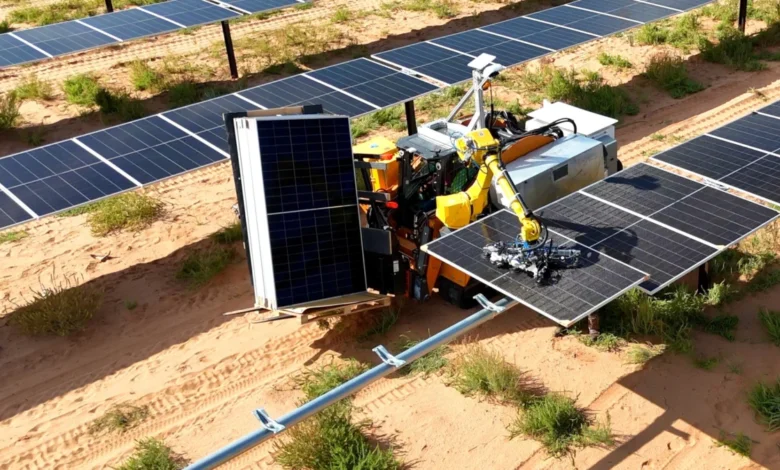
Founded by CEO Puneet Puri and CTO Vishal Dugar, Gritt’s core mission is to "help civilization build infrastructure faster," a sentiment articulated by Puri. Their strategy cleverly bypasses the costly and time-consuming process of developing custom robotics hardware from scratch. Instead, Gritt focuses on building an "intelligent system" that can control off-the-shelf industrial hardware. This approach allows them to leverage existing, proven machinery – in their current deployments, rented skidders and robotic arms from manufacturers like Kawasaki – and imbue them with advanced AI capabilities.
Puri emphasizes that for true construction acceleration, the intelligence must be capable of operating in the "outdoor, chaotic environments of these construction sites" and be "generalizable enough" to adapt to varied conditions. This generalizability is key to scalability and cost-effectiveness. Gritt’s initial application targets the most strenuous and repetitive aspects of solar panel installation: unloading large, glass solar panels, transporting them to the metal frames, and positioning them with sub-millimeter accuracy for human workers to then fasten. This precision is critical, as misaligned panels can reduce efficiency and increase installation time.
Funding Milestones and Operational Prowess
Gritt’s journey to this public unveiling includes a significant financial backing, underscoring investor confidence in their unique approach. Following an earlier seed round supported by First Round Capital, Climactic, Congruent Ventures, and VSC Ventures, the recent $26 million Series A round propelled their total funding to $34 million. Obvious Ventures, a firm known for investing in companies tackling systemic challenges, led the latest round. Andrew Beebe, a partner at Obvious Ventures, praised Gritt’s founders, stating, "There are people who used to build rockets that went into space and had infinite budget for the smallest little part, and then there are people who know what it means to get into dirty, dull, and dangerous jobs and scale them like mad. These guys are in the second camp, and that’s a special kind of entrepreneur that has the technical chops, the AI, and the machine vision skills to make it work." This endorsement highlights Gritt’s pragmatic, problem-solving orientation and technical depth.
The impact of Gritt’s systems is already tangible. With two systems currently deployed in the field, collecting valuable data to continuously refine their AI models, the company reports dramatic improvements in installation efficiency. A typical eight-person crew, without robotic assistance, can install approximately 800 panels per day. However, the same crew, augmented by Gritt’s intelligent systems, can install between 3,000 to 4,000 panels daily – a staggering increase of 375% to 500%. This acceleration is crucial for meeting the ambitious deployment targets of the solar industry.
Gritt’s commercial traction is equally impressive. The company has secured contracts to help install a remarkable 2.8 gigawatts of solar panels over the next 18 months, working with three of the top 10 U.S. power construction companies. Looking ahead, Gritt aims to have 48 of its intelligent systems operational within the next six months, further scaling its impact on the renewable energy sector.
Industry Validation and Broader Implications
Customer feedback further validates Gritt’s solution. An anonymous customer, citing competitive reasons, expressed strong enthusiasm for the system’s ability to enhance their operations. The customer anticipates significant benefits, including easier execution of projects at remote sites where attracting and retaining labor is particularly challenging. Moreover, the reduction in worker injuries, by eliminating the need for humans to repeatedly lift heavy panels overhead, represents a major step forward for occupational safety in the construction industry. This aspect resonates deeply within a sector historically plagued by high injury rates.
Gritt’s approach places it in a competitive landscape alongside other companies developing solar panel-installing robots, such as Luminous Robotics, Cosmic, and China’s Trinabot. A key differentiator lies in Gritt’s software-centric, hardware-agnostic strategy. While competitors are building their own specialized robotics hardware, Gritt’s focus on integrating its AI with readily available, off-the-shelf machinery could offer distinct advantages. This approach may allow Gritt to achieve faster iteration cycles, lower research and development costs, and potentially scale more rapidly by leveraging established supply chains and rental markets for heavy equipment. It also implies a leaner cost structure, which could be critical as demand for such solutions grows and price competitiveness intensifies. Conversely, companies building custom hardware might argue for optimized performance and tighter integration, but at the expense of higher upfront investment and slower hardware development.
The Future of Construction: Beyond Panel Installation
Gritt’s ambitions extend far beyond solar panel installation. The company envisions its intelligent systems performing a wider array of manipulation tasks, including fastening solar panels, drilling posts, and even constructing the racks upon which the panels sit. Longer term, Gritt aims to tackle other labor-intensive construction processes, such as tying rebar before concrete is poured – a complex, precise task that is currently highly manual.
The ability to rapidly train new tasks is a testament to the power of their underlying AI architecture. Puri notes a stark contrast: "Making a system for one solution was still possible to some extent five years ago… but AI is now making that work generalizable." He provides a compelling example: training their system to stack cinder blocks took weeks, whereas a similar demonstration for rebar tying, using the same foundational software pipeline, was achieved in just a single day. This rapid adaptability is crucial for addressing the diverse and evolving needs of the construction industry.
Furthermore, Gritt’s founders envision their systems evolving beyond mere physical labor. By integrating a suite of sensors and advanced intelligence, their robots can act as a "layer of physical AI" on worksites, providing critical management and decision-making support. Imagine a Gritt system detecting an open trench as a storm approaches, automatically alerting workers to cover it before rain damages components, or flagging missing inventory in real-time. This capability transforms the robots from simple tools into intelligent site assistants, enhancing efficiency, safety, and project oversight. This evolution signifies a broader trend in the construction sector towards integrating smart technologies for enhanced project management and predictive analytics.
A New Era for Green Infrastructure
Gritt’s emergence marks a pivotal moment in the convergence of artificial intelligence, robotics, and renewable energy. By directly addressing the labor constraints hindering solar energy deployment, the company is poised to play a crucial role in accelerating the global transition to a sustainable future. The economic implications are vast, promising reduced project costs, faster return on investment for developers, and potentially enabling solar projects in regions previously deemed unfeasible due to labor challenges. Environmentally, faster solar deployment directly contributes to meeting climate goals and reducing carbon emissions. Socially, it offers improved worker safety and the potential for upskilling the workforce into roles that supervise and maintain these advanced robotic systems. Gritt’s innovative, software-first approach, powered by the latest advancements in AI, is not just building solar farms faster; it is laying the groundwork for a more efficient, safer, and intelligent construction industry worldwide.
Related posts: