The Unprecedented Mid-Decade Redistricting Frenzy: States Scramble to Reshape Congressional Maps Ahead of Crucial 2026 Midterms

In a highly unusual and politically charged maneuver, several states across the United States have undertaken mid-decade redistricting efforts, aiming to fundamentally alter the composition of their congressional delegations. This aggressive push, largely initiated after former President Donald Trump began pressing Republican-led states last summer to create more GOP-friendly districts, seeks to help his party maintain or expand its razor-thin majority in the House of Representatives in the upcoming 2026 midterm elections. While redistricting typically occurs once every ten years following the decennial U.S. Census, this current wave of map-drawing represents a rare and contentious intervention into the electoral landscape, highlighting the intense partisan stakes of contemporary American politics.
The Historical Context and the Catalyst for Change
Redistricting, the process of redrawing electoral district boundaries, is a foundational element of American democracy, designed to ensure equal representation based on population shifts. Traditionally, this complex and often contentious task is undertaken by state legislatures or independent commissions every decade, after the U.S. Census reveals new demographic data. The goal is to create districts of roughly equal population, but the process is frequently manipulated through gerrymandering—the drawing of district lines to favor one political party over another. Both Democratic and Republican parties have historically engaged in gerrymandering when given the opportunity, seeking to secure electoral advantages.
The current mid-decade redistricting phenomenon deviates sharply from this established pattern. The catalyst for this expedited timeline appears to be a concerted effort by former President Trump, who, beginning in the summer, publicly urged Republican governors and state legislative leaders to seize opportunities to redraw maps. His rationale was explicit: to shore up Republican control of the House, particularly in anticipation of the 2026 midterms, which historically tend to favor the party out of power in the White House. With a precarious Republican majority in the House, even minor shifts in district lines could prove decisive. This political calculus has driven a flurry of activity, leading to a patchwork of legislative actions, judicial interventions, and even voter referendums across the nation.
A Chronicle of State-Level Redistricting Battles
The mid-decade redistricting saga has unfolded with varying degrees of success and controversy across multiple states, each presenting a unique narrative of partisan ambition, legislative maneuvering, and legal challenges.
Texas: The Genesis of the Push and Supreme Court Intervention
Texas was among the first states to initiate this gerrymandering push. In August, Governor Greg Abbott signed legislation that redrew the state’s congressional districts, aiming to create five new GOP-friendly seats. This move targeted several Democratic strongholds and rising areas of Democratic support. For instance, the new maps drastically reshaped Democratic Rep. Al Green’s Houston district, transforming it from 72% Democratic to 40% Democratic. Similarly, Rep. Julie Johnson’s Dallas-area district saw its Democratic lean drop from 62% to 41%. The liberal bastion of Austin was further fragmented, its population absorbed into neighboring, more conservative districts, prompting long-serving Democratic Rep. Lloyd Doggett to announce he would not seek re-election if the maps were upheld.
The legislative victory for Republicans was short-lived, however. On November 18, a three-judge panel in the U.S. District Court in El Paso blocked Texas from using the newly approved maps. The court’s ruling was a significant blow, stating that the plaintiffs were likely to succeed in demonstrating that race, rather than partisanship, predominated in the map-making process, and that the legislature appeared to have followed a "racial target." This decision underscored the delicate balance between legitimate political redistricting and unconstitutional racial gerrymandering. Yet, the legal battle quickly escalated to the nation’s highest court. Governor Abbott appealed the decision, and the U.S. Supreme Court ultimately intervened, restoring the map passed by the Texas legislature, allowing it to be used for future elections. Texas currently has 38 congressional seats, with Republicans holding 25 and Democrats 13.
California: A Democratic Counter-Offensive Approved by Voters
In response to Republican efforts nationwide, and particularly after Texas’s move, California’s Democratic Governor Gavin Newsom launched a counter-effort to redraw his state’s map to bolster Democratic representation. California, with its 52 House representatives (43 Democrats, 9 Republicans), saw Republicans flip three seats in 2020, two of which they managed to retain. The proposed map aimed to reverse these gains and fortify vulnerable Democratic positions.
Under the new California map, approved by voters in November by a substantial 29-point margin, several Republican incumbents faced significantly tougher electoral landscapes. GOP Rep. David Valadao’s 22nd District in the Central Valley, for example, shifted from 47% Democratic to 49% Democratic, making him more vulnerable. Rep. Darrell Issa’s 48th District near San Diego saw a dramatic change, going from 42% to 52% Democratic. Similarly, Rep. Ken Calvert’s 41st District in Riverside moved further toward Los Angeles, transforming from 47% Democratic to 57% Democratic. In Northern California, Rep. Doug LaMalfa’s District 1 was reconfigured, and Rep. Kevin Kiley’s district, which would become 55% Democratic (up from 48%), became a focal point of opposition. Kiley, a vocal critic of mid-decade redistricting, even introduced legislation in the House to ban such practices, arguing against the instability it introduces into the electoral system.
Missouri: Targeting Key Democratic Incumbents
Following the lead of Texas and California, Governor Kehoe called a special session of Missouri’s legislature in September to address redistricting. Missouri currently has two Democratic representatives in Congress: Rep. Wesley Bell (St. Louis) and Rep. Emanuel Cleaver (Kansas City), a long-time incumbent since 2005. As Missouri has trended Republican over the last two decades, Cleaver’s district has consistently been a target for the GOP. While a "7 to 1 map" proposal in 2021 that would have made Cleaver’s 5th Congressional District more Republican was ultimately rejected due to concerns about long-term problems in neighboring suburban districts, the 2025 push reignited these efforts.
Under the new map, Cleaver’s district underwent a significant transformation, shifting from 62% Democratic to 41% Democratic, a move designed to make his re-election bid considerably more challenging. Despite this, Cleaver has publicly stated his intention to run for re-election. The neighboring 4th and 6th Districts, while becoming slightly bluer, remained safely Republican. Republican Rep. Ann Wagner’s 2nd District also saw its Democratic lean slightly decrease, moving from 46% to 44% Democratic, solidifying its Republican advantage. The legislative approval of this map, however, immediately spurred opposition, with opponents submitting over 300,000 signatures in early December on a petition to force a ballot measure. A judge is currently reviewing the validity of these signatures, indicating that the fate of Missouri’s new map remains uncertain.
North Carolina: Zeroing in on a Single Seat
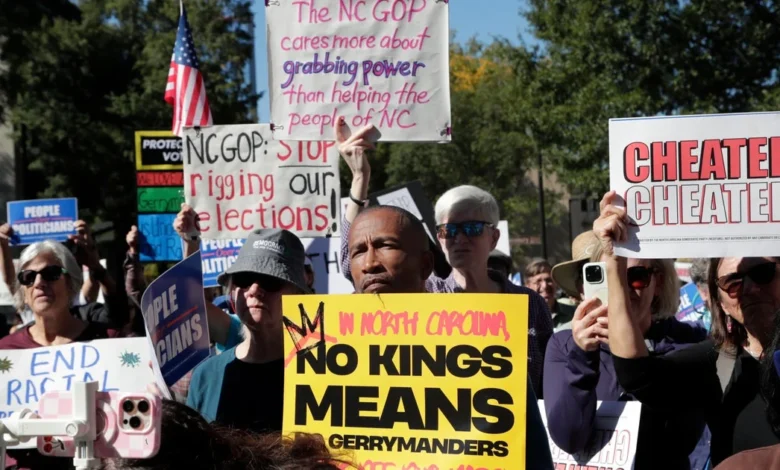
North Carolina, a state with a complex political landscape that often hovers around 50/50 at the presidential level despite its 10 Republican and 4 Democratic congressional seats, also engaged in mid-decade redistricting. In October, North Carolina state Republicans focused their efforts on a single target: Rep. Don Davis’s 1st Congressional District. Davis’s 2024 victory in the northeastern part of the state was a notable success for Democrats, especially after Republicans had flipped three congressional seats in North Carolina that year.
The map passed by the North Carolina Assembly on October 21 and 22 strategically shifted Davis’s district boundaries further south, incorporating portions of the current 3rd District. This redrawing altered the district’s demographic makeup from 48% Democratic to 44% Democratic, making it considerably more favorable to conservative candidates and posing a significant challenge to Davis’s re-election prospects.
Indiana: Republican Resistance to Trump’s Pressure
Indiana presented a unique case, demonstrating that even within a trifecta Republican government, not all GOP lawmakers were willing to acquiesce to the mid-decade redistricting push. Initially, Indiana state lawmakers resisted calls from the Trump administration to redraw their map to eliminate the state’s two Democratic congressional seats. Despite Republican Governor Mike Braun calling a special session in November, Senate President Rodric Bray publicly stated that the votes were not there, and the legislature initially agreed only to reconvene for the regular session in January.
However, lawmakers reversed course in November, agreeing to take up redistricting. On December 1, Indiana House Republicans unveiled a proposed map that drastically altered the boundaries of District 1 (which includes Gary and Chicago suburbs) and District 7 (most of Indianapolis). The plan would have spread District 1 voters across Districts 2 and 4, making all three between 40-44% Democratic. District 7, a heavily Democratic stronghold that backed Kamala Harris with 71% of its vote, would have been fragmented and absorbed into several Republican districts.
Despite passing easily in the Indiana House, the proposed map faced an unexpected hurdle in the state Senate. During public hearings, an overwhelming majority of testifiers opposed the bill. Crucially, despite the GOP’s commanding 40-10 advantage in the Senate, the bill failed in a 31-19 vote on December 11. Senate President Bray indicated the measure would not be revisited, declaring, "it’s time to turn the page." This internal Republican dissent was a significant blow to the mid-decade redistricting effort, and former President Trump subsequently vowed to primary Republicans who voted against the measure, underscoring the high political stakes involved.
Maryland: Democratic Efforts Stalled
On the Democratic side, Maryland saw Governor Wes Moore propose a plan to redraw the state’s map with the explicit goal of eliminating Maryland’s lone Republican member of Congress. However, this Democratic-led effort ultimately failed when the legislative session ended on April 14, with the Democratic-controlled state Senate allowing the redistricting bill to die in a committee. This outcome highlights that even with partisan control, redistricting efforts can face internal hurdles and legislative inertia, preventing their passage.
Utah: Judicial Intervention for Fairer Maps
Utah’s redistricting narrative diverged from others, primarily because its 2025 effort was initiated not by legislative design but by judicial mandate. All four of Utah’s House districts are currently represented by Republicans. However, a judge ruled that the existing districts violated a voter-approved measure designed to prevent partisan gerrymandering. The GOP-controlled legislature, responding to this ruling, produced four maps for public comment and, on October 6, approved a map that was deemed the least competitive for Democrats, splitting Salt Lake County to make Districts 2 and 3 more competitive for Democrats.
This legislative choice was subsequently challenged and overturned. On November 10, 3rd District Court Judge Dianna Gibson rejected the Republican-controlled legislature’s maps. In her opinion, Judge Gibson stated that the legislature’s approved map "does not comply with Utah law" and "unduly favors Republicans and disfavors Democrats." Consequently, she ordered a new map that would create a Democratic-leaning congressional district in Salt Lake City. The judicially enacted map establishes a new district encompassing Salt Lake City that would be 62% Democratic, based on 2024 presidential results, marking a significant, court-mandated shift in the state’s political landscape.
Broader Implications and Expert Analysis
The intense and widespread mid-decade redistricting efforts underscore the high stakes of the upcoming 2026 midterm elections, where control of the House of Representatives hangs in the balance. The outcomes of these battles—whether successful, stalled, or overturned by courts—will profoundly shape the electoral map for years to come.
However, despite the sophisticated mapping technologies and data analysis employed by both parties, the predictability of these efforts remains uncertain in a highly volatile political climate. Kareem Crayton, Vice President of the Washington, D.C.-based Brennan Center for Justice, cautioned against overconfidence in predictive models. "Computers and technology do give us a lot more ability to make predictive statements about outcomes, but we’re doing it — I think it’s fair to say — in a very volatile environment politically, where things that we have seen as trends are sort of being turned on their heads," Crayton stated.
Crayton highlighted several current issues that could heavily influence voters’ decisions, suggesting it would be "folly to assume that just because people showed up and voted for the current president of the United States, that people want to show up for a member of Congress, particularly… a new candidate in a district that hasn’t been created before." This expert analysis points to the inherent unpredictability of voter behavior, especially when confronted with drastically altered districts and potentially unfamiliar candidates.
The implications extend beyond mere partisan advantage. These aggressive redistricting maneuvers raise fundamental questions about democratic fairness, voter choice, and the integrity of the electoral process. When districts are drawn to guarantee outcomes, it can reduce competitive elections, leading to lower voter engagement and potentially more extreme candidates who cater only to their base. The active role of the judiciary, particularly in states like Texas and Utah, highlights the courts’ crucial function as a check on partisan legislative overreach, even as their decisions can be further appealed to higher courts.
Conclusion: An Ongoing Battle for Electoral Control
The unprecedented flurry of mid-decade redistricting efforts represents a significant chapter in American political history, driven by a fierce partisan struggle for control of Congress. While some efforts have succeeded, others have been thwarted by legislative dissent, judicial intervention, or voter referendums. The varied outcomes across states—from Texas’s Supreme Court-backed Republican map to Utah’s judicially mandated fairer districts and Indiana’s internal Republican rebellion—illustrate the complex and often unpredictable nature of these battles. As the nation approaches the 2026 midterms, the electoral landscape has been irrevocably altered, setting the stage for highly contested races that will test the resilience of American democratic institutions and the ultimate power of the ballot box. The fight for fair representation, or partisan advantage, through the drawing of lines, remains a defining feature of contemporary U.S. politics.