Supreme Court Rejects Virginia Democrats’ Bid to Restore Mid-Decade Congressional Map, Impacting Upcoming Midterm Elections

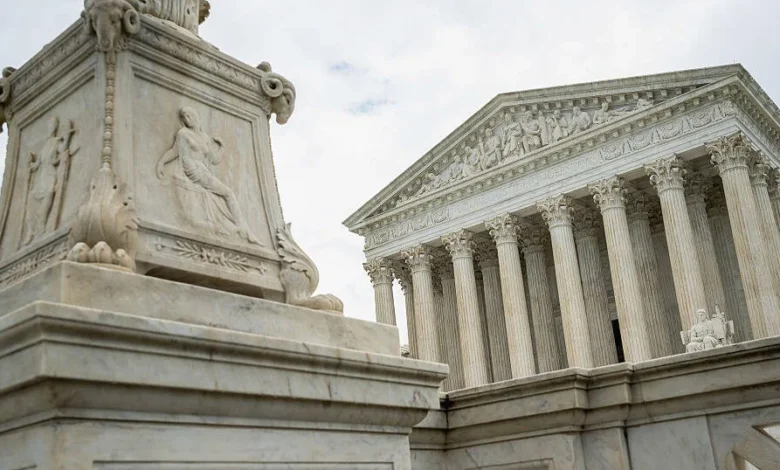
Washington, D.C. – The Supreme Court of the United States on Friday delivered a significant blow to Virginia Democrats, rejecting their last-ditch effort to reinstate a newly drawn congressional map intended to bolster the party’s standing ahead of the crucial November 2026 midterm elections. In an terse, unsigned one-sentence order, the nation’s highest court effectively upheld a prior ruling by the Supreme Court of Virginia, which had invalidated a voter-approved state constitutional amendment authorizing the new House district lines. The decision, issued without noted dissents, underscores the federal judiciary’s reluctance to intervene in state-level interpretations of their own constitutions and legal procedures, even amidst highly charged partisan battles over electoral maps.
The ruling immediately reshapes the political landscape in Virginia, forcing the Commonwealth to proceed with its existing congressional districts rather than the more advantageous boundaries Democrats had championed. The implications were swiftly evident as Dorothy McAuliffe, a prominent Democratic candidate and wife of former Virginia Governor Terry McAuliffe, announced the suspension of her campaign for a newly created seat that will no longer exist under the old map. Her statement, issued Saturday morning, reflected deep disappointment, accusing the state and U.S. Supreme Courts of casting aside the will of Virginia voters who had endorsed the redistricting scheme. This development is but one front in a nationwide, intensely partisan struggle over congressional district boundaries, with both major parties aggressively pursuing maps designed to maximize their electoral advantages and secure control of the U.S. House of Representatives.
A Detailed Timeline of Virginia’s Redistricting Saga
The saga surrounding Virginia’s congressional map is a complex interplay of legislative action, direct democracy, and judicial review, spanning several months and ultimately reaching the nation’s highest court.
The effort to redraw Virginia’s congressional map in the middle of a decade began in October of the previous year, when Democratic legislative leaders in the General Assembly initiated the process. Their goal was to amend the state constitution to allow for a mid-cycle adjustment of the House districts, a move highly unusual outside the standard decennial redistricting process that follows the national census. The proposed constitutional amendment first passed the General Assembly, signaling the Democratic majority’s intent to reshape the electoral landscape.
The measure returned for a second vote in January of the current year, a procedural requirement for constitutional amendments in Virginia. After receiving legislative approval for a second time, the proposal was then put directly before Virginia voters in April. The ballot initiative asked citizens to approve the constitutional change that would authorize the new map. In a significant win for Democrats, Virginia voters approved the proposal, seemingly clearing the path for the implementation of the new congressional districts. This voter approval was seen by many as a clear mandate from the electorate to move forward with the revised boundaries.
However, the victory was short-lived. Just days after the popular vote, the Supreme Court of Virginia intervened, blocking the redistricting plan. In a contentious 4-3 decision, the state’s highest court ruled that state lawmakers had failed to adhere to the proper procedural requirements for amending the Virginia Constitution. Specifically, the court found that the legislative process for bringing the proposal before voters contained errors that rendered the amendment invalid under state law. This ruling immediately threw the electoral plans of Virginia Democrats into disarray, reverting the state to its previous congressional map.
Undeterred, Virginia Democratic leaders swiftly sought emergency relief from the U.S. Supreme Court earlier this week. They argued that the Virginia Supreme Court’s decision was "deeply mistaken" and raised critical issues of federal law, despite the state court’s explicit focus on state constitutional procedures. Their appeal contended that "By forcing the Commonwealth to conduct its congressional elections using districts different from those adopted by the General Assembly pursuant to a constitutional amendment the people just ratified, the Supreme Court of Virginia has deprived voters, candidates, and the Commonwealth of their right to the lawfully enacted congressional districts." This marked a final, desperate attempt to salvage the map before candidate filing deadlines and the run-up to the 2026 midterms.
Virginia Republicans, meanwhile, urged the high court not to intervene, asserting that Democrats "have no case on the merits" and emphasizing that the Virginia Supreme Court’s decision was rooted purely in state law, an area where federal courts traditionally show great deference. The U.S. Supreme Court’s Friday decision to reject the Democrats’ bid, without offering any explanation beyond its one-sentence order, affirmed this principle of federalism and judicial restraint, leaving the Virginia Supreme Court’s ruling as the final word on the matter.
The Stakes: Gerrymandering and the Battle for House Control
This Virginia decision unfolds within a broader national context of aggressive partisan gerrymandering, where both Democratic and Republican parties have increasingly utilized the redistricting process to secure electoral advantages. Gerrymandering, the practice of drawing electoral district boundaries to give one political party an unfair advantage over another, is a centuries-old tactic that has become increasingly sophisticated with the advent of advanced data analytics and mapping technologies. Post-2020 Census, the decennial redistricting cycle saw intense battles across the country, leading to maps often criticized for being highly partisan.
The unusual aspect of Virginia’s case was the mid-decade timing. While states redraw maps every ten years after the U.S. Census, altering them mid-cycle is less common and typically arises from court orders or extraordinary legislative action, often driven by shifts in political control or significant legal challenges. In this instance, the Democrats’ push for a mid-decade map change was explicitly aimed at improving their chances in the upcoming 2026 midterm elections, where control of the U.S. House of Representatives is expected to be fiercely contested.
The 2026 midterms are projected to be particularly critical, with a historically narrow margin separating the two major parties in the House. A shift of just a few seats could determine which party holds the Speaker’s gavel. Consequently, every district, and every potential advantage gleaned from redistricting, is viewed as vital. This high-stakes environment has fueled the aggressive, sometimes unprecedented, efforts by both parties to shape the electoral landscape in their favor.
Reactions from Key Stakeholders and Legal Experts
The immediate aftermath of the Supreme Court’s decision saw a mix of disappointment and vindication from the political factions involved. Dorothy McAuliffe’s announcement to suspend her campaign for the newly created seat was perhaps the most tangible and immediate political consequence. In her statement, she expressed "profound disappointment," lamenting that "Virginia voters showed up, spoke clearly, and had their rejection of Donald Trump’s redistricting scheme cast aside by disgraceful rulings from the Supreme Court of Virginia and the United States Supreme Court." Her strong language highlighted the perception among many Democrats that the judicial system had undermined a legitimate democratic process.
Virginia Democratic legislative leaders echoed McAuliffe’s sentiments, with Senate Majority Leader Richard Hatcher stating, "This ruling is a slap in the face to every Virginian who voted to have their voice heard. Our state Supreme Court, and now the federal one, have prioritized procedural technicalities over the clear will of the people and the fundamental principles of representative democracy." He added, "We will continue to fight for fair maps, but this decision undeniably makes our path to holding the House majority in 2026 significantly harder."
Conversely, Virginia Republicans hailed the Supreme Court’s decision as a victory for the rule of law and constitutional integrity. House Minority Leader Eleanor Vance commented, "Today’s decision by the U.S. Supreme Court is a clear affirmation of the Virginia Supreme Court’s original ruling. It sends a strong message that even when politically expedient, due process and constitutional requirements cannot be circumvented. This was a naked power grab by Democrats attempting to manipulate our electoral system mid-cycle, and the courts rightly rejected it." She further added, "We believe Virginia voters deserve stability and adherence to proper legal procedures, not partisan maneuvers designed to undermine the integrity of our elections."
Legal experts largely anticipated the U.S. Supreme Court’s stance. Professor Michael Chen, a constitutional law scholar at George Washington University, noted, "The U.S. Supreme Court has a long-standing tradition of respecting state supreme courts’ interpretations of their own state constitutions and laws. It’s rare for them to intervene unless there’s a clear violation of federal law or the U.S. Constitution, which was not the core argument in the Virginia Supreme Court’s decision. That court found a procedural flaw in the state’s own constitutional amendment process, an area where federal courts tread very lightly." This explains the terse, unsigned nature of the order, signaling that the federal court saw no federal question meriting full review.
A Nationwide Redistricting Fight with Far-Reaching Consequences
The Virginia case is not an isolated incident but rather a microcosm of a much larger, nationwide redistricting battle that has been ongoing since the 2020 Census. The stakes are immense, as congressional maps drawn today will largely determine the composition of the U.S. House for the next decade.
The mid-decade redistricting push gained significant momentum last year when Texas, reportedly at President Donald Trump’s urging, adopted a new congressional map. This map was strategically drawn to potentially give Republicans an additional five House seats, significantly bolstering the GOP’s chances of maintaining or expanding their majority. The U.S. Supreme Court subsequently allowed this Texas map to be used in the upcoming midterm elections, despite legal challenges.
In response to the Texas developments, California officials undertook their own redistricting efforts, which were then approved by voters. The new House boundaries in California were explicitly designed to net Democrats an estimated five new seats, directly offsetting the potential gains Republicans sought in Texas. The Supreme Court also allowed California’s map to proceed, setting a precedent that allowed both partisan-driven maps to stand.
Beyond these two large states, other states have also been active in reconfiguring their House voting lines for partisan advantage. State lawmakers in North Carolina, Missouri, and Florida have similarly drawn maps aimed at giving Republicans a greater advantage in the upcoming elections. These efforts collectively illustrate a strategic, often aggressive, use of the redistricting process to entrench partisan control, regardless of the broader electorate’s leanings.
Adding another layer of complexity to the national redistricting landscape is the U.S. Supreme Court’s own recent actions regarding the Voting Rights Act (VRA). In a landmark decision last month, the Court weakened a key provision of the VRA, making it more challenging to challenge maps that dilute minority voting power. This ruling has already prompted officials in several Southern states, including Louisiana, Alabama, and Tennessee, to announce plans to pursue new maps ahead of their primary elections. These redraws are expected to further shift the balance of power, often to the detriment of minority representation and Democratic candidates. The cumulative effect of these various state-level redistricting efforts, both partisan and VRA-related, will profoundly influence the composition of the 119th Congress and the balance of power in Washington.
The Virginia decision, while specific to state procedural law, fits into this larger narrative, underscoring the legal and political volatility surrounding electoral maps. It highlights the often-frustrating reality for political parties that even popular referendums can be overturned on legal grounds, especially when complex constitutional procedures are involved. As the 2026 midterm elections draw closer, the battle over who controls the House will continue to be fought not just at the ballot box, but also in legislative chambers and courtrooms across the nation, with redistricting remaining a primary weapon in the arsenal of both major parties.
Related posts: