
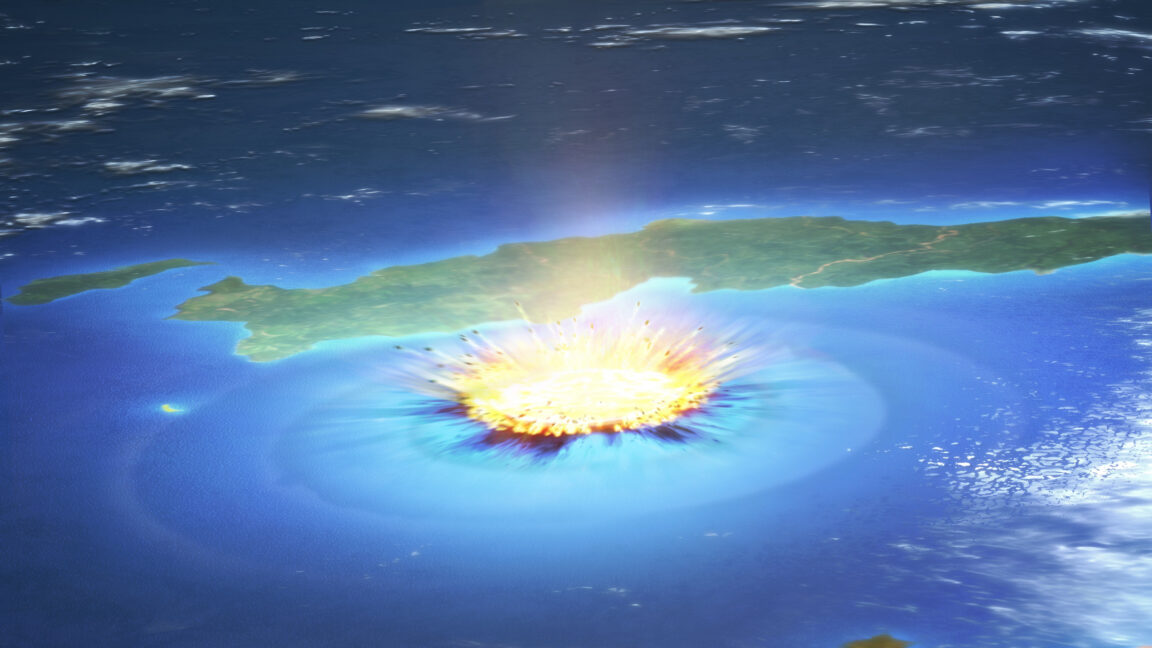
Sixty-six million years ago, the Chicxulub asteroid struck the Yucatan Peninsula with the force of billions of atomic bombs, triggering a global cataclysm that ended the reign of the non-avian dinosaurs and fundamentally altered the trajectory of life on Earth. While this event is remembered primarily for its destructive power—creating massive tsunamis, throwing plumes of sulfur and ash into the stratosphere, and inducing a multi-year “impact winter”—new scientific research suggests that the immediate aftermath of the strike may have also fostered a remarkable, long-lived oasis for biological development. Geologists and planetary scientists, through a detailed analysis of subterranean rock samples, have discovered that the impact crater hosted a robust hydrothermal system that persisted for at least eight million years, potentially serving as a fertile laboratory for the evolution of microorganisms.
The discovery, published in the journal Communications Earth & Environment, challenges previous assumptions regarding the longevity of hydrothermal systems generated by large-scale bolide impacts. Where scientists once estimated that the heat generated by the Chicxulub collision dissipated within two million years, the new data indicates that the cooling process was far more protracted, providing a much wider window of opportunity for prebiotic chemistry and the flourishing of life in the deep subsurface.
A Geological Crucible for Life
The formation of this hydrothermal system was a direct consequence of the immense energy released during the impact. The collision, which carved a crater approximately 150 kilometers in diameter and 20 kilometers deep, induced extreme deformation in the Earth’s crust. This tectonic upheaval pushed rocks as far as 35 kilometers beneath the surface, exposing them to extreme pressures and temperatures.
As the impact pulverized the target rock, it rendered the subsurface highly porous, essentially creating a vast, rocky sponge. The surrounding seawater, rushing into the newly formed, fractured landscape, infiltrated these deep, superheated zones. As this water was heated by the cooling igneous rocks—the remnants of the impact melt—it began to circulate in convection currents. This process created a hydrothermal system, a phenomenon akin to those found today at mid-ocean ridges, where nutrient-rich, warm water provides the chemical energy necessary to support complex ecosystems in the absence of sunlight.
Chronology of the Chicxulub Aftermath
To understand the timeline of this subterranean environment, a research team led by Dr. Annemarie Pickersgill of the University of Glasgow’s SUERC Center for Isotope Sciences conducted an intensive analysis of drill cores retrieved from the crater site in 2016. By sampling rocks from depths of up to one kilometer, the team sought to map the thermal history of the impact zone.
The methodology relied on potassium-argon dating, a technique that measures the radioactive decay of potassium-40 into argon-40 within feldspar minerals. Because argon gas escapes from molten or near-molten rock, the presence of specific levels of argon provides a precise clock for when a rock cooled and solidified.
The data revealed a clear progression:
- 66 Million Years Ago: The Chicxulub asteroid impacts the Yucatan, creating the initial crater and immediate hydrothermal conditions.
- 0 to 2 Million Years Post-Impact: Initial, intense hydrothermal activity characterized by high-temperature water circulation.
- 2 to 5 Million Years Post-Impact: Temperatures gradually cooled to below 50°C (122°F), creating a thermally stable environment ideal for microbial colonization.
- 5 to 8 Million Years Post-Impact: The hydrothermal system gradually declined in intensity, with fluid flow eventually ceasing as the crust returned to thermal equilibrium.
These findings were further corroborated by computer simulations, which modeled the rate at which a mass of melted rock would lose heat under the specific geological conditions of the Yucatan Peninsula. The simulations confirmed that the transition from a scorching environment to one conducive to life—below 90°C—occurred within the timeframe supported by the isotope data.
Implications for Prebiotic Chemistry
The discovery that this system remained active for eight million years is significant for the study of the origin and evolution of life. “Longer periods of hydrothermal activity will generate extended windows of opportunity for prebiotic chemical reactions to occur, life to develop, and micro-organisms to thrive and propagate beyond their point of origin,” stated Dr. Pickersgill.
In biological terms, eight million years is a vast expanse of time. If a hydrothermal system provides the necessary heat, chemical gradients, and mineral nutrients, it can facilitate the development of colonial microbial life. While the current study does not provide direct evidence that the Chicxulub crater was, in fact, inhabited, it demonstrates that the environmental requirements for such habitation were present for a duration that exceeds the time required for simple life forms to establish stable populations.
Comparative Planetary Science
The study of Chicxulub also provides a model for understanding the role of asteroid impacts on other planetary bodies. Earth’s early history was defined by frequent, massive bombardments. If the relatively small Chicxulub impact was capable of maintaining a hydrothermal system for eight million years, it stands to reason that larger impacts in Earth’s formative years—or on other planets like Mars—could have created even more enduring and stable habitats.

Geologists have identified approximately 70 underwater impact craters on Earth, yet signs of biological colonization have been confirmed in only a small fraction of them. The difficulty lies in the preservation of evidence; hydrothermal systems are dynamic, and the evidence of their chemistry is often overwritten by subsequent geological processes. The Chicxulub site remains unique because its burial beneath thick layers of later sediment has preserved it from the erosive forces that typically destroy such records.
Broader Scientific Context
This research contributes to a growing body of evidence that impacts, while traditionally viewed as purely catastrophic, have played a dual role in the history of the biosphere. By creating deep-seated, shielded environments, impacts may have served as “refugia” during times of surface instability.
Furthermore, the study highlights the importance of deep-crustal drilling in understanding the planetary evolution. The 2016 drilling project, which retrieved the samples used in this study, was a joint effort between the International Ocean Discovery Program (IODP) and the International Continental Scientific Drilling Program (ICDP). This collaborative approach allowed scientists to look past the surface-level damage of the asteroid and examine the profound internal changes it wrought upon the Earth’s crust.
Future Directions
The implications of this work extend to the search for extraterrestrial life. Astrobiologists studying the potential for life on icy moons such as Europa or Enceladus often point to the potential for hydrothermal activity as a primary indicator of habitability. The Chicxulub data provides a concrete empirical baseline for how long such systems can last following a high-energy impact, assisting researchers in calculating the probability of life emerging in the wake of asteroid strikes on other worlds.
As the scientific community continues to analyze the 2016 drill cores, further research will likely focus on identifying potential biosignatures—molecular traces or isotopic ratios that could definitively prove whether microbes occupied these deep-sea vents. For now, the Chicxulub impact remains a subject of profound paradox: the event that caused the most famous mass extinction in history may have simultaneously provided one of the longest-lasting, protected habitats for life to recover and evolve in the deep dark of the Earth’s crust. The findings serve as a reminder that the history of life is not merely a chronicle of survival against the elements, but a complex interaction with the geological forces that have repeatedly reshaped our planet.
Related posts: