A Cosmic Oddball: How a Deceptively Weak Gamma-Ray Burst Revealed the Secrets of an Extreme Stellar Death

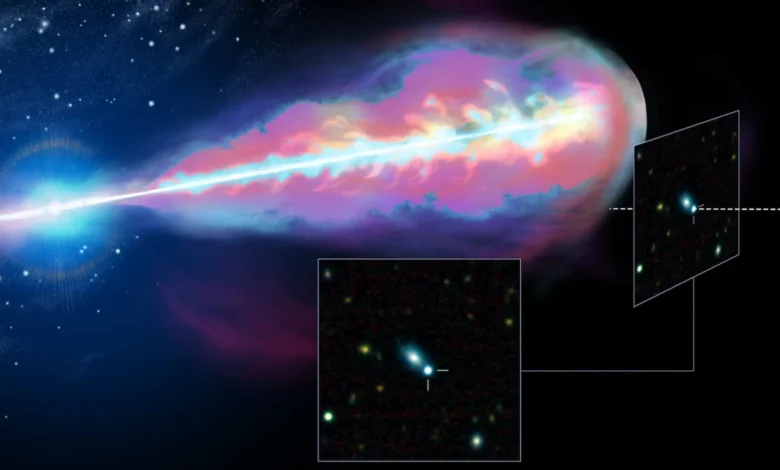
The universe occasionally plays tricks on astronomers, presenting phenomena that defy standard models before revealing extraordinary underlying mechanics. This was precisely the case with GRB 260310A, a celestial event that initially baffled scientists by appearing remarkably weak, only to be subsequently recognized as one of the most brilliant cosmic light shows observed over the past two decades. Detailed in a recent study published in The Astrophysical Journal Letters, this gamma-ray burst (GRB) has provided astrophysicists with a rare, unobstructed look at the internal architecture of a stellar explosion, offering unprecedented insights into the life and death of massive stars.
Main Facts and the Discovery of GRB 260310A
On March 10, NASA’s Fermi Gamma-ray Space Telescope captured a sudden, high-energy flash of light that lasted less than one minute. Designated as GRB 260310A, the event originated from the catastrophic collapse of a massive star, a process that typically launches ultra-fast, highly focused jets of matter into deep space at nearly the speed of light. As these relativistic jets plow through surrounding interstellar gas and cosmic dust, they generate brilliant afterglows detectable across the electromagnetic spectrum, spanning visible light, radio waves, and X-rays.
However, GRB 260310A immediately confounded researchers. The initial gamma-ray readings were surprisingly modest, prompting early assumptions that the event was an unremarkable, routine cosmic transient. Yet, within a matter of hours, the visible-light afterglow began to intensify dramatically, briefly outshining the entirety of its distant host galaxy. Weeks later, the object’s X-ray emissions experienced a secondary brightening phase, remaining observable to terrestrial and space-based instruments for months.
Subsequent data analysis revealed that while the initial high-energy gamma-ray pulse was relatively faint, the visible-light and X-ray measurements placed the event firmly in the top one percent of all recorded afterglow luminosities. Furthermore, radio observations placed GRB 260310A within the top five percent for radio brightness.
The Chronology of an Astrophysical Anomaly
To fully understand the mechanics of GRB 260310A, an international collaboration of astronomers reconstructed the precise timeline of the event, utilizing a global network of ground-based facilities, including the Large Binocular Telescope.
The sequence of events unfolded across several distinct phases:
- March 10: NASA’s Fermi Gamma-ray Space Telescope detects the initial, short-lived burst of gamma rays, logging the event as GRB 260310A. Initial impressions suggest a weak, distant cosmic explosion.
- Hours After the Burst: The optical afterglow defies expectations by rapidly brightening, surging in intensity until it dwarfs its host galaxy in visible wavelengths. Co-author and astronomer Yu-Han Yang initially suspects instrumentation error, remarking that the luminosity felt more akin to an interfering local X-ray source than an fading afterglow.
- Weeks Following the Event: The GRB’s X-ray emissions undergo an unexpected secondary brightening, a phenomenon rarely captured with such clarity.
- Months Following the Event: Continuous monitoring via a multi-wavelength observation campaign confirms the signature of an accompanying supernova, validating the stellar-collapse origin while cementing the burst’s place in observational history.
Decoding the Off-Axis Perspective
The key to unlocking the mystery of GRB 260310A lay in the spatial orientation of the explosion relative to Earth. Most gamma-ray burst models are calibrated using events where the relativistic jet points directly toward observers, much like looking straight down the beam of a high-powered flashlight. In these direct-angle observations, the energy density appears maximized, but subtle structural details of the jet itself can be obscured by the intense glare of the core.
In the case of GRB 260310A, however, researchers determined that the jet was pointed slightly away from Earth.
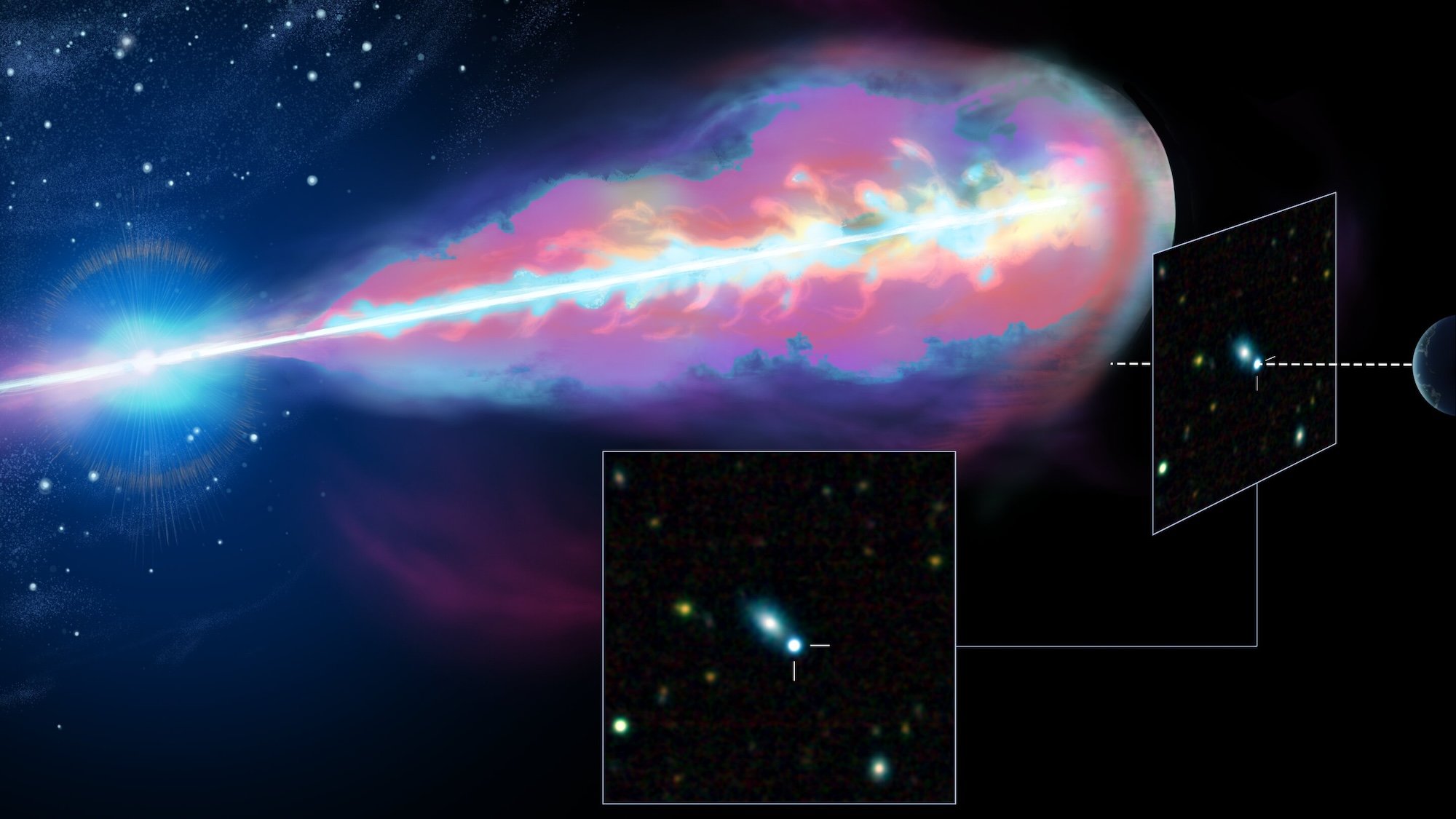
"We looked at it from a side angle," explained Yu-Han Yang. "As the jet slowed down, its light became visible over a wider range of angles, allowing us to probe the jet’s shape, from its outer edges toward its inner core."
This off-axis alignment provided a natural cosmic coronagraph. As the jet expanded and decelerated, instruments on Earth captured the emission from the broader, slower outer wings of the outflow first. Only later, as the dynamics shifted, did the observations capture the radiation emanating from the ultra-fast, highly energetic core.
Scientists now theorize that GRB 260310A featured a complex, two-tier jet structure: a razor-thin, highly concentrated core capable of channeling roughly one billion years’ worth of solar energy into the cosmos, wrapped inside a broader, slower-moving outer sheath. This structural dichotomy explains the apparent contradiction of a weak gamma-ray signature paired with an extraordinarily intense and prolonged optical and X-ray afterglow.
Supporting Data and Expert Perspectives
The rarity of this event has generated substantial excitement within the astrophysical community. Roberto Ricci, a radio astronomer at Italy’s National Institute of Astrophysics, emphasized the scientific value of such anomalies.
"We see hundreds of GRBs every year, but the oddballs are the most informative ones," Ricci noted. He further highlighted the analytical challenges the team faced, adding, "We could explain individual features of this burst, but fitting them all into the same picture proved much harder."
The multi-wavelength dataset compiled for GRB 260310A represents a benchmark for studying jet stratification in collapsars—massive stars undergoing core collapse. By comparing data from the Fermi telescope, the Large Binocular Telescope, and various X-ray observatories, researchers have been able to constrain theoretical models regarding how energy is distributed across the entirety of a stellar explosion’s outflow, rather than just its central axis.
Broader Impact and Future Implications
The implications of the GRB 260310A study extend far beyond a single stellar death. Understanding the precise geometry of gamma-ray burst jets is critical for cosmological research, as GRBs serve as standard beacons used to measure the expansion rate of the universe and probe the properties of the early interstellar medium.
Historically, selection effects—the tendency to only detect and analyze bursts pointed directly at Earth—have introduced biases into theoretical models of stellar explosions. By providing a clear case study of an off-axis event with a well-resolved internal structure, GRB 260310A equips researchers with a new framework for interpreting similar anomalies in archival and future data.
Astronomers anticipate that capturing similar off-axis events will become increasingly common with the advent of next-generation astronomical survey facilities. Instruments such as the recently completed Vera Rubin Observatory, with its unprecedented capability to scan large swathes of the night sky with high sensitivity, are expected to uncover numerous transient phenomena that challenge standard astrophysical paradigms.
As researchers continue to refine their models using the insights gained from GRB 260310A, the scientific community moves one step closer to fully comprehending the extreme physics governing the final moments of the universe’s most massive stars.
Related posts: