A Culinary Map of China Essential Dishes and the Cultural History of a Global Gastronomic Powerhouse

China possesses one of the world’s most sophisticated and geographically diverse culinary landscapes, making the task of defining a single "best" list of dishes nearly impossible. From the wheat-heavy plains of the north to the spice-laden mountains of the southwest and the delicate, seafood-centric coasts of the south, Chinese cuisine is a reflection of millennia of migration, imperial tradition, and regional resourcefulness. To understand the modern Chinese palate, one must navigate a complex tapestry of flavors that are categorized into the "Eight Great Traditions": Anhui, Cantonese, Fujian, Hunan, Jiangsu, Shandong, Sichuan, and Zhejiang. By examining the essential eats that define these regions, travelers and gourmands alike gain insight into the soul of a nation where food is often viewed as the ultimate form of medicine and cultural expression.
The Imperial Heritage: From Nanjing to the Forbidden City
The most globally recognized symbol of Chinese culinary excellence is undoubtedly Peking duck (Beijing Kaoya). While the dish is synonymous with the capital, its origins are rooted in Nanjing, the seat of ancient imperial regimes. Historical records suggest that roasted duck began appearing on royal menus more than 1,500 years ago. When the Ming Dynasty relocated the capital to Beijing in the 1400s, the imperial family brought their master chefs—and their prized duck recipes—with them.

The modern iteration of the dish is a marvel of texture and timing. The duck is typically air-dried and roasted in a closed or hung oven until the skin reaches a glass-like crispness while the meat remains succulent. It is traditionally served as a "small mountain" of sliced skin and meat, accompanied by thin pancakes, scallions, cucumber, radish, and sweet bean sauce.
However, residents of Nanjing maintain that their city remains the true "duck capital." The Nanjing obsession manifests in varied forms, such as salted duck and duck grease pancakes. Perhaps most representative of the city’s street-level devotion is duck blood vermicelli soup (Ya Xie Fen Si Tang). This dish utilizes a duck-bone broth enriched with duck blood curds and offal, including liver and gizzards, embodying the Chinese culinary principle of "nose-to-tail" eating to maximize flavor and minimize waste.
The Sichuan Spice Revolution and the Art of "Mala"
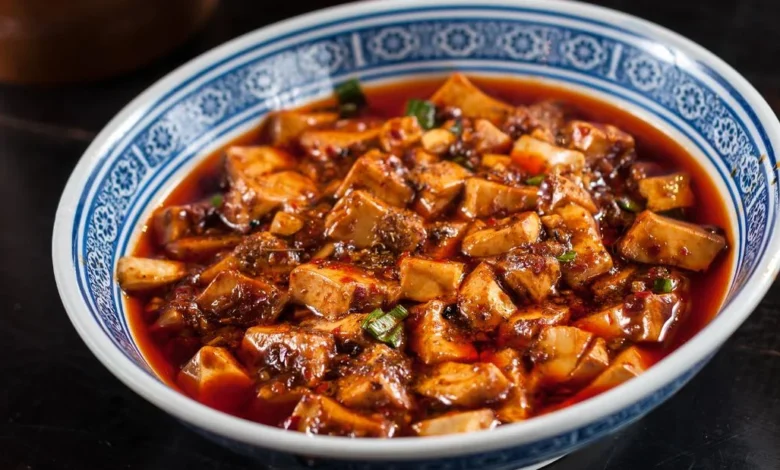
Sichuan cuisine (Chuan Cai) has achieved global dominance through its bold use of garlic, chili peppers, and the unique Sichuan peppercorn, which produces a numbing sensation known as "ma." At the heart of this tradition is Mapo Tofu, a dish that combines soft tofu with minced beef or pork in a spicy, oily sauce. Discerning gourmets argue that an authentic Mapo Tofu must use Hanyuan peppercorns and fermented broad bean paste (doubanjiang) from Sichuan’s Pidu district to achieve the necessary depth of flavor.

Another cornerstone of the region is Dan Dan noodles (Dan Dan Mian). Named after the carrying poles (dan dan) used by 19th-century street hawkers, the dish varies by vendor. Some prefer a dry mix of noodles topped with preserved vegetables and minced meat, while others serve it in a nutty, spicy broth. A key element across all versions is "rou saozi"—finely chopped pork fried in lard until golden and crispy.
Sichuan’s influence also extends to the "Shui Zhu" or "water-boiled" technique. Despite the mild name, this involves poaching meats—such as beef (Shui Zhu Niu Rou) or fish (Shui Zhu Yu)—in a searing hot, chili-laden broth. This method ensures the meat remains incredibly tender while absorbing the intense heat of the spices. Similarly, Kung Pao Chicken (Gong Bao Ji Ding) represents a fusion of traditions. Inspired by Ding Baozeng, a 19th-century governor of Sichuan, the dish combines the stir-fry techniques of his native Shandong with the chilies and peanuts of the southwest.
The Southern Coastal Traditions: Precision and Freshness
Cantonese cuisine (Yue Cai) is often defined by its restraint and focus on the natural flavors of ingredients. This is best exemplified in Cantonese steamed fish. The dish is a test of a chef’s mastery over fire; the timing must be calculated down to the second based on the fish’s weight and the stove’s intensity. If undercooked, the flesh clings to the bone; if overcooked, it loses its signature flakiness. Usually finished with sweetened soy sauce and ginger-scallion oil, it is a masterclass in simplicity.

In the realm of roasted meats (Siu Mei), Cantonese chefs are unparalleled. Char Siu (barbecue pork) relies on a marinade of maltose, honey, and five-spice powder to create a charred, sweet exterior. Meanwhile, roast goose, often prepared in wood-fired ovens using lychee or camphor wood, offers a complex smoky profile.
Beyond the main courses, the Cantonese culture of Dim Sum represents a communal dining ritual. Rather than a single dish, Dim Sum is a collection of small plates—from prawn dumplings (Har Gow) to radish cakes—designed to be shared over tea (Yum Cha). This style of eating emphasizes variety and the social aspect of gastronomy.
Further along the coast, Chaozhou (Teochew) cuisine focuses on umami. Chaozhou-style cold crab or fish involves steaming seafood with minimal seasoning and serving it at room temperature to highlight its natural sweetness. The region is also famous for its hand-beaten beef balls, which are praised for their "bouncy" texture, achieved through a laborious process of pounding the meat into a fine paste.

Regional Legends: From Scholar’s Bridges to Mountain Retreats
The inland provinces offer dishes steeped in folklore. In Yunnan, "Cross-the-Bridge" rice noodles (Guo Qiao Mi Xian) tell the story of a devoted wife who kept her husband’s soup hot by using a layer of chicken oil as insulation while she traveled across a bridge to his study island. Today, the dish remains a theatrical experience, with raw ingredients cooked tableside in a bowl of scalding broth.
In Shaanxi, the Rou Jia Mo—often called the Chinese hamburger—is a historical staple. Consisting of shredded, spiced pork belly tucked into a grilled flatbread (mo), it is a testament to the region’s ancient wheat-based culture. A perfect "mo" is said to have the "iron ring, tiger’s back, and chrysanthemum heart"—a reference to the specific charred patterns on the bread.
Hunan cuisine (Xiang Cai) offers a different kind of heat compared to Sichuan. Known for being "dry-hot," it is best represented by steamed fish head with chopped salted chilies (Duo Jiao Yu Tou). The chilies are fermented with ginger, garlic, and baijiu, creating a salty, sour, and spicy topping that cuts through the richness of the fish.

Comfort Foods and the "Breath of the Wok"
Across the nation, certain dishes provide a universal sense of comfort. Jiaozi (dumplings) are a staple of northern China and a symbol of family unity, particularly during the Lunar New Year. Whether boiled, steamed, or pan-fried, they represent the ultimate balance of protein and vegetables. In Shanghai, the Xiaolongbao (soup dumpling) takes this concept further, encasing a rich pork broth inside a delicate, pleated wrapper.
Fried rice (Chao Fan) and Congee (rice porridge) serve as the foundation of the Chinese diet. A superior fried rice is judged by its "Wok Hei"—the "breath of the wok"—a smoky flavor achieved through high-heat stir-frying that caramelizes the exterior of the rice grains without burning them. Congee, conversely, is the ultimate healing food. From the lean pork and century egg versions of the south to the pumpkin and millet porridges of the north, it is the go-to meal for restoration and health.
Analysis of Broader Impact and Global Implications
The global proliferation of Chinese cuisine has transitioned from the "Americanized" takeout of the 20th century to a more nuanced appreciation of regional authenticity. According to market data, the global Chinese restaurant market is projected to continue its steady growth, fueled by a rising interest in authentic regional styles like Sichuan and Hunan.

This shift is not merely gastronomic but also economic. Culinary tourism is becoming a significant driver for regional Chinese economies. Cities like Chengdu (a UNESCO City of Gastronomy) and Shunde have seen a surge in international visitors specifically seeking "authentic" food experiences. This has led to a renewed focus on preserving traditional cooking methods and sourcing hyper-local ingredients, such as the Fuding taro used in Fujianese desserts or the Wenchang chicken of Hainan.
Furthermore, the emphasis on the medicinal qualities of food—such as Cantonese herbal soups or the humidity-expelling properties of hot and sour soup—is finding resonance in the global wellness industry. As diners worldwide become more health-conscious, the Chinese philosophy of "food and medicine originating from the same source" (Yishi Tongyuan) is likely to influence future global food trends.
In conclusion, the culinary landscape of China is a living history. Each dish, from the imperial roast duck to the humble street-side jian bing, carries a narrative of a region’s geography, its people’s resilience, and their unwavering dedication to the art of the meal. To eat through China is to witness the evolution of a civilization, one bite at a time.