Yankees Face Familiar October Pressure as American League Division Series Opens in St. Petersburg

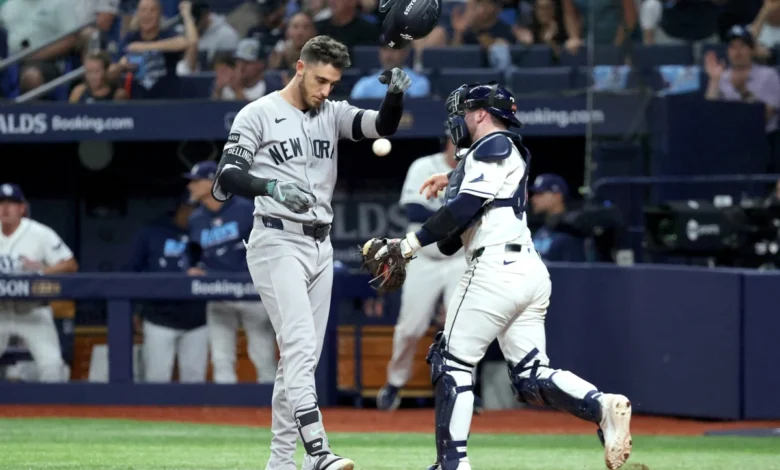
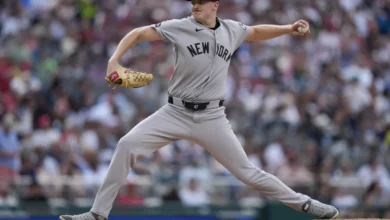
ST. PETERSBURG, Fla. — The New York Yankees arrived at Tropicana Field facing a narrative as persistent as it is demanding: that their regular-season dominance fails to translate reliably when the postseason calendar turns to October. Following a rigorous 162-game campaign, the organization entered Game 1 of the American League Division Series against the Tampa Bay Rays with an opportunity to rewrite the script that has defined their postseason runs in recent years. Under the leadership of manager Aaron Boone, the Bronx Bombers have routinely proven their capability to dispatch lesser opponents and handle the rigors of the American League Central, yet critical questions remain regarding their resilience when matched against elite, battle-tested postseason competition.
The atmosphere in St. Petersburg on Saturday, October 3, 2026, set a high-stakes stage. With a pivotal late-inning mound visit captured in the tension of the eighth frame—featuring Boone conferring with pitcher Brent Headrick while catcher Austin Wells looked on—the game encapsulated the fine margins of October baseball. For a franchise built on the expectation of perennial championship contention, the opening game of the division series served as an immediate test of both tactical execution and psychological fortitude.
Historical Context and Postseason Expectations
To understand the weight resting on the Yankees’ shoulders this October, one must examine the trajectory of the franchise over the preceding seasons. Under Aaron Boone’s stewardship, the organization has consistently secured postseason berths, establishing a high floor of regular-season success. However, the postseason has frequently exposed vulnerabilities, particularly against clubs possessing elite pitching depth, sophisticated defensive alignments, and high-leverage tactical management.
In past autumn campaigns, the Yankees have found success against structurally flawed opponents or teams lacking the offensive firepower to match New York’s formidable lineup. Series victories against wild-card contenders or divisional rivals plagued by offensive inconsistencies have sometimes masked deeper roster concerns. Observers and analysts have frequently pointed to a perceived rigidity in high-pressure scenarios, where the team’s reliance on the home run can become a liability if the pitching staff faces disciplined, velocity-heavy opponents.
Entering the 2026 American League Division Series, the Tampa Bay Rays presented a classic test of adaptability. Known for their meticulous roster construction, analytical precision, and deep bullpen architecture, the Rays represent the archetype of an opponent that forces high-payroll franchises into uncomfortable tactical territory. For the Yankees, overcoming Tampa Bay requires more than raw talent; it demands situational hitting, defensive precision, and flawless bullpen management.
Chronology of Game 1 at Tropicana Field
The opening matchup of the series unfolded before a raucous crowd at Tropicana Field, setting a tense tone from the first pitch. Both pitching staffs executed their game plans effectively through the early frames, keeping opposing bats in check and minimizing high-damage opportunities.
As the game progressed into the middle innings, strategic adjustments took center stage. The Rays leveraged their bullpen depth to neutralize the heart of the Yankees’ order, forcing New York into difficult offensive counts. The pivotal moment of defensive and tactical strain crystallized in the eighth inning. With high-leverage outs required to keep the game within reach, manager Aaron Boone emerged from the dugout to consult with reliever Brent Headrick. Catcher Austin Wells joined the conference near the mound, illustrating the collaborative communication required to navigate the late-game threat posed by Tampa Bay’s lineup.
While the immediate tactical decision aimed to stabilize the frame, the sequence underscored the narrow margin for error that defines postseason baseball. Every pitching change, defensive alignment, and umpire’s call carries magnified importance, transforming standard late-inning strategy into high-stakes chess matches. Ultimately, the execution in those decisive moments dictated the flow of the game, setting the tone for how both clubs would approach the remainder of the series.

Statistical Profile and Roster Dynamics
An evaluation of the Yankees’ current roster reveals a balanced blend of veteran leadership and emerging young talent, though statistical metrics highlight areas of historical postseason vulnerability. Throughout the 2026 regular season, New York’s offense demonstrated formidable power numbers, ranking near the top of the American League in home runs and slugging percentage. Yet, metrics tracking performance against elite pitching staffs—specifically teams with a collective bullpen ERA in the league’s top quartile—suggest a drop in offensive productivity.
On the pitching side, the Yankees compiled a strong regular-season staff ERA, anchored by reliable starting pitching and a reconstructed bullpen designed to bridge the gap to the late innings. However, postseason baseball invariably tests the depth of a pitching staff beyond its primary rotation pieces. The deployment of arms like Brent Headrick reflects the team’s reliance on depth pieces to eat crucial outs when primary high-leverage options face fatigue or matchup disadvantages.
Defensively, the club showed steady improvement over the course of the 162-game schedule, though postseason environments routinely amplify defensive miscues. Catcher Austin Wells, tasked with handling a complex pitching staff, faced the rigorous challenge of managing opposing base stealers and framing pitches against elite hitters under maximum pressure.
Official Responses and Dugout Perspectives
Speaking to reporters following the conclusion of Game 1, manager Aaron Boone emphasized the necessity of maintaining focus and resilience regardless of external narratives regarding the team’s postseason history.
"Every game in October writes its own script," Boone remarked during his postgame media session. "We understand the expectations associated with wearing this uniform. Our focus remains entirely on the execution of our game plan, pitch by pitch, inning by inning. This group has shown character and capability all year, and we look forward to the adjustments required as this series unfolds."
Players echoed a similar sentiment, downplaying historical trends in favor of immediate preparation for Game 2. Veterans within the clubhouse stressed the importance of short-term memory, noting that the intensity of a division series requires complete immersion in the current contest rather than dwelling on past autumn outcomes. Leadership figures highlighted the necessity of aggressive plate approaches and disciplined pitching as non-negotiable elements for the remainder of the matchup against Tampa Bay.
Broader Implications for the Franchise
The outcome of this American League Division Series carries profound implications for the direction of the New York Yankees franchise. In a market where success is measured exclusively by World Series titles, early postseason exits generate immediate scrutiny regarding roster construction, tactical philosophy, and organizational leadership.
A victory over a disciplined opponent like the Tampa Bay Rays would validate the team’s current trajectory, reinforcing the front office’s belief in its core roster and coaching staff. Conversely, a prolonged struggle or an early elimination would likely ignite intense discussions regarding structural changes during the upcoming offseason. For an organization with championship aspirations, October performance serves as the definitive benchmark of success.
As the series continues in St. Petersburg, the Yankees are tasked with proving that their regular-season foundation can withstand the intense pressures of championship-level baseball. How they respond to the challenges posed by the Rays will determine not only their fate in the current postseason bracket but also the enduring narrative surrounding the team’s competitive identity in the years to come.