Democrat Cindy Holscher wins Kansas governor’s race, extending party’s hold on governor’s mansion

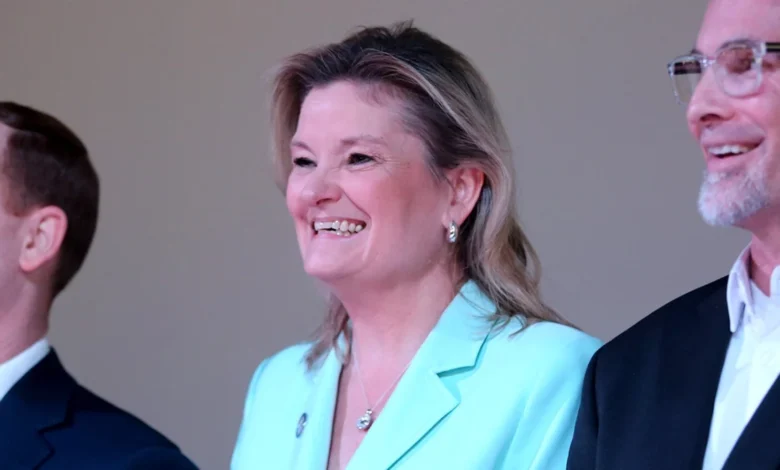
Democratic state Senator Cindy Holscher has won the fiercely contested Kansas gubernatorial race, defeating Republican state Senate President Ty Masterson in the November 3 election, according to a race projection by The Associated Press. Holscher’s victory maintains Democratic control of the governor’s office, successfully preserving the seat held by term-limited Democratic Governor Laura Kelly. This outcome marks a significant milestone for the Kansas Democratic Party, securing a third consecutive gubernatorial win in a traditionally conservative-leaning Midwestern state.
The open-seat contest drew intense national attention, heavy campaign spending, and sharp ideological clashes. Holscher, a seasoned legislator who transitioned from the state House to the state Senate, triumphed over Masterson, a prominent conservative leader who secured a coveted endorsement from President Donald Trump during a crowded Republican primary. With Holscher’s victory, Democrats have bucked broader national trends in certain rural and Midwestern battlegrounds, proving that localized candidate appeal and coalition-building can overcome entrenched partisan demographics.
The Path to the Governor’s Mansion: Chronology of the Race
The 2026 Kansas gubernatorial race was characterized by high-stakes primaries, unexpected controversies, and a relentless general election battle between two contrasting legislative leaders.
The political cycle effectively began as Governor Laura Kelly approached the constitutional limit of two consecutive terms, leaving the governor’s mansion open for the first time since 2018. The primary season set the stage for intense intra-party battles. On the Democratic side, Holscher faced off against fellow state Senator Ethan Corson. Corson entered the primary with formidable establishment backing, including endorsements from outgoing Governor Laura Kelly and former Democratic Governor Kathleen Sebelius. Despite this institutional support, Holscher successfully galvanized the progressive and moderate wings of her party, pulling off an upset primary victory in August to secure the Democratic nomination.
On the Republican side, the primary was an aggressive contest featuring several prominent conservative figures. Ty Masterson, who had served as the Kansas Senate President since 2021, consolidated the conservative base after receiving an endorsement from President Donald Trump. Masterson’s legislative record of cutting taxes, restricting abortion access, and championing school choice made him a favorite among the state’s Republican apparatus.
Following the August primaries, the general election immediately shifted into high gear. Holscher and Masterson presented vastly different visions for the state’s economic, social, and educational future. While Masterson campaigned on fiscal conservatism, regulatory relief, and traditional family values, Holscher focused heavily on public education funding, healthcare expansion, reproductive rights, and bipartisan governance.
The race tightened significantly in the final months, complicated by intense media scrutiny. Holscher faced a wave of political attacks over resurfaced social media posts from 2023. During a legislative debate concerning proposed state restrictions on drag performances in the presence of children, Holscher had posted comments suggesting that Jesus Christ could have been transgender. The remarks generated widespread national media coverage and became a central talking point for conservative super PACs attempting to paint Holscher as out of touch with mainstream Kansas values. Despite the controversy, Holscher maintained her focus on economic issues and local infrastructure, ultimately weathering the storm to cross the finish line ahead on November 3.
Background Context and Political Significance
To understand the weight of Holscher’s victory, one must examine the unique political ecosystem of Kansas. While the Sunflower State is widely regarded as a Republican stronghold in presidential elections—having voted reliably red in federal cycles for decades—it has a long history of electing pragmatic, moderate, or Democratic governors when state-level dynamics favor them.
Governor Laura Kelly’s tenure (2019–2027) demonstrated that a disciplined Democrat could win statewide by focusing on public schools, fiscal responsibility, and opposing polarizing social legislation through strategic vetoes. When Kelly reached her term limit, political analysts questioned whether Democrats could retain the seat without her direct incumbency advantage.
Cindy Holscher’s political career has prepared her for this moment. Serving in the Kansas House of Representatives for four years before winning election to the state Senate in 2021, she developed a reputation as a persistent advocate for suburban growth, education funding, and government transparency. Her legislative district in Johnson County—a rapidly suburbanizing area just outside Kansas City—exemplifies the broader demographic shifts transforming Kansas politics. Over the past decade, Johnson County has trended away from the Republican Party, shifting from a reliable conservative bastion into a critical battleground that heavily influences statewide outcomes.
By defeating Ty Masterson, Holscher not only defended the Democratic stronghold in Topeka but also signaled the continued erosion of traditional rural-suburban voting divides in the Midwest. Masterson, representing a heavily conservative rural and exurban base, struggled to generate the necessary margins in fast-growing suburban centers like Johnson and Sedgwick counties to offset Holscher’s strong performance there.
Supporting Data and Campaign Dynamics
Campaign finance reports and voter turnout metrics illustrate the fierce nature of the 2026 Kansas gubernatorial contest. Total spending by the candidates and independent expenditure groups shattered previous state records, surpassing tens of millions of dollars. National political organizations poured resources into the state, viewing Kansas as a bellwether for legislative and executive power heading into the midterms.
Voter turnout in key urban and suburban counties reached unprecedented levels for a midterm-adjacent gubernatorial cycle. Exit polls and early voting data indicated that independent voters and moderate Republicans concerned about healthcare access and public education disproportionately broke for Holscher. Conversely, Masterson dominated among rural voters and registered Republicans, capitalizing on a unified conservative message centered on economic growth and traditional social policies.
The ideological contrast between the candidates gave voters a stark choice. Masterson’s platform emphasized lowering income taxes, reducing state spending, and implementing stricter accountability measures within state agencies. Holscher’s platform countered with proposals to fully fund public schools, expand Medicaid under the Affordable Care Act—a perennial battleground in the Kansas legislature—and invest heavily in green energy and infrastructure.
Official Responses and Stakeholder Reactions
Following The Associated Press projection on Thursday, reactions from political figures across the state and nation poured in, highlighting the polarizing nature of the campaign and the high stakes involved.
Supporters of Governor-elect Holscher praised the outcome as a triumph of pragmatic leadership and resilience. Democratic National Committee (DNC) officials highlighted the win as proof that Democratic candidates can compete and win in traditionally conservative states by focusing on kitchen-table issues. Allies within the Kansas legislature expressed optimism that Holscher’s executive leadership would foster a more collaborative environment in Topeka, even as Republicans retain majorities in both the state House and Senate.
Conversely, Republican leaders expressed disappointment over the result while signaling readiness to maintain a robust legislative check on the incoming governor. Ty Masterson’s campaign released a statement thanking supporters, volunteers, and conservative donors who fueled his run. Republican legislative leaders emphasized that while the governor’s office remains in Democratic hands, the conservative-led legislature will continue to advance its policy agenda, setting the stage for potential veto battles and legislative stalemates when the new term begins.
Outgoing Governor Laura Kelly offered her congratulations to Holscher, praising her dedication to Kansas families and expressing confidence in her ability to lead the state forward. Kelly’s endorsement in the broader political landscape, coupled with her successful two-term tenure, provided a stable bridge for Holscher’s campaign to build upon.
Broader Impact and Implications for Kansas
Holscher’s ascension to the governorship carries profound implications for the state of Kansas, particularly regarding legislative relations, fiscal policy, and social issues.
First and foremost, the executive veto remains a powerful tool in Kansas politics. With Republicans holding substantial majorities in the Kansas House and Senate, Governor Laura Kelly’s vetoes were instrumental in blocking conservative legislation regarding taxation, transgender rights, and abortion restrictions. With Cindy Holscher taking office, Democrats retain that crucial institutional firewall. Observers expect immediate legislative clashes over Medicaid expansion, tax reform packages, and education funding guidelines as soon as the new legislative session convenes.
Second, the election underscores the ongoing political transformation of Kansas suburbs. The ability of a Democrat to win the governorship twice in succession—following Kelly’s victories in 2018 and 2022—suggests that Johnson County and other suburban regions have fundamentally altered the state’s electoral math. Republicans will likely need to re-evaluate their statewide coalition-building strategies to reclaim the executive mansion in future cycles.
Finally, Holscher’s victory places her in a prominent national spotlight. As one of the few Democratic governors operating in a predominantly conservative Midwestern state, she joins a select group of executives tasked with navigating deep partisan divides while delivering practical governance to their constituents.
As the transition process begins, Governor-elect Holscher faces the immediate task of assembling her administration, selecting cabinet officials, and preparing a legislative agenda aimed at bridging the gap between her campaign promises and the realities of a split government in Topeka. The coming months will test her ability to forge bipartisan consensus in a deeply divided statehouse, setting the tone for the next chapter of Kansas politics.