German cuisine is a complex tapestry woven from rich, hearty agricultural traditions and centuries of cross-cultural exchange. While global perceptions of German food are often distilled into the simplistic trinity of beer, sauerkraut, and sausage, the reality is a diverse gastronomic landscape that mirrors the nation’s multifaceted history. Today, the German culinary scene balances a deep reverence for regional heritage with a modern, dynamic appreciation for high-quality, locally sourced ingredients. From the high-end Michelin-starred kitchens of Berlin to the rustic, communal atmosphere of Bavarian beer gardens, German food is defined by its diversity, reflecting its geography from the Baltic Sea in the north to the Alpine foothills in the south.
The Historical Evolution of the German Palate
Germany’s food culture has been significantly shaped by its position at the crossroads of Europe. The country’s transition from an agrarian society to an industrial powerhouse in the 19th and 20th centuries fundamentally altered how its population ate. The "Protestant Ethic" of thrift and utility influenced many traditional recipes, which were designed to be filling, shelf-stable, and affordable for the working class.
However, the late 20th century saw a paradigm shift. Following the 1960s and 70s, the influx of "Gastarbeiter" (guest workers)—particularly from Turkey, Italy, and Greece—forever changed the urban food environment. This demographic shift introduced flavors and street-food concepts that have become deeply integrated into the German national diet, often surpassing traditional staples in terms of daily popularity.
The Sausage Legacy: A National Institution
The German sausage, or Wurst, is not merely food; it is a cultural totem. With over 1,500 documented varieties, the diversity of German charcuterie is unparalleled. While sausages vary by region, the Bratwurst remains the quintessential street food.
In Thuringia, the Thüringer Rostbratwurst is protected by geographical indication, highlighting the importance of regional heritage. The dedication to this craft is so intense that the first German Bratwurst Museum opened in 2006, serving as a testament to the nation’s obsession. The most iconic evolution of this tradition is the Currywurst. Developed in 1949 by Herta Heuwer in post-war Berlin, the dish—consisting of sliced sausage smothered in a mixture of ketchup and curry powder—is a symbol of post-conflict ingenuity. Current industry data suggests that approximately 800 million servings of Currywurst are consumed annually, proving that this "messy" street food remains a cornerstone of German life.

The Influence of Migration: The Döner Kebab
Perhaps no dish better illustrates Germany’s modern multicultural identity than the Döner Kebab. Introduced to Berlin in 1972 by Turkish immigrant Kadir Nurman at the Zoo Station, the dish was originally a modest affair of meat, onions, and minimal salad. Over the decades, it has evolved into a sophisticated, customizable meal featuring a vast array of fresh vegetables and signature sauces. It is now arguably the most consumed fast food in Germany, outperforming traditional domestic offerings in metropolitan areas. This shift highlights the broader impact of immigration on German society, where the culinary landscape has become a fluid space for integration and innovation.
Regional Specialties and Historical Resilience
Many traditional German dishes tell a story of resilience and survival. Königsberger Klopse, a dish of meatballs in a creamy white sauce with capers, originated in the former East Prussian capital of Königsberg (now Kaliningrad, Russia). During the Cold War, the dish faced political erasure in the German Democratic Republic; officials attempted to rename it Kochklopse (boiled meatballs) to avoid any reference to the lost Prussian territory. Today, it has reclaimed its original name and is a fixture in restaurants, particularly in Berlin and Brandenburg, serving as a reminder of the historical complexities of the German nation.
Similarly, Labskaus represents the seafaring history of the north. Originating in the 18th century, it was a practical solution for sailors on long voyages, using preserved salted beef, potatoes, and pickled beetroot. Though its visual appearance—a vibrant pink mash—can be daunting, it remains a beloved comfort food in port cities like Hamburg and Bremen, often served as a "hangover cure" for the modern urbanite.

The Ritual of Seasonal Eating: Spargelzeit
One of the most distinct aspects of German food culture is the seasonal obsession with Spargelzeit (asparagus time). Between mid-April and June 24 (St. John’s Day), the country enters a state of near-frenzy over white asparagus. Statistics from the Federal Statistical Office of Germany indicate that over 70,000 tons of the "white gold" are consumed annually during this short window. The commitment to this vegetable is absolute; one can find asparagus-themed festivals, dedicated "Asparagus Routes," and countless road-side stalls. This seasonal focus highlights the German appreciation for local agriculture and the importance of timing in traditional cooking.
The Art of the Dumpling: Maultaschen and Spätzle
In the southern state of Baden-Württemberg, the Maultaschen holds a unique place in history. Often described as a larger, rectangular version of ravioli, these dough pockets are filled with meat, breadcrumbs, and spinach. In 2009, the European Union granted the dish regional specialty status, acknowledging its importance to the cultural heritage of the state.
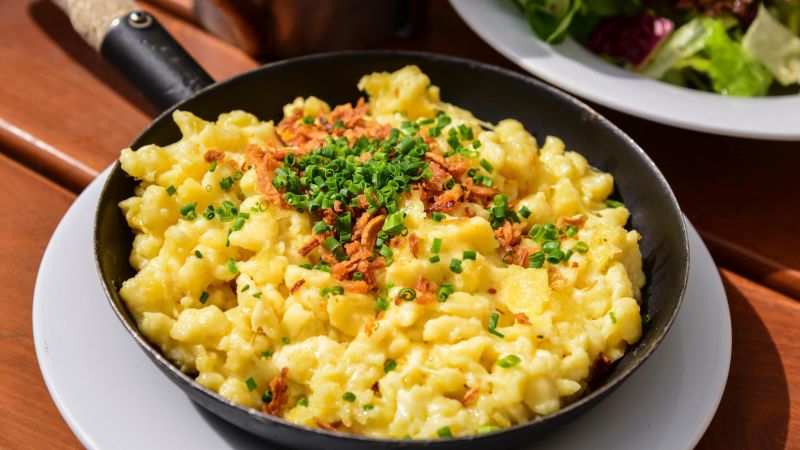
Closely related is the Spätzle, a simple but labor-intensive egg noodle. Whether served as a side dish or elevated into Käsespätzle (layered with cheese and fried onions), these noodles are an essential component of southern German dining. In the Allgäu region, the preparation of these dishes is treated with high regard, often anchoring the menu at both family-run taverns and high-end beer halls.

The Sunday Roast: Sauerbraten and Rouladen
For Sunday family dinners and special occasions, German cuisine leans into complex, slow-cooked preparations. Sauerbraten (literally "sour roast") is widely considered a national dish. The preparation is a lesson in patience: the meat (traditionally horse, though beef and venison are now standard) must be marinated for several days in a mixture of vinegar, herbs, and spices. The resulting dark, tangy gravy, thickened with crushed gingerbread or rye bread, creates a flavor profile that is uniquely German.
Similarly, Rinderrouladen—thin slices of beef wrapped around bacon, onions, mustard, and pickles—epitomizes the traditional Sunday table. These dishes are rarely found in the fast-paced world of street food, serving instead as a point of continuity for the German family unit, where recipes are passed down through generations.
The Sweet Finish: Cakes and Confections
German baking is a science of its own. The Schwarzwälder Kirschtorte (Black Forest Gateau) is the most globally recognized dessert, though it is often misunderstood. It is not named for the mountain range, but for the Schwarzwälder Kirsch—a potent cherry brandy produced in the region. Since its alleged creation in 1915, it has become a staple of the Kaffee und Kuchen (coffee and cake) ritual that defines German Sunday afternoons.

Equally significant is the German cheesecake (Käsekuchen). Unlike its American counterpart, which relies on cream cheese and a cookie crust, the German version uses Quark—a fresh, acid-set dairy product—and a shortcrust pastry base. The result is a lighter, fluffier texture that emphasizes the quality of the dairy rather than the sweetness of the additives. Finally, the whimsical Spaghettieis (ice cream shaped like spaghetti) stands as a modern icon, invented in 1969 by the son of an Italian immigrant. It serves as a reminder that even in the realm of dessert, Germany’s culinary future remains inextricably linked to its history of migration.
Conclusion: A Culinary Identity in Flux
The German culinary landscape is far more than a collection of heavy, meat-centric dishes. It is a record of historical borders, industrial shifts, and the integration of diverse immigrant communities. While traditional dishes like Sauerbraten and Rouladen maintain their status as cultural anchors, the popularity of Döner Kebab and the national obsession with seasonal produce demonstrate a country that is constantly updating its palate. For the traveler, Germany offers a gastronomic experience that is deeply rooted in regional pride, yet continuously reshaped by the global influences that have come to call the country home.