The Evolution of Luxury: How Experiential Retail Is Redefining High-End Travel Itineraries

The geography of luxury has always been dictated by the movement of human desire. Long before market analysts began categorizing consumer segments or mapping demographic shifts, the luxury sector adapted organically to evolving concepts of personal aspiration and identity. Today, this profound transformation is starkly reflected in both macroeconomic metrics and shifting consumer behaviors. According to Euromonitor’s 2025 World Market for Luxury Goods report, experiential luxury emerged as the fastest-growing segment of the market in 2025, expanding by 8 percent year-on-year to reach a staggering $103 billion. As affluent travelers increasingly demand uncompromising standards of engagement and personalization across every facet of their lives, the fundamental value of luxury travel is steadily migrating toward sectors that the tourism industry has historically neglected—chief among them, experiential retail.
Main Facts and Market Realities
The disconnect between modern affluent consumer spending habits and traditional destination strategy is remarkably wide. Data from Visa’s 2025 Global Travel Insight report reveals that retail accounts for more than half of all international credit card spending by affluent travelers in select global markets. Despite this massive economic footprint, shopping rarely commands a strategic role in destination planning, itinerary architecture, or the curation of the holistic guest experience. For decades, institutional tourism viewed retail merely as an ancillary commercial transaction rather than an essential cultural touchpoint.
Industry leaders argue that this narrow perspective is obsolete. Elena Foguet, chief international business officer for Europe at The Bicester Collection, emphasizes that contemporary retail functions far beyond simple commerce. Retail can and should serve as an immersive portal of discovery, offering travelers a meaningful gateway to engage with local culture, regional craftsmanship, indigenous design, and the creative minds behind the products.
Whether a traveler journeys to the Emilia-Romagna region of Italy to experience the Museo Ferrari or spends an idyllic afternoon unearthing avant-garde independent designers in the Marais district of Paris, the underlying psychological driver remains identical: the thrill of authentic discovery. In the modern luxury paradigm, the experiential journey of acquiring an object matters just as much as—if not more than—the physical item itself.
The Chronology and Evolution of Retail Tourism
The formal recognition of experiential retail as a core pillar of tourism did not happen overnight; it is the culmination of a decade-long evolution in consumer expectations. Historically, luxury shopping villages were viewed as isolated suburban outlets designed primarily for discount-seeking tourists. However, through a deliberate strategy of repositioning, entities like The Bicester Collection transformed these properties into cultural and lifestyle destinations.
The turning point in bridging the gap between high-end travel advisors and experiential retail materialized through strategic alliances, most notably the partnership between Virtuoso, the global network luxury travel agency, and The Bicester Collection. Matthew Upchurch, CEO of Virtuoso, admits that he was initially skeptical about integrating shopping into elite travel itineraries. The core challenge of any experiential offering, Upchurch noted, is that its true value remains opaque until a traveler encounters it firsthand.
What ultimately shifted Upchurch’s perspective was observing how experiential retail successfully fulfilled the exact same psychological and experiential objectives that Virtuoso advisors spent years curating: providing sophisticated travelers with an alternative, unscripted entry point into a destination. Advisors eventually realized that clients were independently seeking out these curated retail environments because they offered unexpected access to local creative communities and regional subcultures. Consequently, the formal partnerships that emerged in recent years simply codified what the global luxury market had already organically decided.
Supporting Data and Economic Impact
The commercial and economic metrics supporting the integration of experiential retail into tourism strategies are compelling. High-net-worth individuals are demonstrating a clear preference for destinations and environments that offer depth, authenticity, and seamless hospitality.
In Europe, top-tier VIP clients (VICs) of The Bicester Collection increased their total spending by 17 percent year-over-year in 2025. Simultaneously, the adoption of specialized auxiliary services surged; registrations for the company’s hands-free shopping service—which allows guests to purchase items throughout a village and have them securely consolidated and delivered at the end of the visit—climbed by 40 percent over the same twelve-month period.

Furthermore, the geographical placement of these experiential retail hubs has generated substantial economic multipliers for surrounding regions. Built deliberately outside major urban centers, these villages are designed to decentralize tourism spending, ensuring that the economic benefits of international travel flow outward into suburban and rural communities. Guest data consistently indicates that high-net-worth travelers who engage deeply with experiential retail ecosystems tend to extend their stays in the region, increase their overall expenditures, and return more frequently. This dynamic transforms retail destinations into powerful economic anchors that support local hotels, independent restaurants, transportation networks, and regional cultural institutions.
Official Responses and the Hospitality Standard
As the profile of the retail tourist has evolved, so too has the standard of service required to satisfy them. Affluent travelers arrive with exceptionally high expectations regarding service execution, personalization, and discretion—standards traditionally reserved for five-star luxury hotels and Michelin-starred dining establishments.
To meet and exceed these expectations, operators like The Bicester Collection have actively imported hospitality philosophies into the retail environment. The company embraces the principle of "Unreasonable Hospitality," a service ethos popularized by renowned restaurateur Will Guidara. Furthermore, the organization partnered with the Ecole hôtelière de Lausanne, one of the world’s premier hospitality management institutions, to design specialized training programs that embed elite hospitality standards across all its European and global properties.
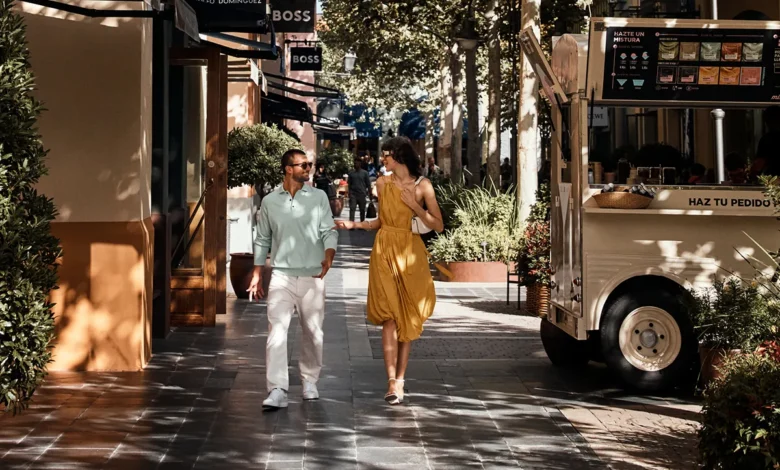
The physical and cultural manifestations of these service standards vary intentionally by location. La Roca Village, situated outside Barcelona, deeply integrates Catalan architecture, gastronomy, and design motifs. Fidenza Village, located near Milan, mirrors the region’s profound historical connection to Giuseppe Verdi and the operatic arts. In Asia, Shanghai Village expanded its footprint by adding 57 new boutiques to accommodate a rapidly growing international VIC audience. Meanwhile, Belmont Park Village, located just outside New York City, offers visitors the ability to seamlessly pair a day of bespoke shopping and cultural programming with a live concert or a New York Islanders hockey game at the adjacent UBS Arena, or thoroughbred horse racing at the newly revitalized Belmont Park.
Each village explicitly curates a delicate balance between globally recognized luxury Maisons—such as Ferragamo, Vivienne Westwood, Manolo Blahnik, and Creed—and regional artisans, emerging designers, and local culinary talents. This hyper-local focus extends beyond the physical boundaries of the villages through newly launched editorial city guides and curated travel itineraries designed to encourage visitors to explore deeper into the surrounding countryside and urban centers.
Broader Impact, Implications, and the Rise of AI
The intersection of luxury travel, experiential retail, and human curation arrives at a critical juncture for the broader tourism industry. As artificial intelligence and automated travel planning tools become increasingly sophisticated at generating generic itineraries, the ability of technology to genuinely understand human nuance remains inherently limited.
According to industry analysts and leaders like Matthew Upchurch, wealthy consumers are growing progressively discerning regarding the distinction between genuinely bespoke recommendations derived from deep human relationships and automated suggestions generated by algorithms. As technology democratizes basic access and booking capabilities, the definitive differentiator for human travel advisors and luxury brands alike will be relational judgment, contextual understanding, and absolute trust.
This technological shift elevates the strategic importance of human-to-human collaboration. Travel advisors are being forced to re-evaluate their standard itineraries, questioning whether legacy inclusions continue to drive genuine cultural discovery or whether they have simply become default checklist items. By incorporating intentional, high-touch experiential retail into these journeys, advisors can offer clients a multi-dimensional understanding of a destination that purely digital itineraries cannot replicate.
Moreover, the broader implications of this trend extend into corporate social responsibility and sustainable growth. Modern high-net-worth consumers are intensely conscious of the socio-economic impact of their spending. Initiatives such as The Bicester Collection’s DO GOOD program—which actively channels philanthropic support into local community partnerships, empowers female social entrepreneurs through the Unlock Her Future Prize, and champions child protection standards across the travel and leisure sectors via collaborations with the World Travel & Tourism Council (WTTC) and ECPAT International—demonstrate that commercial retail can successfully align with ethical stewardship.
Looking ahead, industry experts agree that the historical compartmentalization of tourism into rigid silos—separating accommodation from transport, and culture from commerce—is permanently defunct. The world’s most discerning travelers have decisively voted with their time and capital, favoring holistic experiences that seamlessly blend discovery, narrative, and human connection. The ongoing challenge for destination marketers, travel advisors, and luxury brands is not whether to adapt to this paradigm shift, but whether they will proactively shape its trajectory or merely react to its momentum.