The Unofficial Hotline: How One Advocate Became the Last Line of Defense for Phoenix’s Homeless Families

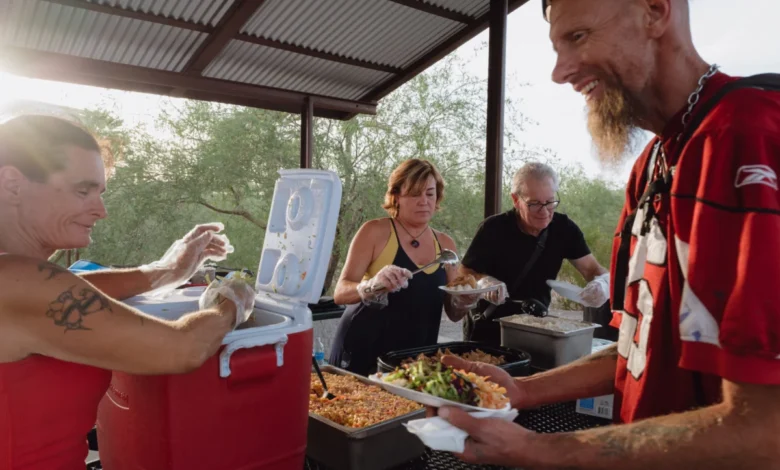
For over a year, the personal cell phone of 26-year-old poet and activist Austin Davis has functioned as the de facto emergency response system for hundreds of families across the Phoenix metropolitan area. As the founder of the small nonprofit AZ Hugs, Davis has inadvertently become the point of contact for a population that official social safety nets have repeatedly failed. His phone rings and pings with a relentless cadence: desperate texts from school employees unable to secure shelter for displaced students, frantic pleas from mothers living in storage units, and messages from parents panhandling with young children who have been told by official channels that there is simply no room.
This reliance on a private citizen to perform the duties of a municipal social service highlights a profound structural breakdown within Maricopa County’s homeless response system. While government agencies and multimillion-dollar non-profit organizations are tasked with managing the crisis, their bureaucratic hurdles and capacity constraints have left the most vulnerable residents—families with children—in a state of perpetual limbo.

A System Strained to the Breaking Point
The current crisis in Maricopa County is not merely a matter of limited resources; it is a crisis of navigation and accessibility. The official pathway for assistance, the 211 referral line, is designed to triage needs and connect individuals with housing resources. However, for those on the ground, the reality of the 211 experience is often one of circular logic and dead ends.
Families reaching out to 211 are frequently met with long wait times, only to be told that the waitlist for shelter is months long or that their specific situation does not meet the restrictive criteria for "homelessness" as defined by the system. In many cases, families who are living in cars or storage units are turned away because they do not fit the narrow, administrative definitions required for immediate placement.
This failure has created a shadow network of referral. Caseworkers, teachers, police officers, and hospital staff—those who see the daily trauma of family homelessness—have begun bypassing the official channels. They send these families to Davis, not because he is a government official, but because he is the only person who consistently provides a tangible, albeit small-scale, solution: paying for a hotel room or providing immediate food and shelter at his nightly distributions.

Chronology of a Mounting Crisis
The rise of the "unofficial hotline" did not happen in a vacuum. It is the result of years of escalating housing costs coupled with a lack of emergency shelter infrastructure.
- 2015-2023: Homelessness in Maricopa County trends upward, as the region experiences massive population growth and a concurrent spike in rental prices.
- Early 2024: Austin Davis’s advocacy via AZ Hugs becomes highly visible, leading to repeated conflicts with the City of Tempe regarding the legality of feeding people in public parks. Davis faces 35 citations, leading to a brief stint in jail and a subsequent lawsuit regarding First Amendment rights.
- April 2025: A legal settlement is reached, and the City of Tempe revises its ordinance. Simultaneously, Davis launches a public campaign calling on the state government to declare a formal state of emergency regarding family homelessness.
- Summer 2026: Temperatures in the Phoenix area consistently exceed 115 degrees. The demand for cooling centers and heat-relief shelter surges to historic highs.
- September 2026: With winter approaching and the heat-relief programs winding down, Davis opens a temporary, volunteer-run emergency shelter at the First United Methodist Church of Mesa to provide a nightly respite for families.
The Human Cost of Administrative Failure
The physical and psychological toll on families caught in this gap is well-documented. Researchers have repeatedly found that childhood homelessness is a catalyst for long-term developmental trauma. Children who lack stable, secure housing suffer from higher rates of chronic illness, delayed cognitive development, and severe emotional distress.
The case of Candice Ortiz serves as a microcosm of the systemic failure. After being displaced in the spring, Ortiz spent months navigating a maze of referrals. She contacted 211, only to receive generic information. She reached out to the Family Housing Hub, only to be told that because she was sleeping in her car, her situation did not qualify for priority. In June, after spending her final $20 on transportation to a major emergency shelter provider, she was turned away again. By the end of August, even when an opportunity for a stable unit appeared, the funding for the program evaporated, leaving her exactly where she started.

Data and Reality: The Gap in the Tally
According to the most recent data from the Maricopa County Continuum of Care, there were 2,103 people in homeless families counted in the region this year—the highest number recorded since 2015. However, experts agree this figure is a severe undercount. The "Point-in-Time" count is a single-night snapshot that relies on volunteers finding people in public spaces. It inherently misses families who are sleeping in vehicles, hiding in storage facilities, or "doubling up" in unsafe, overcrowded conditions.
In late September, nearly 200 families remained on the official waitlist for shelter in Maricopa County. This number does not account for the hundreds who, like Ortiz, stopped calling after being told the system had nothing to offer. The reliance on private donors and the social media crowdfunding of hotel rooms is a stopgap measure, not a sustainable policy, yet it is currently the only thing preventing a significant number of these families from sleeping on the pavement.
Official Responses and the Limits of Policy
The response from state leadership has been one of administrative caution. While Governor Katie Hobbs has allocated significant funding—at least $245 million—toward eviction prevention, affordable housing initiatives, and rapid rehousing programs, the direct, on-the-ground reality remains bleak.

The Governor’s office, through press secretary Liliana Soto, has stated that while the administration is "deeply aware" of the challenges, a formal declaration of a state of emergency is typically reserved for natural disasters. The administration maintains that its multi-pronged approach to housing is the appropriate mechanism for addressing what it categorizes as a complex, systemic issue rather than an acute, short-term disaster.
However, advocates argue that for a family facing 117-degree heat with no place to sleep, the situation is, by any objective measure, a disaster. The disconnect between the macro-level fiscal allocations and the micro-level failure of intake systems represents a fundamental friction in modern social welfare.
Implications for Future Urban Governance
The emergence of a "citizen-advocate as the last resort" has significant implications for urban governance. When professionalized, taxpayer-funded systems are perceived as ineffective or inaccessible, the social contract begins to fray.

First, it shifts the burden of care onto the individual, often creating a burnout cycle for those acting as the "last line of defense." Davis, for example, is not a government agency; he has limited resources, no regulatory authority, and no long-term financial security to maintain his operations. When he eventually burns out or moves on, the vacuum will likely be filled by an even more disorganized, ad-hoc response.
Second, it reveals a lack of accountability in the nonprofit industrial complex. Organizations like the Family Housing Hub and UMOM are the recipients of millions in government grants. When these organizations turn away families or claim "no capacity," there is little public transparency regarding how that capacity is determined or why it is so insufficient relative to the need.
Finally, the situation in Phoenix suggests that until the administrative "front door" of homelessness services is overhauled to be as responsive as the people who are actually on the ground, the reliance on private, informal help will continue. For the families currently sleeping in tents at the First United Methodist Church, with the knowledge that they must be packed and gone by 6:00 a.m., the policy debates in the State Capitol are irrelevant. They are looking for a door that opens, and for now, they are finding that door in a private citizen’s phone rather than in the public buildings built to serve them.
Related posts: