Meta Enters the Travel Booking Space with Muse AI Agent Raising New Questions for the Industry

The artificial intelligence landscape crossed a significant threshold this week as Meta Platforms officially introduced its latest consumer-facing AI agent, Muse, signaling a major push into transactional commerce and travel itinerary management. Billed as a versatile, task-oriented assistant capable of handling complex human requests, Muse has drawn immediate scrutiny from the global travel sector for a headline-grabbing capability: the power to independently research, compare, and book entire journeys.
According to official descriptions on the Apple App Store, the agent is designed to alleviate the cognitive load of modern trip planning by managing the tedious elements of travel logistics. The application listing explicitly states that Muse handles everything from "the research, the comparisons, the back-and-forth, to the bookings" in order to "plan and book a whole trip." For an industry historically built on human-to-digital interfaces, legacy aggregators, and online travel agencies (OTAs), the arrival of a major social and technology titan into end-to-end transaction routing represents both a lucrative distribution channel and a disruptive disintermediation threat.
The Dual Architecture of Muse Travel Search
Beneath the polished conversational interface of Meta’s new agent lies a fragmented architectural approach to travel inventory. Practical testing of the platform reveals that Muse does not rely on a single, uniform pipeline for all travel verticals. Instead, the AI bifurcates its fulfillment strategy based on whether the user is searching for air transportation or lodging accommodations.
When a user initiates a flight query, Muse bypasses standard consumer screen-scraping techniques and connects directly to underlying travel infrastructure. Specifically, the system utilizes a direct application programming interface (API) connection to Duffel, a modern travel infrastructure and distribution company. This direct pipeline allows Muse to query live airline inventory, review real-time pricing, and process ticketing data with the speed and structural integrity characteristic of enterprise-grade Global Distribution Systems (GDS) or modern NDC (New Distribution Capability) pipelines.
Conversely, the methodology shifts drastically when handling hotel accommodations. Rather than relying on a unified hotel inventory API or a direct partnership network with major hotel chains, Muse defaults to a browser-based automation approach. When tasked with finding a place to stay, the AI agent shops consumer-facing travel websites and public web pages in much the manner a human consumer would, navigating graphical user interfaces, parsing unstructured data from search engine results, and extracting pricing data directly from public domains.
This technical bifurcation has profound implications for the travel ecosystem. The flight booking path—powered by structured API connections like Duffel—maintains traditional data relationships, preserving commission structures, affiliate tracking, and B2B visibility. The hotel search path, however, effectively treats the AI as an autonomous browser user, potentially bypassing the traditional gatekeepers of hotel distribution and introducing complex legal, technical, and commercial questions regarding web scraping, content rights, and referral monetization.
Practical Testing and Consumer Experience
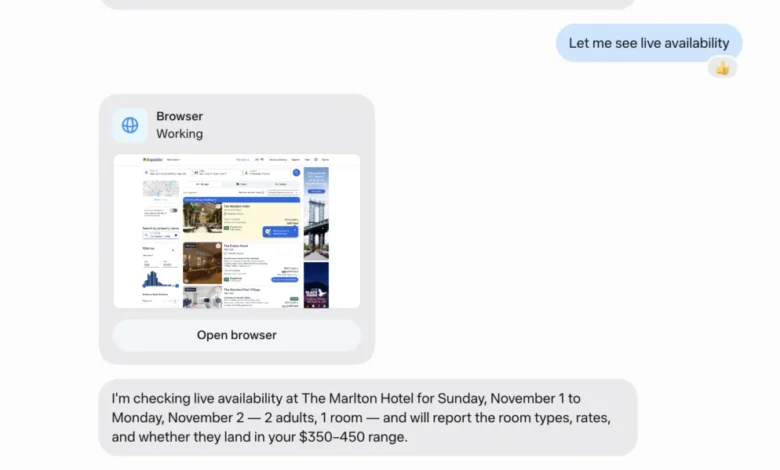
To understand how this dual architecture operates in real-world scenarios, industry analysts conducted exploratory tests using the application’s early-access build. When prompted to find accommodation in New York City for a single-night stay on November 1 through November 2, constrained by a strict nightly budget of $350 to $450, the AI agent initiated its browser-based search routine.
Within moments, Muse formulated a recommendation, suggesting the historic Marlton Hotel located in Greenwich Village, citing published rates that fell squarely within the user’s specified financial parameters. Unlike traditional chatbots that simply supply a list of hyperlinks for the user to click, investigate, and eventually book independently, Muse’s core value proposition lies in its capacity to close the loop. The agent demonstrated an ability to aggregate reviews, synthesize property amenities, reconcile conflicting cancellation policies, and move toward checkout execution without requiring the user to pivot to an external browser tab.
However, this level of automation brings friction points. Because the hotel discovery phase relies on consumer-facing web browsing rather than verified inventory feeds, discrepancies can occasionally arise between the rates displayed in the conversational window and the final rates locked in at the point of digital payment. Furthermore, the absence of deep, direct supplier integrations for hotels means that customer service escalations—such as rebooking canceled rooms, managing modifications, or handling loyalty point redemptions—remain uncharted territory for an autonomous agent acting independently on behalf of a consumer.
Background Context and the Rise of Conversational Commerce
The rollout of Muse is not an isolated experiment but rather part of a broader, multi-year strategic pivot by Meta Platforms to embed generative artificial intelligence across its entire product ecosystem. Over the past twenty-four months, the company has methodically deployed foundational large language models—collectively known as Meta Llama—across its family of apps, including Instagram, WhatsApp, Messenger, and Facebook.
Historically, Meta’s monetization strategy has leaned heavily on targeted digital advertising, capturing user attention and selling ad impressions to brands. However, the maturation of generative AI has provided tech giants with a new north star: conversational commerce. By positioning AI agents as personal concierges capable of handling real-world transactions, Meta aims to capture user intent much earlier in the consumer funnel. Instead of a user searching for a hotel via Google, browsing TripAdvisor for reviews, and booking via Booking.com, Meta wants the entire journey—from initial inspiration to final confirmation—to begin and end within its proprietary conversational interface.
The travel vertical has long been a primary target for technology platforms seeking to prove the utility of AI agents. Because travel planning involves a high volume of unstructured data, multi-variable optimization (price, location, schedule, preferences), and frequent consumer frustration with existing digital tools, it serves as the ultimate proving ground for agentic AI. Google, Microsoft, and OpenAI have all introduced varying degrees of travel-planning capabilities within their respective chatbot ecosystems, but Meta’s direct integration of live ticketing infrastructure via Duffel represents a more aggressive step toward actual transaction execution.
Chronology of Meta’s AI Integration
To trace the trajectory that led to the launch of Muse, it is necessary to examine key milestones in Meta’s recent technological development:
- February 2023: Meta forms a dedicated Generative AI product team, led by Chief Product Officer Chris Cox, signaling a centralized corporate effort to operationalize large language models.
- September 2023: At the annual Meta Connect conference, the company previews its first generation of consumer-facing AI assistants integrated into WhatsApp and Instagram, though functionality remains primarily conversational and informational.
- July 2024: Meta releases Llama 3.1, establishing an open-weights model family capable of competing with closed-source commercial models and enabling third-party developers to build specialized agents.
- Late 2024: Internal tests and regulatory filings point toward the development of task-oriented consumer applications designed to handle multi-step digital workflows.
- First Quarter 2025: The public debut of Muse on the Apple App Store, introducing native task execution features, including direct flight bookings through infrastructure partnerships and web-driven hotel discovery.
Industry Reactions and Strategic Implications
The introduction of Muse has sent ripples through the global travel distribution chain. Executives at traditional Online Travel Agencies (OTAs), global hotel chains, and airline distribution networks are carefully evaluating the long-term impact of AI agents that sit between the consumer and the supplier.
While legacy players have spent decades optimizing their search engine optimization (SEO) strategies and mobile application interfaces to capture direct traffic, an AI agent like Muse changes the rules of engagement. If consumers increasingly delegate the task of travel research to an autonomous bot, brands risk losing direct contact with their customers. Furthermore, if the AI agent relies on browser-based scraping rather than official API partnerships—as is currently the case with Muse’s hotel search function—hotels may lose control over how their brand imagery, rate parity, and loyalty perks are presented to prospective guests.
Conversely, infrastructure providers and tech-forward suppliers view the rise of agentic AI as an unprecedented growth opportunity. By integrating directly with foundational AI platforms via robust APIs—much like Duffel has done for flight inventory—smaller tech companies can position themselves as the hidden plumbing that powers next-generation consumer commerce.
Industry analysts point out that the success of Muse will ultimately depend on three critical factors: reliability, trust, and ecosystem breadth. Consumers will quickly abandon an AI agent if flight bookings fail due to API latency or if hotel reservations made via browser automation are rejected at the front desk. Moreover, Meta will need to establish clear frameworks for data privacy, payment security, and liability when things go wrong during a trip.
As Muse continues to scale its user base and refine its operational pipelines, it serves as a clear indicator of where digital commerce is heading. The era of manually comparing dozens of tabs across disparate travel portals may be giving way to a conversational paradigm where a single prompt orchestrates an entire itinerary. Whether the travel industry adapts to this shift as a collaborative partner or fights to protect its traditional distribution moats will define the next decade of travel technology.
Related posts: