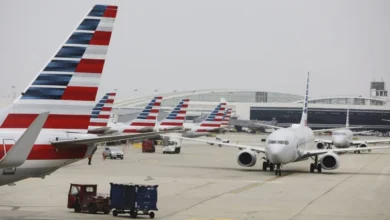
Senator Bernie Sanders recently ignited a firestorm of public debate with a bold declaration regarding corporate tax compliance. On October 24, 2026, the Vermont senator asserted that any individual who paid at least $1 in federal income taxes last year contributed more to the public coffers than major U.S. carriers, specifically naming American Airlines, United Airlines, and Southwest Airlines. However, a review of official 2025 financial filings and federal tax data suggests that the senator’s characterization is fundamentally at odds with the reported reality of corporate tax payments.
The discrepancy between the senator’s public rhetoric and audited financial statements highlights a growing friction between populist political narratives and the complex, often misunderstood mechanics of the U.S. tax code. While the senator occupies a senior position on the Senate Committee on Finance—the very body responsible for drafting the legislation he criticizes—his recent claims appear to conflate tax accruals with cash payments and ignore the billions of dollars these corporations contribute through other tax channels.
The Financial Reality of Airline Tax Payments
The assertion that major airlines paid nothing in federal income tax is contradicted by the companies’ own regulatory filings. For instance, United Airlines reported paying $33 million in federal income taxes during the 2025 fiscal year. When analyzing these figures, tax experts distinguish between financial accounting and cash-basis reporting. While United reported a $4 million federal income tax expense on its financial statements (an accrual-based figure), the actual cash payment made to the Treasury reached $33 million. This difference often arises from the timing of tax payments, revisions to previous estimates, and the reconciliation of refunds against current obligations.

American Airlines and Southwest Airlines also operate within a volatile financial environment where thin profit margins make large-scale tax contributions difficult to sustain. In 2025, American Airlines reported a net income of $111 million on $54.6 billion in revenue—a net margin of roughly 0.2 percent. For a company of that scale, the tax burden is naturally constrained by low profitability, a reality that complicates the narrative of massive, untaxed windfalls.
The Role of Carryforwards and Depreciation
Critics of corporate tax structures often point to "zero-tax" years as evidence of loopholes, but industry analysts emphasize that these figures are often the result of long-standing provisions designed to account for the cyclical nature of the aviation industry. Airlines frequently carry forward massive losses from previous years to offset current income. As Warren Buffett famously observed, the airline industry is notoriously capital-intensive and historically unprofitable; allowing companies to offset prior losses against future gains is a standard feature of the tax code that prevents the government from taxing a company on its gross revenue rather than its net economic performance.
Furthermore, the 2025 tax environment was heavily influenced by the reinstatement of 100% bonus depreciation for eligible property, including aircraft. When an airline purchases a new fleet, federal law allows them to deduct the value of those assets rapidly to incentivize investment and fleet modernization. This creates a temporary divergence between the airline’s financial statements—where the cost of the plane is spread over its useful life—and its tax filings, where the deduction is claimed immediately. This is not a "loophole" in the traditional sense, but a deliberate legislative tool intended to stimulate capital expenditure.
Beyond Income Tax: The Total Fiscal Contribution
Focusing exclusively on federal income tax provides a narrow and potentially misleading view of a corporation’s total fiscal contribution. Airlines represent a significant source of federal revenue through payroll taxes and aviation-specific excise taxes.

According to data reported to the Department of Transportation, the three airlines targeted by Senator Sanders paid approximately $2.45 billion in employer-side FICA payroll taxes in 2025 alone. Additionally, these carriers are subject to a 4.3-cent-per-gallon commercial aviation fuel excise tax. When multiplied across domestic flight operations, this generates substantial annual revenue for the Airport and Airway Trust Fund. In 2025, that fund received $15.915 billion from various aviation-related taxes, including the 7.5% excise tax on domestic tickets. To suggest that these companies contribute nothing to the federal treasury ignores the billions they remit in support of national infrastructure and social security funding.
Discrepancies in the Senator’s Broader List
The list of 19 companies cited by Senator Sanders as tax-avoiders also includes organizations that, according to public filings, clearly paid significant amounts in federal income tax. CVS Health, for example, disclosed $1.583 billion in federal tax payments for 2025, while PayPal reported $535 million. Other entities on the list, such as H&R Block and Kohl’s, also reported substantial tax payments.
The inclusion of these companies on a list purportedly highlighting tax avoidance suggests a lack of alignment with verifiable SEC filings. The list also displays a misunderstanding of corporate structure, as it treats subsidiaries and parent companies as distinct entities for the sake of inflating the count, despite their integrated tax reporting.
Broader Implications for Legislative Oversight
The irony of the situation is that Senator Sanders, a prominent member of the Senate Subcommittee on Taxation, holds significant influence over the laws governing these corporate behaviors. If the current tax code allows for outcomes that the senator finds unacceptable, the responsibility for reform rests within the legislative process he oversees.

The public discourse surrounding corporate tax rates is increasingly polarized, but experts warn that using inaccurate data to characterize corporate behavior can undermine legitimate policy debates. There is a valid argument to be made regarding the balance between corporate tax incentives and public revenue needs; however, the consensus among economists is that this debate should be grounded in the reality of how global corporations function and how tax accounting is structured.
Conclusion and Contextual Perspective
While political rhetoric often seeks to simplify complex economic issues, the reality of corporate taxation is defined by a intricate set of rules, incentives, and obligations. The airline industry, characterized by high operational costs and thin margins, is a primary example of how standard tax provisions—such as loss carryforwards and accelerated depreciation—interact with volatile market conditions.
As policymakers move forward, the debate will likely shift toward whether these existing tax incentives continue to serve the public interest. However, for a constructive dialogue to occur, both the proponents of higher corporate taxation and the industry representatives must agree on the fundamental facts of what is currently being paid. By mischaracterizing the tax contributions of major employers, the current discourse risks distracting from the more substantive challenges of tax reform, such as addressing the global nature of corporate profit allocation and the efficiency of existing investment incentives.
Ultimately, the goal of federal tax policy is to balance the need for government revenue with the desire to maintain a competitive business environment. Whether the current balance is correct remains a matter of ongoing legislative debate, but it is a debate that requires an accurate accounting of the status quo.
Related posts: