The Homeland Security Secretary Is Now A Hologram—Praising President Trump While You’re Stuck In Line At Airport Security

The Technology Behind the Hologram
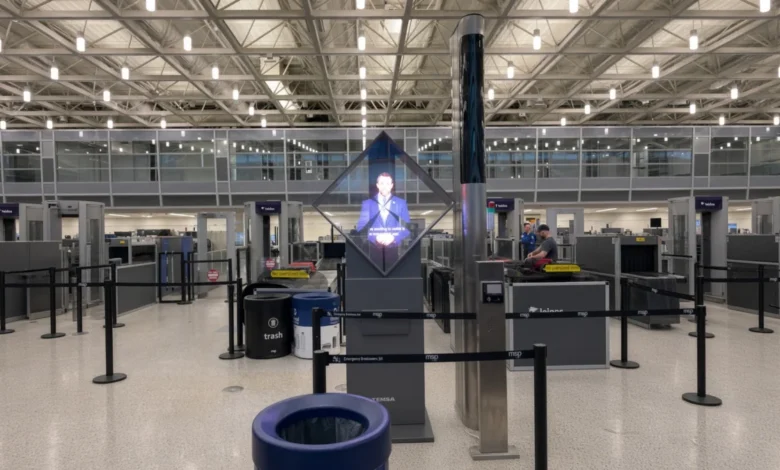
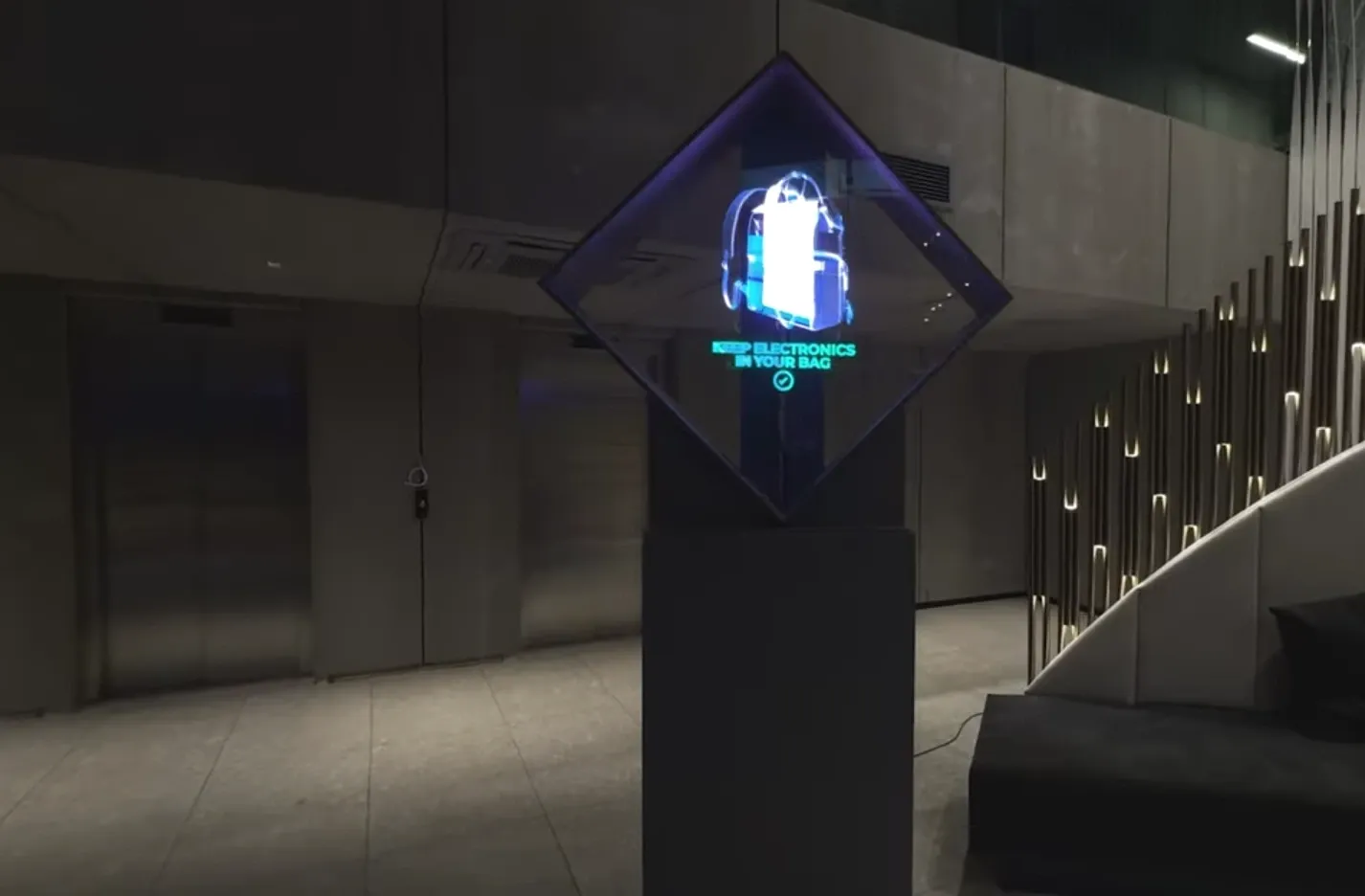
The installations are part of a broader deployment by Campaign3D, which has reportedly rolled out 50 “Tensator Shard” displays across 27 U.S. airports. While marketed as “holograms,” the technology relies on HYPERVSN systems—a series of rapidly rotating LED blades that create the visual persistence of a floating image. The primary stated purpose for these devices is to improve the communication of TSA security protocols, such as requirements for electronics and liquids, in high-traffic environments where traditional signage might be overlooked.
However, the content displayed on these units has shifted from purely functional instructional guidance to political commentary. Travelers at the Minneapolis–St. Paul checkpoint reported that the loop features Secretary Mullin asserting that passengers are “not the problem” regarding security delays, followed by an expression of gratitude toward President Trump and a concluding “God Bless America.” This integration of federal administrative messaging with overt political branding has drawn sharp criticism from travelers and civil liberties advocates, who characterize the installation as a modern, high-tech iteration of “Big Brother” surveillance culture.
A Chronology of Politicized Checkpoints
The use of airport infrastructure for political messaging is not an entirely new phenomenon, though it has reached a new level of technological sophistication under the current administration. The evolution of this trend can be traced back to the previous administration under Secretary Kristi Noem.
In October 2025, during a period of intense political friction surrounding a government shutdown, the Department of Homeland Security under Noem authorized the broadcast of pre-recorded videos on airport monitors. These videos explicitly blamed opposition lawmakers for the funding impasse. The backlash was immediate and widespread. Several major airport authorities, most notably Dallas–Fort Worth and Dallas Love Field, formally declined to display the footage, citing internal policies that prohibit political advertising within their terminals to maintain a neutral environment for a captive audience.

Following the transition in leadership, Secretary Mullin’s office initiated a concerted effort to scrub the legacy of his predecessor from the aviation landscape. In July 2026, internal DHS communications surfaced in which the Secretary’s office issued directives to airport operators nationwide. The instruction was explicit: airport authorities were ordered to identify any remaining Kristi Noem-era videos and remove them immediately, providing official confirmation once the content had been purged. This systematic replacement of one official’s messaging with another’s has led observers to compare the scenario to the shifting propaganda narratives described in George Orwell’s 1984.
Implications for Passenger Experience and Compliance
The security checkpoint at a modern airport is a site of compulsory compliance. Travelers are legally required to submit to screening, including biometric data collection and physical searches, to exercise their right to travel. By placing a political figurehead directly in the line of sight of this captive audience, the Department of Homeland Security has effectively transformed a government service into a platform for partisan dissemination.
Analysts suggest that this strategy may be counterproductive to the agency’s goals. Research into passenger satisfaction consistently shows that wait times are the primary driver of negative perceptions regarding the Transportation Security Administration (TSA). When passengers are subjected to political monologues while standing in restrictive queues, the association between the agency and political friction is reinforced. Rather than acting as a reassuring authority figure, the digital avatar of the Secretary risks becoming a symbol of the very bureaucratic fatigue that the agency is attempting to mitigate.
Technical and Operational Criticisms
From an operational standpoint, the utility of the Tensator Shard displays remains a point of contention. While the visual clarity of the projection is high, critics argue that the medium is inherently distracting. The "hologram" effect is designed to capture attention—a goal that potentially conflicts with the need for travelers to focus on their personal belongings, boarding passes, and identification documents.
Furthermore, the monetization of the security checkpoint has been a growing concern for travel industry experts. For years, private companies have been permitted to sell advertising space on the bins used for screening, essentially profiting from the forced waiting time of the public. The current administration’s decision to utilize this infrastructure for its own messaging represents a transition from commercial monetization to political utilization. By controlling the visual environment of the terminal, the government is exerting a degree of psychological influence over citizens that some constitutional scholars suggest warrants closer oversight.
Broader Perspectives and Official Responses
The response to the installations has transcended traditional partisan lines, as evidenced by the widespread dissemination of photos and videos on social media platforms like Bluesky and X. Observers have noted that the installations are reminiscent of dystopian cinematic tropes—specifically the “Ludovico technique” from A Clockwork Orange, wherein a subject is forced to view disturbing or ideological content to induce a conditioned response. While passengers are not physically forced to watch the Mullin hologram, they are effectively forced to exist within its proximity to reach their gates.
Airport authorities remain in a difficult position. Most receive federal grants and must coordinate closely with the TSA on security protocols. While some airports have historically pushed back against political content, the integration of these displays into the standard hardware of the security lane makes refusal more difficult. If a display is presented as an “instructional” tool for security, an airport operator that turns it off could theoretically be accused of hindering federal security operations.
Analysis of Future Trends
As the 2026 travel season peaks, the presence of the Mullin hologram serves as a case study in the intersection of advanced visual technology and administrative power. The “holographic” projection is likely to remain a fixture in airports for the foreseeable future, given the capital investment required for the 50-unit deployment.
The incident highlights a significant shift in how government agencies communicate with the public. Historically, federal messaging in transportation hubs was limited to public service announcements regarding safety, security, or health. The shift toward personalized, political messaging suggests a move toward a more permanent, digitally-integrated form of government propaganda. As these technologies become more immersive, the legal and ethical boundaries surrounding what constitutes “official communication” versus “political campaigning” will likely face increased scrutiny from legislative oversight committees and civil rights organizations.
Ultimately, the deployment of these holograms serves as a reminder that the airport security environment is a unique space where the government holds almost absolute authority. Whether this technology will eventually be viewed as a successful, modern tool for communication or as an overreach that alienated the traveling public remains to be seen. For now, travelers across the United States will continue to navigate the security lines under the gaze of a flickering, digital projection of the Secretary of Homeland Security, reflecting a new and complex chapter in the relationship between state authority and the traveling public.
Related posts: