The Hidden Benefactor: Uncovering the Russian Oligarch Behind the Wedding of Donald Trump Jr.

For days, the investigative team operated under a cloud of uncertainty, chasing a tip that seemed almost too surreal to be true: that a Russian oligarch with deep ties to President Vladimir Putin had not only attended the wedding of Donald Trump Jr. this past May in the Bahamas but had functioned as a primary financier for the weekend’s lavish festivities. Confirming the presence of Umar Kremlev, a figure under Ukrainian sanctions and head of the scandal-plagued International Boxing Association (IBA), required more than just hearsay. It demanded the kind of visual forensic evidence that is often buried beneath layers of carefully curated social media projections.

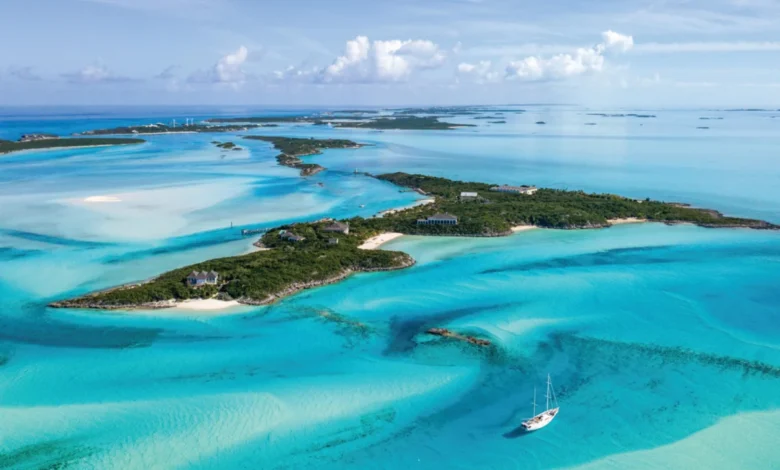
The wedding, held across two private islands in the Exumas, had been presented to the public through a tightly controlled lens. Official photos released to outlets like Page Six and Hello! magazine depicted an intimate, picturesque affair—a chapel ceremony followed by beachside celebrations. Yet, scanning these official galleries for a glimpse of Kremlev proved fruitless. The Trump family’s visual footprint for the event appeared scrubbed, or perhaps intentionally curated to omit guests whose presence might invite uncomfortable scrutiny.
The breakthrough did not come from the glossy pages of a lifestyle magazine, but from a painstaking analysis of digital crumbs. A series of videos posted to Telegram by Kremlev during the wedding weekend provided the first tangible lead. In the background of one clip, while the oligarch spoke in Russian, the camera captured a specific set of wicker patio furniture. By cross-referencing this furniture against promotional imagery of the private islands in the Exumas, the investigation team established a spatial link. While a piece of furniture is rarely enough to ground a major political allegation, it served as the necessary catalyst to broaden the search.

The final confirmation emerged from an unexpected source: an Instagram gallery uploaded by a friend of the bride. Nestled among candid shots of the weekend was a group photo taken on a white sand beach. There, in the back row, was the unmistakable profile of Umar Kremlev. His presence, alongside two other unidentified Russian associates, was striking. In a guest list of only 50 people, the deliberate omission of these individuals from all other official wedding media suggested an intentional effort to keep their involvement in the background.
A Chronology of Extravagance
The wedding weekend was defined by its exclusivity and extreme cost. The festivities began on a Friday with a ceremony on a private island, a location famously used in Hollywood productions like Pirates of the Caribbean and Casino Royale. While Kremlev was not present for the Friday vows, his involvement escalated significantly over the following forty-eight hours.

On Saturday and Sunday, the focus shifted to a second, nearby island—a destination that commands rental fees of approximately $100,000 per night. Records reviewed by investigators, bolstered by accounts from individuals familiar with the event, confirm that Kremlev bankrolled multiple nights on this island. The Sunday reception was particularly ornate, featuring a nautical theme, a seafood boat buffet, and a performance by a Junkanoo band. As the night reached its climax, the couple shared their first dance under disco balls hung from palm trees, followed by a professional fireworks display over the water—a pyrotechnic show estimated to cost in the range of $70,000, all paid for by the Russian oligarch.
The Financial Trail and Corporate Affiliations
The funding for these events did not come from Kremlev’s personal accounts alone, but rather through a Dubai-based entity affiliated with the International Boxing Association (IBA). The IBA has long been under intense international scrutiny, particularly regarding its financial reliance on Gazprom, the Russian state-owned energy giant. This connection creates a problematic optics issue, as the wedding of the President’s son was essentially facilitated by an organization sustained by one of the Kremlin’s primary financial instruments.

Kremlev’s own history is equally contentious. Beyond his role at the IBA, his proximity to the Russian state security apparatus has led to his sanctioning by the Ukrainian government. The timing of his arrival at the wedding was also notable: he reportedly appeared in the Bahamas just days after joining a Russian delegation alongside President Putin in China. While his press office has issued denials regarding his status as an "official" member of that delegation, the logistical sequence of his travel from China to the Caribbean raises significant questions about the nature of his current activities and his access to the American political inner circle.
Official Responses and Political Repercussions
The revelation of the payments has triggered an immediate legislative response. Within hours of the findings being published, the top Democrat on the House Oversight Committee launched an formal inquiry. The investigation seeks to uncover the full extent of the financial relationship between Trump Jr. and Kremlev, specifically requesting all communications and records regarding "all purchases made for your wedding by foreign nationals."

In response to the mounting pressure, Donald Trump Jr. and his wife, Bettina, released a joint statement via Instagram. The statement acknowledged that Kremlev had hosted the celebrations on Saturday and Sunday, but attempted to distinguish between the "ceremony" and the "celebrations." The couple described the payments as an "extraordinarily generous wedding gift from a friend," expressing gratitude for the gesture.
A spokesperson for Trump Jr. further clarified the relationship, stating that "Umar is a personal friend of Don" and that there is "not a business relationship" between the two men. Kremlev’s press office mirrored this sentiment, emphasizing that the two have been friends for "a couple of years" and asserting that Kremlev has never engaged in political discussions with his American counterparts. Despite these characterizations, the failure to address why a foreign national, particularly one with such significant ties to Russian state interests, would underwrite a private wedding remains a central point of contention.

Broader Implications: The "Gift" Economy of Influence
The situation highlights a recurring concern in modern political ethics: the "gift" economy and its potential to compromise public figures. Frank Montoya Jr., a retired FBI official with extensive experience in counterintelligence, underscored the strategic danger of such arrangements. "If I’m paying for your wedding, at some point, you’re going to owe me something," Montoya observed. This principle of reciprocity—often referred to as the "quid pro quo" of social influence—is a foundational concern in intelligence and ethics oversight.
When a figure closely aligned with a foreign adversary covers significant expenses for the family of an American political leader, it creates a vector for influence that is difficult to monitor through traditional lobbying disclosures. The wedding was not merely a social event; it was a high-stakes gathering in an ultra-exclusive setting, providing a level of proximity that is inherently valuable.

The case of the "wicker chair" discovery serves as a reminder of how digital footprints can undo even the most carefully managed public narratives. As the House Oversight Committee continues its investigation, the focus will likely remain on the financial conduits used to move the funds and whether these "gifts" were truly personal, or part of a broader, more calculated effort to foster dependency.
The wedding of Donald Trump Jr. and Bettina Trump will be remembered for its opulence and its "pure magic," as described by the bride. However, for those observing the intersection of international finance, foreign influence, and American political dynasties, the event serves as a case study in how the boundaries between private celebration and public accountability have become increasingly porous. As the investigation unfolds, the primary question remains: what was the true cost of such an "extraordinarily generous" gift, and who ultimately stands to benefit from the debts created on those white sand beaches in the Exumas? The answers, as with the proof of the guest list, may be hidden in plain sight, waiting for the right detail to bring them into focus.