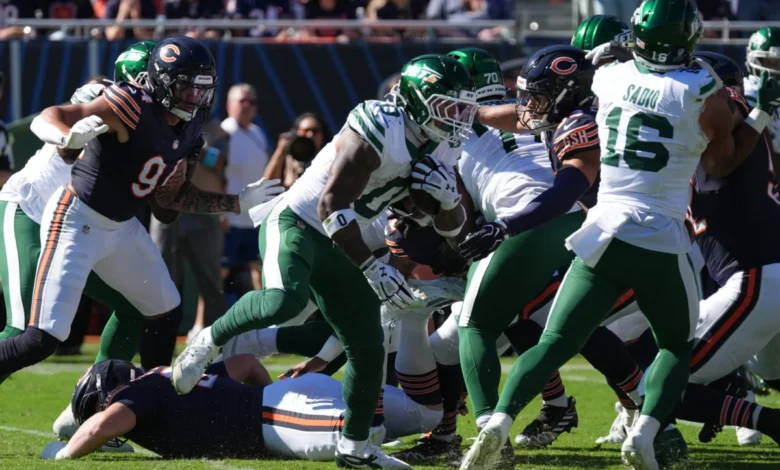
CHICAGO — There were no moral victories, silver linings, or optimistic talking points to salvage the afternoon for the New York Jets following a thoroughly uninspiring 23-12 defeat to the Chicago Bears at Soldier Field. While the final 11-point margin might suggest a competitive, hard-fought contest on paper, anyone who endured the full 60 minutes on the shore of Lake Michigan recognized that the outcome was far more lopsided than the scoreboard indicated.
The loss abruptly erased the modest wave of optimism that had built around head coach Aaron Glenn’s squad over the first month of the season. Following narrow, competitive defeats to NFC powerhouses like the Green Bay Packers and the Detroit Lions—outings where the Jets showed grit and late-game execution—Sunday’s performance felt like a severe regression. For a franchise attempting to establish a stable, competitive identity under Glenn, this ugly interconference matchup bore an uncomfortable resemblance to the disjointed, mistake-prone football that plagued the organization throughout the previous season.
Main Facts of the Matchup
The contest at Soldier Field showcased a complete breakdown across all three phases of the game for the visitors. Offensively, the Jets struggled to generate any sustained rhythm, bogged down by inefficient execution, porous pass protection, and an inability to convert in critical situations. Chicago’s defense dictated the terms of engagement from the opening whistle, suffocating New York’s ground game and relentlessly harassing the backfield.
Defensively, the Jets failed to contain the Bears’ multi-dimensional attack, allowing Chicago to control the clock and dictate the pace of the game. Field position heavily favored the home team throughout the afternoon, as special teams miscues further compounded New York’s difficulties. By the time the fourth quarter rolled around, the contest had degenerated into a battle of attrition that the Jets were ill-equipped to win.
The final statistical breakdown underscored the extent of the domination. New York managed just a fraction of the total yards accumulated by Chicago, converting a meager percentage of their third-down attempts and turning the ball over at inopportune times. For a team striving to climb out of the AFC basement, the afternoon served as a stark reminder of the talent and execution gap that still separates them from consistent contenders.
Chronology and Flow of the Game
The tone for the afternoon was established early in the first quarter. After winning the toss and electing to defer, the Jets’ defense took the field needing to set a tone. Instead, the Bears orchestrated a methodical opening drive that mixed effective play-action passing with steady interior runs, deep into New York territory. Although the Jets’ defense stiffened in the red zone, forcing a field goal, the early success of the Bears’ offense signaled long-term trouble for the visitors.
New York’s opening possession offered little reassurance. A quick three-and-out, punctuated by a sack and an incompletion, handed the ball right back to Chicago. As the first half progressed, the game settled into a grinding defensive struggle, but one heavily tilted in favor of the hosts. The Bears capitalized on short fields and persistent penalty flags against the Jets to steadily build a multi-score lead before halftime.
Coming out of the locker room, adjustments were desperately needed for the Jets. However, the third quarter began in disastrous fashion. A turnover deep in their own territory handed Chicago prime scoring real estate, which the hosts converted into a touchdown that effectively broke open the game. While the Jets managed to string together a late scoring drive in the fourth quarter to narrow the deficit and avoid a complete shutout, it was too little, too late. The outcome had long been decided, leaving the remaining minutes as a slow march toward the final whistle.
Background Context and Season Trajectory
To fully understand the gravity of Sunday’s loss, it is necessary to examine the trajectory of the Jets’ season up to this point. Head coach Aaron Glenn, who took over the reins with a mandate to instill discipline, toughness, and a modern tactical approach, has spent the early portion of his tenure trying to rebuild the team’s culture.
The initial weeks of the campaign offered legitimate reasons for hope. In Week 2, the Jets pushed the Green Bay Packers to the brink in a contest that was decided in the final minutes. A week later, they went toe-to-toe with the Detroit Lions, displaying resilience that convinced many observers that the roster was more competitive than projected. Those narrow losses, while frustrating in the win-loss column, fostered a narrative that the team was close to turning a corner.
However, the NFL is an unforgiving league where moral victories have a short shelf life. Entering Sunday’s game against Chicago, analysts viewed the matchup as a litmus test—an opportunity for the Jets to translate "close calls" into a decisive victory against a peer-level opponent. Instead, the team failed the test comprehensively. The regression to undisciplined play, missed assignments, and offensive stagnation has raised immediate questions about whether the early-season resilience was an anomaly rather than a sign of sustainable progress.

Supporting Data and Statistical Realities
A deeper dive into the numbers highlights the depth of the Jets’ struggles in Chicago. New York’s offense managed a season-low in total net yards, struggling mightily on third down conversions—a metric that has plagued the team throughout the first month of the season.
The offensive line, which has faced scrutiny regarding depth and continuity, surrendered multiple sacks and allowed consistent pressure up the middle, disrupting the timing of the passing game and rendering the running game virtually non-existent. Without a reliable ground game to balance the playbook, the offense became predictable and easy for Chicago’s defensive coordinator to scheme against.
On the defensive side of the ball, the Jets struggled on third down, allowing the Bears to sustain crucial drives that drained the clock and exhausted the defensive unit. Time of possession heavily favored Chicago, leaving the New York defense on the field for nearly two-thirds of the game. Fatigue inevitably set in during the second half, leading to missed tackles and blown coverages that sealed the team’s fate.
Official Responses and Post-Game Reactions
In the immediate aftermath of the defeat, head coach Aaron Glenn did not mince words during his post-game press conference at Soldier Field. Addressing the media with a visibly strained expression and a hand resting on his head, Glenn rejected any notion of looking for silver linings.
"There are no moral victories today," Glenn stated firmly when asked about the team’s inability to maintain the momentum built over previous weeks. "We didn’t play winning football, plain and simple. From coaching to execution, across every single phase, that was not up to the standard we are trying to build here in New York."
Glenn emphasized that the responsibility for the performance falls squarely on the coaching staff and the players alike. "When you take a step backward like this, you have to look in the mirror," he continued. "We had a week of good preparation, but preparation doesn’t mean anything if it doesn’t translate on Sunday afternoon. We got outcoached, we got outplayed, and we got out-physicaled. We have to own that."
Leadership figures within the locker room echoed the head coach’s blunt assessment. Senior players acknowledged that the performance lacked the energy and focus required to win on the road in the NFL. Discussions behind closed doors reportedly centered on the need for accountability and a swift return to fundamentals during the upcoming week of practice.
Broader Impact and Implications
The 23-12 loss to Chicago carries significant implications for the Jets as they navigate the remainder of the autumn schedule. Beyond the immediate damage to their record, the performance threatens to undo the psychological gains secured during the competitive losses to Green Bay and Detroit.
For a rebuilding franchise, maintaining belief within the locker room is a delicate balancing act. When a team plays hard and loses closely, players maintain faith in the process. However, when a team suffers a comprehensive, regression-style defeat against a beatable opponent, doubt can quickly creep in.
The coaching staff now faces a critical juncture. The upcoming week of preparation will test Glenn’s ability to rally the team and correct systemic flaws before the schedule intensifies. Analysts point out that upcoming opponents will undoubtedly study the blueprint laid out by the Bears—pressuring the offensive front, forcing quick decisions, and testing the run defense—making strategic adjustments imperative.
Ultimately, the trip to Chicago served as an unvarnished reality check for the New York Jets. The journey toward sustained competitiveness in the NFL is rarely linear, but Sunday’s display demonstrated just how far the franchise still has to travel to reach its desired destination. As the team boards the flight back to the New York metropolitan area, the focus shifts immediately to introspection, correction, and the arduous task of ensuring history does not repeat itself in the weeks to come.