Engineering Sanctuary: How the Haida Nation is Restoring Bear Habitat Through Artificial Den Innovation

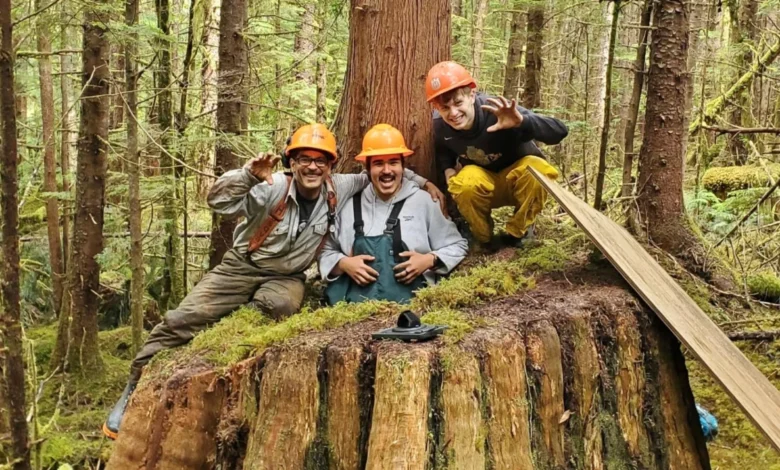
Elijah Washington navigates the dense, sodden undergrowth of Haida Gwaii, his boots sinking into the mossy forest floor that bears the scars of decades of industrial logging. He pauses beside a massive western red cedar stump, a remnant of an era when old-growth harvesting defined the economic trajectory of this British Columbia archipelago. To the casual observer, it is merely a decaying relic of a lost forest. To Washington, a stewardship technician with the Council of the Haida Nation, it is a foundation for survival. Using chainsaws, plywood, and weather-resistant roofing, Washington and his crew have transformed these hollowed-out stumps into artificial dens, a last-resort intervention for the coastal black bear, known in the Haida language as taan.
The coastal black bear is a unique subspecies, recognized as one of the largest in North America. For centuries, these animals have relied on the natural cavities of ancient, old-growth western red cedars to weather the harsh coastal winters. However, decades of intensive clear-cutting have decimated the primary habitat required for hibernation and, crucially, for birthing and nursing cubs. As the old-growth disappears, the secondary forests that follow—often younger, smaller, and lacking the structural complexity of their predecessors—cannot provide the hollows these bears need to survive.
A Chronology of Ecological Decline and Response
The crisis facing the taan is deeply tied to the history of forestry in the region. During the late 20th century, the industrial logging boom on Haida Gwaii prioritized the extraction of high-value timber, leaving behind fragmented landscapes. Wildlife biologist Helen Davis, who has spent over three decades studying these animals, notes that the loss of old-growth was not immediately identified as a crisis. In the 1990s, when Davis began tracking radio-collared bears to approximately 65 specific den sites, her research confirmed a near-total dependence on massive, hollow old-growth trees.
At the time, the prevailing assumption was that old-growth reserves would remain sufficient. That assumption proved fatal for the bears as logging continued to encroach on critical areas. By 2019, the situation had reached a tipping point, prompting Taan Forest—the Haida-owned forestry company—to partner with Davis. The goal was to pivot from mere resource extraction to active ecosystem stewardship. The program began with identifying natural dens and has since expanded into the current, more aggressive strategy of manual den construction. In the summer of 2026, the Council of the Haida Nation intensified this effort, retrofitting seven stumps, with plans to reach a total of ten by the end of October.

The Science of Survival: Anatomy of an Artificial Den
The engineering of an artificial den is a process of "Goldilocks" precision. The entrance must be small enough to deter larger predators or unwanted intruders but large enough for a mother bear to safely maneuver her cubs into the chamber. The internal space must be dry and insulated, mimicking the natural rot-hollows created by centuries of fungal activity in living cedars.
The crew employs a specific protocol: scouting suitable stumps, modifying the hollows with chainsaws, and capping them with moisture-resistant materials. To increase the likelihood of occupancy, they have begun incorporating biological cues, such as hair samples collected from deceased bears, to provide a scent profile that signals to other bears that the location is a secure, established site.
This work is not merely about providing a roof; it is about population sustainability. Black bear cubs are born in the dead of winter, often weighing only about one pound. They are vulnerable, blind, and entirely dependent on the micro-climate provided by a secure den for up to 100 days. Without these structures, neonatal mortality rates are projected to rise, potentially destabilizing the subspecies’ presence on the islands.
Official Responses and the Industrial Dilemma
The provincial government of British Columbia remains caught between competing interests. While Minister of Forests Ravi Parmar has signaled that total cessation of old-growth harvesting would fundamentally disrupt the regional forestry sector, Indigenous nations and conservationists argue that the current pace of extraction is ecologically untenable.
"People would just sort of throw that out somewhat frequently and since nobody seems to want to conserve old growth for them, I was like, ‘Well, fine, then let’s see if we can build them,’" Davis explained, highlighting the frustration of working within a system that prioritizes timber over biodiversity.

Taan Forest’s Chief Forester, Jeff Mosher, asserts that protecting the bears is a core mandate, even at the cost of lower corporate dividends. This perspective contrasts with larger industrial players in the region who have faced criticism for discovering active dens only after cutting into them, occasionally resulting in the death of hibernating bears.
Broader Implications: A Model or a Crutch?
The initiative has sparked a nuanced debate among the Haida community. Lisa White, a councillor with the Old Massett Village Council, expressed deep emotional distress upon seeing the artificial structures. For White, the necessity of building dens for bears is a symbol of how profoundly the land has been broken. "I actually cried," she admitted, reflecting on the historical relationship between the Haida and the forest—a relationship where individual trees were harvested for canoes or housing without destroying the entire ecosystem.
Furthermore, there is a legitimate fear that these artificial dens might be used as a political justification to continue logging. If technology can "solve" the problem of lost habitat, some policymakers might feel emboldened to allow further encroachment into remaining old-growth stands.
Wildlife experts also warn that a den is only one component of a bear’s life cycle. Noel Bellis, a carver and Haida member, points out that the "mossy lawns" of second-growth forests offer little in the way of the forage bears need in the spring, such as horsetail, salmonberry shoots, and fireweed. Deer populations in these areas have often overgrazed the understory, leaving a nutritional void for bears emerging from hibernation. Taan Forest has begun addressing this by opening gaps in the canopy to encourage shrub growth, but the long-term viability of these efforts remains to be seen.
Monitoring and the Path Forward
The success of the 2026 program will be measured through rigorous, non-invasive monitoring. Motion-activated cameras have been installed at the den sites to track usage, with researchers deliberately avoiding the areas from October through April to prevent disturbance. DNA analysis of hair caught at the entrances will provide a longitudinal look at whether the same individuals return or if the dens serve as a transient resource.

For the Haida, this is not just an ecological experiment; it is a cultural imperative. Elder Barney Edgars recalls the traditional teachings of his youth, emphasizing that the bears are "kin" with whom the Haida share the landscape. The loss of traditional bear-human boundaries—as animals are forced out of their natural shelters and into human-occupied zones to forage—represents a breakdown of a long-standing, respectful co-existence.
The Haida approach, while revolutionary, is ultimately a palliative measure for a landscape in recovery. While these modified stumps provide a critical safety net, they cannot replicate the ecological complexity of a living, ancient forest. As the Haida look toward the future, the primary goal remains to secure the long-term health of the bears, acknowledging that while they can build a home for a bear, they cannot build the forest itself. The program serves as a poignant reminder that human innovation, no matter how sophisticated, remains a secondary substitute for the natural systems that have been sacrificed to the saw. Whether this initiative becomes a blueprint for global conservation or a cautionary tale about the limits of restoration remains the defining question for the forests of Haida Gwaii.
Related posts: