Netflix Integrates Artificial Intelligence Into Three Hundred Titles As Industry Leaders Debate The Future Of Creative Production

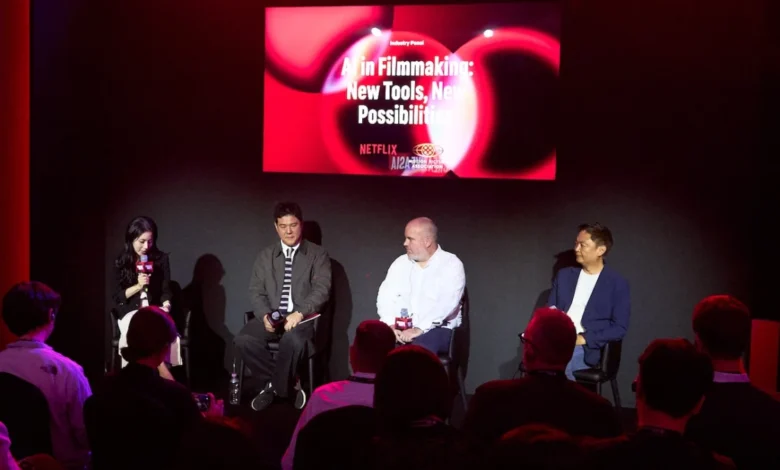
Netflix has confirmed that it has utilized artificial intelligence across approximately 300 of its titles, marking a significant milestone in the integration of machine learning within the global streaming giant’s production pipeline. This disclosure came to light during the annual Creative Asia event, held in partnership with the Busan International Film Festival, where executives and filmmakers gathered to discuss the intersection of cutting-edge technology and traditional cinematic storytelling.
Sung Q Lee, Netflix’s senior director of production for the Asia-Pacific region, emphasized that while the company is aggressively exploring the utility of AI, the objective remains strictly tethered to augmenting human ingenuity rather than replacing it. The revelation that 300 projects have already employed these tools underscores a rapid shift in industry standards, moving AI from the fringes of experimental VFX work to a core component of previsualization, set design, and post-production workflows.
The Evolving Landscape of Digital Production
The inclusion of AI at Netflix is not a sudden pivot but rather a continuation of the platform’s long-standing reliance on data-driven decision-making. Since its inception, Netflix has utilized algorithms to optimize recommendation engines and, more recently, to streamline the physical production process.
According to Lee, the implementation of AI tools is multifaceted. In the pre-production phase, filmmakers use generative software to build detailed visualization boards and set-dressing concepts, which allows creative teams to iterate on visual ideas with unprecedented speed. During production, these tools assist in complex VFX tasks, reducing the time-intensive labor traditionally required to render high-fidelity environments. However, Lee cautioned against the "how much" fallacy, noting that the focus should not be on maximizing AI usage but on how the technology can unlock creative possibilities that were previously unattainable.
Chronology of AI Integration in Filmmaking
The rapid adoption of AI in the film industry can be mapped over the last half-decade:
- 2019-2020: The industry begins experimenting with AI-driven de-aging technology and frame interpolation in major studio features.
- 2021-2022: The emergence of generative adversarial networks (GANs) and early diffusion models sparks interest in using AI for rapid storyboarding and concept art.
- 2023: The release of high-profile "AI-assisted" films, such as Korea’s Run to the West, triggers intense debate regarding the aesthetic quality and ethical implications of machine-generated imagery.
- 2024: Netflix and other major studios formalize "assistive AI" guidelines, focusing on cost-efficiency and workflow optimization as the technology matures into a standard production tool.
Case Study: The Promise and Pitfalls of AI
The panel at the Busan International Film Festival provided a platform for Korean director Kang Yun-sung to share his firsthand experience with the technology. Kang, known for directing the hit The Outlaws, has become a vocal proponent of AI, despite the commercial struggles of his recent project, Run to the West. Co-directed with AI filmmaker Kwon Han-seul, the project was billed as Korea’s first fully AI-assisted feature.
The film, which grossed approximately $100,000 at the box office, suffered from public backlash regarding its visual quality. Kang noted that the rapid pace of technological advancement meant that the software used during the film’s production was already outdated by the time it reached theaters. Despite this, Kang remains undeterred, citing the project as a vital learning experience.
He is currently working on an action feature titled The Gulf of Aden, which utilizes generative AI tools developed by the Chinese firm Kling AI. Kang estimates that these tools have reduced his production budget by approximately 40 percent. This reduction is not merely a result of replacing traditional VFX, but of a fundamental streamlining of the entire production schedule. By identifying visual errors early and automating repetitive tasks, the team has been able to bring scenes to the screen that would have otherwise been sidelined due to financial constraints.
The Global Divide: Hollywood vs. Asia
One of the most striking takeaways from the Busan discussion was the divergence in sentiment between Western and Asian creative communities. While the Hollywood creative sector, represented by guilds and unions, has often viewed AI with profound skepticism—fearing the devaluation of human labor and intellectual property rights—the Asian content sector appears to view it primarily as a bridge for growth.
For many filmmakers in Asia, particularly those working with limited domestic budgets, AI represents a "great equalizer." It allows independent directors to compete with the high-gloss production values of Western studios, providing the tools to realize grand cinematic visions on a fraction of the budget. This optimism is balanced by a shared, universal insistence on the necessity of the "human touch."
The Role of Assistive Technology
Kimball Thurston, chief technology officer at Wētā FX, reinforced the concept of "assistive AI." During the panel, Thurston argued that the technology should never be allowed to dictate creative intent. At Wētā FX, the integration of AI is focused on providing directors and cinematographers with rapid visual feedback.
"Our goal is to reduce simple, repetitive tasks," Thurston stated. "It provides us with the visual images and visualization [so] it’s very easy to identify the errors and correct them." By offloading the technical burden of identifying frame-by-frame inconsistencies or lighting mismatches, the AI allows the human creative team to spend more time on high-level narrative and emotional resonance.
Economic and Ethical Implications
The financial implications for the film industry are profound. If a 40 percent reduction in production costs—as cited by Kang—becomes the industry standard, it could lead to a massive influx of content, lower barriers to entry for emerging filmmakers, and a shift in how production budgets are allocated.
However, this transition brings significant ethical questions. Industry analysts point to several areas of concern:
- Labor Displacement: While the current narrative focuses on "assistive" tools, the potential for AI to eventually perform more complex tasks threatens entry-level positions in VFX and post-production houses.
- Intellectual Property: The datasets used to train these models often include copyrighted materials, leading to ongoing legal battles that may eventually restrict how studios utilize these tools.
- Creative Homogenization: There is a persistent fear that if AI tools become standardized, films may begin to share a "look" or a structural predictability, diminishing the distinct voices that define cinema.
The Future of "The Why"
Despite the technical focus of the discussion, the consensus among the panelists was that technology, no matter how sophisticated, remains a tool rather than a creator. Sung Q Lee’s commentary on the "why" of filmmaking served as the anchor for the discussion. He argued that while AI can master the "how"—the mechanics of lighting, color grading, and structural editing—it lacks the capacity to determine the "why"—the underlying motivation for a story.
"When it comes to conveying emotion, ultimately, a human has to touch it," Lee said. "AI can get many jobs done, but does it touch human emotion? The human touch is critical and necessary."
As Netflix continues to scale its use of AI across its massive library, the company faces the challenge of balancing its reliance on algorithmic efficiency with the public’s expectation for authentic, human-driven storytelling. The 300 titles already utilizing these tools represent the first wave of a permanent shift in cinematic production. Whether this transition will result in a renaissance of independent filmmaking or a move toward a more automated, mass-produced content model remains a subject of intense scrutiny by critics, creators, and audiences alike.
For now, the industry remains in a delicate holding pattern, testing the limits of what machines can do while fiercely guarding the final cut—the point where human judgment is expected to reign supreme. As the technology continues to evolve, the distinction between human artistry and machine assistance will likely become increasingly blurred, necessitating new industry standards and ethical frameworks to ensure that the "human touch" remains at the heart of global storytelling.