Engineer builds his own four-seater plane from a kit in his garden during the Covid-19 pandemic

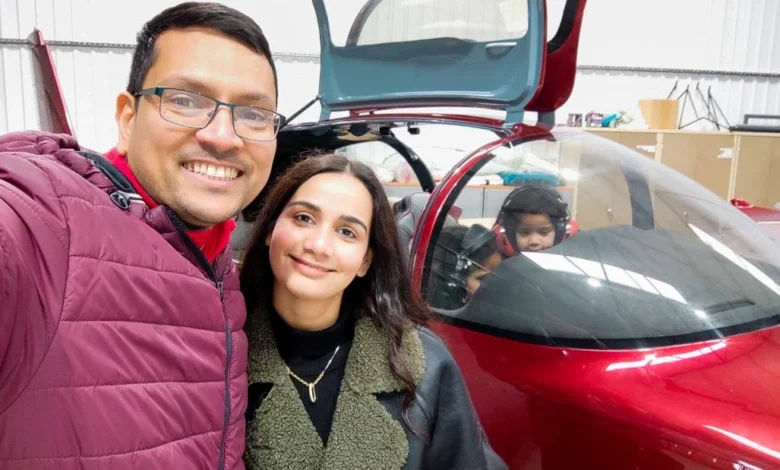
The story of Ashok Aliseril Thamarakshan is one that blends the precision of mechanical engineering with the audacity of a personal dream. A resident of Essex, England, Thamarakshan spent 18 months of the global pandemic transforming a collection of metal parts into a functional, four-seater Sling TSi aircraft. His project, which began as a solution to the lack of suitable family-sized aircraft for hire, has evolved into a testament to the viability of home-built aviation, inspiring a new conversation about how amateur enthusiasts can navigate the skies.
The Spark of Aviation
Thamarakshan’s journey toward the clouds began more than a decade ago. Initially, his interest in aviation was casual, fueled by his proximity to a local UK airfield. However, the turning point arrived when his wife, Abhilasha, gifted him a 30-minute flight experience for his birthday. The brief excursion to the Isle of Wight served as a catalyst, revealing to him the immense freedom that private flight offers.
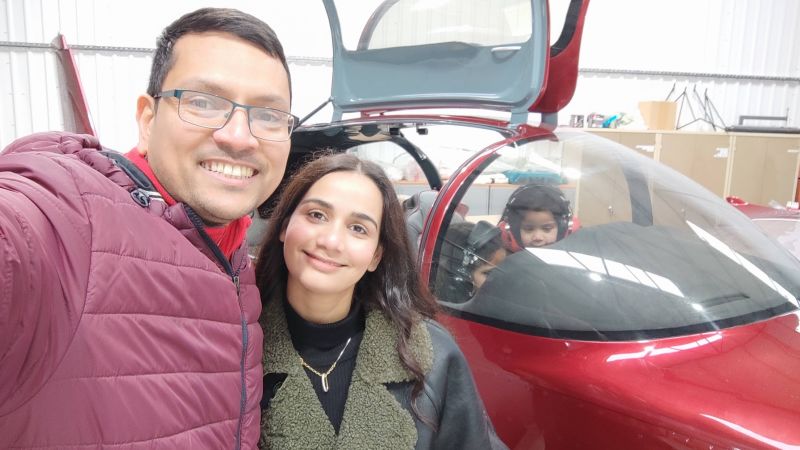
By 2019, Thamarakshan had earned his private pilot’s license. As his family grew—the couple now has two daughters—he found that the traditional two-seater aircraft available for private rental were insufficient for family outings. While he briefly considered purchasing a vintage aircraft from the 1960s or 70s, he grew concerned about the reliability and maintenance requirements of aging machines. This hesitation led him to a bold alternative: building his own.
The Path to Construction: A Pandemic Project
In January 2020, just before the full weight of the Covid-19 pandemic caused global travel to grind to a halt, Thamarakshan traveled to the Sling Aircraft factory in Johannesburg, South Africa. After test-flying the Sling TSi, he was convinced of its capability and safety. Upon returning to the UK, he ordered the kit. By the time the components arrived, the United Kingdom had entered a strict lockdown.
The isolation of the pandemic, which prevented professional colleagues from assisting him as originally planned, turned the project into a singular focus. Thamarakshan erected a specialized shed in his back garden, creating a makeshift hangar. This space became the epicenter of his engineering endeavor. Under the rigorous oversight of the Light Aircraft Association (LAA) and the UK Civil Aviation Authority (CAA), he began the assembly process in April 2020.
The project was not merely a construction task; it was a process of meticulous documentation and inspection. The LAA conducted approximately 12 formal inspections throughout the build to ensure that each stage met safety standards. From the assembly of the tail and wings in the summer of 2020 to the final fuselage integration, the project required a blend of technical expertise and patient craftsmanship.
Chronology of the Build
- January 2020: Thamarakshan visits the Sling Aircraft factory in South Africa to test the TSi.
- April 2020: Construction begins in a custom-built garden shed in Essex, following the arrival of the kit and initial CAA/LAA oversight.
- Summer 2020: Tail and wing sections are successfully assembled.
- October 2020: Construction of the fuselage commences.
- Late 2021: Components are transported to a hangar near Cambridge for final assembly and engine installation.
- January 2022: The aircraft, registered as G-Diya in honor of his youngest daughter, undergoes its maiden flight.
- May 2022: The aircraft receives its formal Permit to Fly from the CAA.
- 2023: A dedicated hangar is completed at an Essex airfield to house the aircraft.
Technical Specifications and Economic Reality
The Sling TSi is a high-performance, four-seat aircraft designed for efficiency. For the average enthusiast, the costs associated with aviation are often prohibitive. Thamarakshan navigated this by acknowledging the financial reality of the hobby. The initial kit cost approximately £80,000, but when factoring in avionics, the high-performance Rotax engine, propeller, and other essential supplies, the total investment climbed to around £180,000.

To mitigate the financial burden, Thamarakshan implemented a shared-ownership model. By partnering with three other pilots, the cost of ownership was effectively divided, rendering it comparable to the expense of a luxury SUV. Furthermore, the aircraft’s fuel efficiency is notable; it consumes roughly 20 liters of unleaded fuel per hour, making the cost of operation competitive with long-distance road travel.
The Psychological Leap: From Project to Aircraft
There is a distinct psychological threshold in the home-built aircraft community: the transition from "project" to "aircraft." For Thamarakshan, that moment occurred during the maiden flight in January 2022. Watching a test pilot take the machine he spent 18 months building into the air was, as he describes, a moment of profound relief.
The experience of that first flight highlighted the difference between engineering theory and flight practice. When Thamarakshan later took the controls himself, accompanied by an experienced test pilot, he was struck by the aircraft’s handling. "He was throwing the aircraft about as if it was a racing car," Thamarakshan remarked, noting that the test pilot’s aggressive maneuvers served to confirm the structural integrity of his own handiwork.
Broader Implications and Future Outlook
The success of G-Diya has broader implications for the future of private aviation. Thamarakshan’s experience suggests that with the right support from regulatory bodies like the CAA and the LAA, complex engineering tasks are accessible to those with a hands-on approach and a commitment to safety.

By documenting his journey via the Instagram account fly_home_or_away, Thamarakshan has provided a roadmap for others interested in the LAA’s "Permit to Fly" process. His story challenges the notion that private aviation is an exclusive domain for the ultra-wealthy. Instead, it positions aviation as a communal, accessible pursuit where shared ownership and amateur construction can democratize access to the skies.
Since receiving its permit in May 2022, G-Diya has logged over 300 flight hours. The family has utilized the plane for numerous trips, ranging from quick visits to the Isle of Wight to international journeys, including an excursion to Bergerac, France, and flights as far north as Norway. These trips are not merely recreational; they serve as a practical demonstration of the aircraft’s reliability and range.
As of 2024, Thamarakshan continues to advocate for the benefits of home-built aviation. He emphasizes that the friendships formed through shared hangar space and pilot networks provide a safety net and a knowledge base that sustains the community. For those considering a similar path, his advice remains consistent: the "Ikea-style" instructions provided by modern kit manufacturers, combined with local aviation oversight, make the dream of flight a tangible reality for the dedicated amateur.
In a world where travel is often restricted to commercial corridors, the ability to maintain and fly one’s own craft represents a unique form of autonomy. Whether it is the efficiency of the Rotax engine or the simple joy of flying the family to a beach for the afternoon, Thamarakshan’s endeavor stands as a successful experiment in personal aviation, proving that even in a garden shed, one can engineer a path to the horizon.