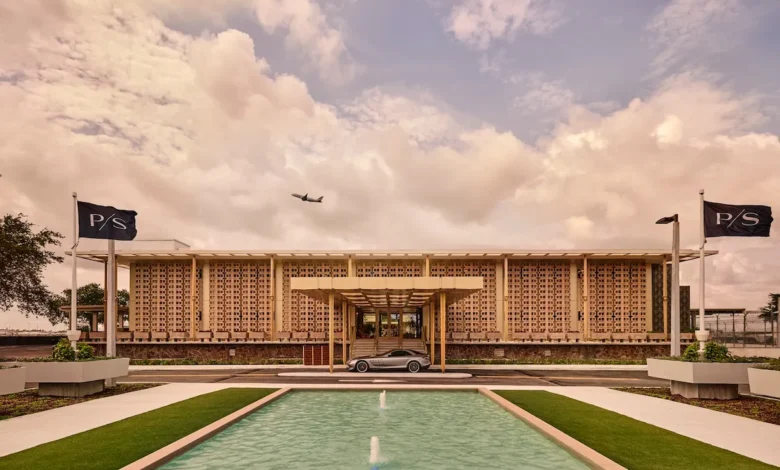
Entering the private confines of the PS terminal at Los Angeles International Airport offers a striking contrast to the typical chaos of modern commercial aviation. A traveler signs in, and a dedicated attendant immediately offers a familiar beverage, recalling preferences from a previous visit—a level of personalized recall that eludes many luxury hotels and exclusive members-only clubs. This hyper-attentive service model forms the core of PS, a brand that has carved out a lucrative and highly specialized niche by catering to ultra-high-net-worth individuals, celebrities, diplomats, and corporate executives who view time as their most valuable asset.
Operating in the complex intersection of aviation security, real estate development, and elite hospitality, PS has redefined what it means to travel commercially. To understand the mechanics and mindset behind this burgeoning sector, an examination of the company’s leadership provides critical insight. Amina Belouizdad Porter, the chief executive officer of PS, brings a dual perspective to the enterprise. With a professional background spanning private equity and hotel development, Porter approaches the business with the cold, calculated discipline of an institutional investor balanced by the nuanced, people-first affection of a seasoned hospitality operator.
Disrupting the Commercial Airport Experience
Founded in 2017 under the original moniker The Private Suite at LAX, the concept was simple yet radical: allow commercial airline passengers to bypass the public terminal entirely. Rather than navigating crowded check-in counters, noisy departure halls, and congested security lines, PS members are whisked away from the public eye into a private enclave. Here, departing guests clear a dedicated, private TSA security screening checkpoint in a matter of seconds, avoiding the public queues altogether. Arriving international passengers enjoy an equally seamless transition, clearing customs and immigration directly on-site within the private facility.
Once inside the terminal, guests wait for their flights in luxurious private salons or open social lounges equipped with high-end amenities, ranging from fully stocked bars and gourmet dining to spa-grade bathrooms, daybeds, and private outdoor yard spaces. When it is time for departure, guests are driven directly across the tarmac in a luxury BMW sedan, stepping straight from the vehicle into the aircraft cabin via the jet bridge or stairs, entirely out of view of fellow passengers.
The operational hurdles of running such a facility are immense. PS must coordinate closely with federal agencies, including the Transportation Security Administration (TSA) and Customs and Border Protection (CBP), as well as local airport authorities, airlines, and ground handlers. Maintaining absolute security compliance while delivering five-star luxury requires meticulous operational precision, making expansion a deliberately measured process rather than a rapid land grab.
Strategic Expansion and Growth Timeline
For the first several years of its existence, the brand operated solely out of its flagship location at Los Angeles International Airport. The model proved not only viable but exceptionally resilient, even weathering the unprecedented disruptions of the global COVID-19 pandemic as affluent travelers sought out isolated, private spaces to minimize health risks.
Following years of refinement at LAX, the company embarked on a calculated multi-city expansion strategy. In 2023, PS officially opened its second location at Hartsfield-Jackson Atlanta International Airport, tapping into one of the world’s busiest aviation hubs and proving that the concept could succeed outside of the entertainment-heavy Los Angeles market.
The growth trajectory accelerated significantly in the summer of 2026, when PS effectively doubled its operational footprint in a single season. The launch of new terminals at Dallas-Fort Worth International Airport (DFW) and Miami International Airport (MIA) marked a major milestone for the company. These additions placed PS in critical southern and central aviation gateways, capturing high-volume domestic and international traffic flowing between the Americas, Europe, and beyond. Additional development pipelines point toward future locations in major metropolitan areas, reflecting sustained investor confidence in the private terminal asset class.
The Business Case and Market Demographics
The financial model underpinning PS relies on a tiered membership structure alongside per-use fees. Membership typically requires an annual financial commitment, which grants access to reserve the terminal spaces, with individual use fees billed separately per visit. For executives whose hourly value far exceeds the cost of admission, or for public figures requiring absolute discretion and security, the expense is easily justified.
Industry data highlights a broader structural shift in consumer spending habits. While the post-pandemic travel boom saw massive surges in economy and premium-economy bookings, the ultra-luxury segment has experienced permanent structural growth. Travelers who can afford it are increasingly willing to pay significant premiums to eliminate friction points in their journeys. Airports are massive economic engines, and the ability to carve out private real estate on airfield perimeters represents a highly lucrative public-private partnership model for airport authorities seeking non-aeronautical revenue streams.
Real estate analysts note that operating within secure airport perimeters (the airside) presents unique regulatory and construction barriers that naturally insulate established players like PS from quick-imitation competitors. Securing long-term leases, federal regulatory approvals, and ramp access requires deep institutional capital and sophisticated stakeholder management.
Leadership Perspective and Operational Philosophy
Under Amina Belouizdad Porter’s leadership, the corporate strategy marries private equity rigor with hospitality-driven empathy. In interviews and industry panels, Porter has emphasized that scaling a luxury brand requires protecting the intimacy of the guest experience at all costs. As the company expands from a single-city novelty into a national network, maintaining the hyper-personalized recall—such as remembering a guest’s favorite beverage or seating preference across different cities—becomes both the primary challenge and the ultimate competitive moat.
The integration of technology plays a quiet yet vital role in this operational choreography. Behind the scenes, customer relationship management systems track preferences, dietary restrictions, and travel patterns across the network, ensuring that a member departing from Miami receives the same bespoke attention they would experience in Los Angeles, Atlanta, or Dallas.
Broader Industry Implications and Future Outlook
The success of PS is altering how major airports approach terminal design and ancillary service offerings. Airport operators globally are taking note of the revenue potential generated by private terminal concepts, leading to increased interest in dedicating marginal land near runways to private aviation and VIP commercial processing facilities.
Furthermore, commercial airlines are watching closely. While PS operates independently of the major carriers, the presence of private terminals enhances the value proposition for first-class and business-class travelers flying out of supported airports. Airlines frequently partner implicitly by facilitating seamless tarmac transfers for high-value frequent flyers who utilize the private infrastructure.
As PS continues to mature past its initial expansion phase into Dallas and Miami, the company stands as a case study in modern niche luxury operations. By transforming the most stressful aspects of air travel into an invisible, effortless background process, PS has successfully institutionalized a new standard of elite mobility. Whether the brand can successfully scale internationally while preserving the granular, highly personalized touch that defines its reputation will be the defining test of its next chapter.
Related posts: