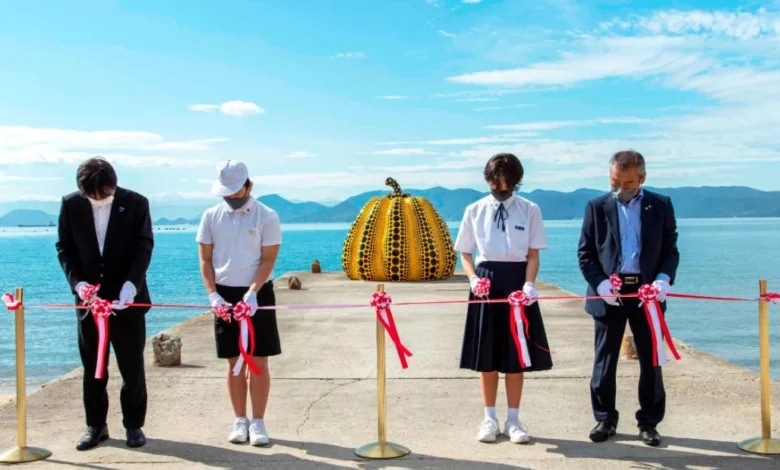
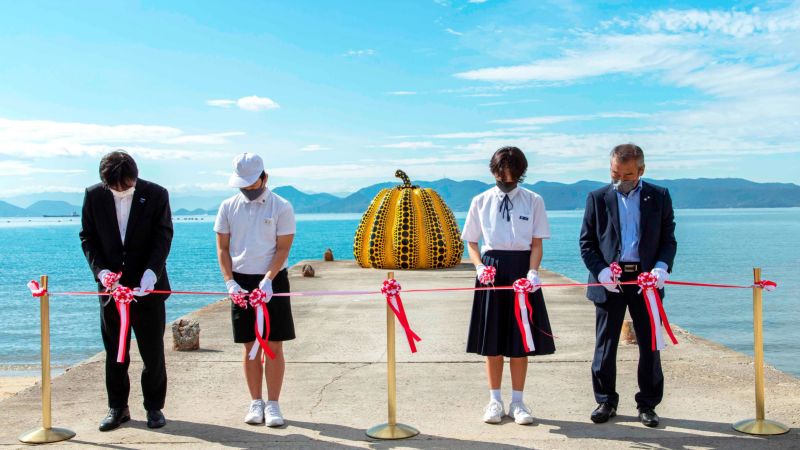
The tranquil shores of Naoshima, Japan’s famed “art island,” have regained their most recognizable landmark. On October 4, 2022, the iconic yellow pumpkin sculpture by world-renowned artist Yayoi Kusama was officially reinstalled on its historic pier, marking the end of a year-long absence that began when a powerful typhoon swept the beloved work into the Seto Inland Sea. The return of the sculpture serves as a poignant restoration of the island’s visual identity, providing a sense of closure for the local community and the global art world alike.
The reinstallation ceremony was attended by local residents, students, and government officials, all of whom gathered at the pier to witness the return of a piece that has been synonymous with Naoshima since its original debut in 1994. Managed by Benesse Holdings, the sculpture has long acted as the gateway for visitors arriving at the island, serving as a beacon of the contemporary art movement that transformed this quiet, rural fishing community into a world-class cultural destination.
A Timeline of Destruction and Resilience
The saga of the pumpkin began in August 2021, when a severe typhoon struck the Setouchi region. The storm’s high-velocity winds and surging sea levels proved too much for the fiberglass-reinforced plastic structure. Despite being securely anchored, the two-meter-tall, 2.5-meter-wide sculpture was dislodged from its concrete plinth and dragged into the ocean. The impact with the water and the surrounding rocks caused the piece to break into three distinct sections.
Following the incident, the recovery effort was swift but delicate. Benesse Holdings officials coordinated with local maritime workers to retrieve the shattered remains from the sea, ensuring that the artist’s original work was preserved for evaluation. Once recovered, the fragments were transported to a secure facility where experts, in close consultation with Kusama’s own production team, conducted a thorough forensic assessment of the damage.
The consensus was that the original structure had been too severely compromised to permit a simple repair. Instead, the decision was made to fabricate an entirely new sculpture. This process was not merely a replacement but an act of artistic evolution. The production team, working through the spring and summer of 2022, sought to recreate the visual essence of the 1994 original while incorporating modern engineering advancements to ensure its longevity against the increasingly volatile weather patterns seen in the region.
Engineering for the Future
The new iteration of the yellow pumpkin features an outer shell that is 10% thicker than its predecessor. This design change, while subtle to the casual observer, significantly enhances the structural integrity of the fiberglass-reinforced plastic, allowing it to better withstand the intense wind and wave pressure characteristic of the Seto Inland Sea.
Perhaps the most important modification is a functional one: a permanent hook has been embedded into the sculpture’s stem. This feature is intended to allow for rapid, controlled removal of the piece should weather alerts indicate the approach of another major typhoon. This integration of disaster-preparedness technology into fine art reflects the unique challenges faced by outdoor installations in coastal Japan.
Yukari Stenlund, a spokesperson for Benesse Holdings, emphasized the significance of the return during the unveiling. "Since the pumpkin was a symbol of Naoshima, it is great to see the same artwork installed again at the same spot. We are happy to share the joy with residents in Naoshima," she noted. According to the organization, the goal was to honor the original "Out of Bounds" exhibition, which first brought the sculpture to the island, while simultaneously reinforcing the bond between the island’s landscape and the global art community.
Naoshima: The Evolution of an Art Island
Naoshima is a small, historically sleepy island with a population of approximately 3,200 residents. Located in the Setouchi Sea, north of the island of Shikoku, it was once a quiet enclave known primarily for its fishing industry. The transformation into an "art island" began in the late 1980s and early 1990s through the efforts of the Benesse Corporation, which sought to revitalize the region by integrating high-concept contemporary art into the natural landscape.
The island now boasts three major modern and contemporary art museums—the Chichu Art Museum, the Benesse House Museum, and the Lee Ufan Museum—along with the "Art House Project," which converts abandoned traditional houses into immersive art installations. This synergy between the local environment and global contemporary art has made Naoshima a pilgrimage site for art lovers worldwide.
The yellow pumpkin has, over the decades, become the most photographed element of this landscape. Its vibrant, polka-dotted yellow skin provides a striking, whimsical contrast to the deep blues of the Seto Inland Sea. Its presence on the pier acts as a point of arrival, signaling to visitors that they have entered a space where the boundaries between nature, architecture, and art are intentionally blurred.
Economic and Cultural Implications
The timing of the sculpture’s return is particularly significant from a logistical and economic standpoint. In October 2022, Japan began easing its strict border controls, which had been in place for over two years due to the COVID-19 pandemic. The reopening to international leisure travelers on October 11, 2022, coincided almost perfectly with the return of the pumpkin.
Furthermore, the Setouchi Art Festival, one of the most prominent contemporary art events in Asia, was in full swing during the autumn of 2022. The return of the pumpkin ensured that international visitors arriving on the island would be greeted by the iconic sight, providing a much-needed boost to the local tourism economy, which had suffered from both the pandemic-induced border closures and the physical loss of its most famous attraction.

The island’s accessibility remains a factor in its popularity. Most visitors reach Naoshima via a 20-minute ferry ride from Okayama City. Okayama itself is a major hub, located just 50 minutes from Osaka via the Shinkansen (bullet train). This infrastructure allows the island to host a significant number of day-trippers while maintaining the quiet, contemplative atmosphere that is core to the "Art Island" experience.
A Broader Reflection on Public Art
The incident with the pumpkin has sparked a broader conversation regarding the risks and responsibilities inherent in public art. As climate change increases the frequency and intensity of extreme weather events, the curators and stewards of outdoor installations are faced with new challenges. The "Naoshima model"—whereby art is not just placed in a landscape but is actively protected and managed with an eye toward both preservation and environmental realities—is becoming an industry standard.
Experts in museum management have praised the decision to not merely restore the old sculpture, but to rebuild it with enhanced durability. By doing so, the stakeholders have ensured that the artwork remains a living, evolving part of the island’s history rather than a relic of the past.
For the residents of Naoshima, the return of the sculpture is more than just a restoration of tourism revenue; it is a restoration of a sense of place. When the pumpkin was swept away, many felt as though a vital component of the island’s identity had been severed. Its return signifies that the island has successfully weathered the storm—both literally and metaphorically.
As the global art community looks toward the future, the yellow pumpkin on Naoshima stands as a testament to the resilience of human creativity. It serves as a reminder that while natural disasters may destroy physical objects, the underlying cultural and emotional connections those objects represent are often strong enough to facilitate their return. The "art island" continues to flourish, with the bright yellow beacon once again welcoming travelers to its shores, ready to inspire the next generation of visitors who seek to find meaning at the intersection of nature and human expression.