Supreme Court Blocks Trump Administration Attempt to Impose New Mail-In Voting Restrictions for Midterm Elections

The Supreme Court of the United States issued a significant ruling this week that effectively maintains the status quo for the upcoming November midterm elections by rejecting the Trump administration’s attempt to impose sweeping new regulations on mail-in ballot procedures. In an unsigned order issued on Monday, the court’s majority determined that the administration’s legal challenge was unlikely to succeed on its merits, thereby upholding the injunctions previously issued by two separate federal judges. This decision serves as a critical reprieve for state and local election administrators, who had argued that the proposed federal requirements would have been logistically impossible to implement before the fast-approaching election cycle.
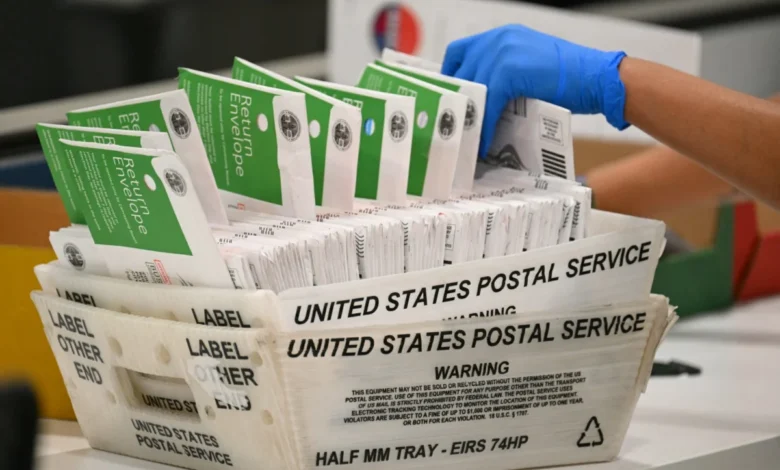
The legal standoff originated in March when President Donald Trump issued an executive order mandating that the United States Postal Service (USPS) establish strict new criteria for the distribution and handling of mail-in ballots. Under the proposed directive, the Postal Service would have been empowered to refuse the delivery of ballots from any state that failed to adhere to specific, newly codified design and processing standards. By August, the USPS had finalized these rules, which required that all ballot envelopes feature an official election mail logo and a unique bar code corresponding to a centralized database of eligible voters. The administration argued these measures were necessary for security, but the resulting judicial challenge focused on the feasibility and potential for voter disenfranchisement.
A Chronology of the Regulatory Dispute
The trajectory of this conflict spans several months of intense debate between federal oversight agencies and state election officials. In early spring, the executive order set the wheels in motion, tasking the USPS with building a secure portal for states to upload voter registration data. By mid-summer, while the portal remained under development, states raised alarms about the technical and administrative hurdles the mandate created.
By August, the situation escalated when the USPS finalized the rule, necessitating immediate changes to ballot printing and administrative workflows. On August 31, a whistleblower within the Postal Service filed a disclosure with Senator Richard Blumenthal, characterizing the implementation process as "secretive, rushed, chaotic, and fundamentally flawed." This internal dissent bolstered the arguments of state officials who, on September 3, filed a bipartisan court brief signed by 99 current and former election authorities. They argued that complying with the new standards would require a complete overhaul of their ballot design and distribution chains in a matter of weeks, threatening to delay or disqualify ballots for millions of voters.
Following the lower court rulings that blocked the policy, the Trump administration appealed to the Supreme Court on September 6. The administration’s filing maintained that the regulations were merely "modest envelope-design and addressee-information requirements." However, the high court’s refusal to stay the lower court’s injunctions has effectively sidelined the rules for the November midterms. Justice Samuel Alito, joined by Justice Clarence Thomas, issued an eight-page dissent, arguing that the court should have permitted the rules to take effect. Conversely, in a concurring opinion, Justice Brett Kavanaugh acknowledged the time constraints faced by states, though he left the door open for the legality of such rules to be evaluated in future election cycles.
Supporting Data and the Landscape of Mail-In Voting
The controversy highlights a deepening divide over the mechanics of American democracy. According to data from the Brookings Institute, approximately one-third of all American voters now cast their ballots by mail. This shift has been gradual but steady, though the prevalence of the practice varies significantly by region. In states like Oregon and Washington, where all-mail elections are the standard, participation through the mail exceeds 95%. Conversely, in states such as Tennessee and West Virginia, the reliance on mail-in ballots remains below 3%, often due to more restrictive absentee voting laws.
The administrative burden of the proposed USPS rule would have fallen disproportionately on jurisdictions that rely heavily on mail-in voting as a primary method of election participation. Experts in election law, including Richard Hasen, director of the Safeguarding Democracy Project at UCLA, have noted that such mandates specifically risk disenfranchising the populations most reliant on these systems: the elderly, those with physical disabilities, and voters residing in rural or remote geographic locations where in-person polling access may be limited.
Despite the administration’s claims that universal mail-in voting is "highly susceptible to fraud," independent research consistently contradicts this narrative. Numerous studies, including analyses by the Brennan Center for Justice and various nonpartisan election oversight bodies, have concluded that documented cases of voter fraud involving mail-in ballots are statistically rare, occurring at rates often measured in the hundred-thousandths of a percent.
Official Responses and Political Implications
The Supreme Court’s decision prompted a swift reaction from the White House. President Trump took to Truth Social on Tuesday to express his dissatisfaction, characterizing the order as "a big loss for Republicans, and America itself." This rhetoric aligns with a long-standing pattern of criticism from the President regarding mail-in voting, which he has repeatedly labeled as "corrupt" or "cheating," despite his own history of utilizing absentee ballot systems in Florida elections.
In defense of the administration’s position, White House spokesperson Olivia Wales reiterated that the objective was to ensure "commonsense exceptions" for those who truly cannot reach a polling station. She maintained that the focus of the executive order was on maintaining the integrity of the franchise, though she stopped short of addressing the practical failures identified by the USPS internal audit.
The Postal Service, for its part, has maintained a stance of administrative neutrality. In the wake of the whistleblower’s report and the inspector general’s September audit, Postmaster General David Steiner issued a statement asserting that the agency’s standards for "quality, security, and system integrity were not compromised." While the agency acknowledged the need to "reinforce and amplify" internal procedures, it continues to insist that its primary goal is to ensure the reliable delivery of election mail.
Implications for the November Midterms
For the average voter, the immediate implication of the Supreme Court’s order is that election procedures will remain unchanged. There is no new federal mandate for envelope designs or bar-coded verification systems that must be met for this cycle. However, the legal uncertainty surrounding the case serves as a reminder of the complexity of the current electoral environment.
Barbara Smith Warner, a senior adviser for the Institute for Responsive Government, emphasized the reliability of local administration in the wake of the ruling. "State and local election administrators all across the country will continue to do what they always do, which is run safe, secure and transparent elections," she stated. "Everyone can and should be sure that they can vote in this election."
For voters planning to participate by mail, experts recommend a proactive approach to ensure their ballot is counted. The guidance remains consistent across nonpartisan advocacy groups:
- Verification: Confirm your registration status through official state portals.
- Planning: Request your ballot well in advance of the state’s specific deadline.
- Execution: Follow all instructions meticulously, ensuring the ballot is signed with a consistent, standard signature.
- Delivery: Due to the potential for shifting mail routes and processing times, election experts—including Tammy Patrick of the Election Center—recommend that voters mail their ballots at least one week before the deadline or, preferably, utilize secure drop boxes provided by local election offices.
Future Outlook on Election Administration
While the immediate threat of federal intervention in mail-in ballot design has been neutralized for the midterm elections, the underlying debate remains unresolved. The Supreme Court’s decision was narrow, focusing on the lack of time for implementation rather than a definitive ruling on the scope of the Postal Service’s authority to regulate election materials.
As the country looks toward the post-midterm landscape, the question of federal versus state control over election administration will likely persist. Efforts to gather voter data and conduct audits of voter eligibility, which have been a point of contention for months, suggest that the administration is continuing its push to exert greater federal oversight. Whether the USPS will attempt to reintroduce these or similar rules in future election cycles remains a matter of significant concern for voting rights advocates and state officials alike.
For now, the focus shifts back to the local level, where clerks, poll workers, and election boards are finalizing preparations for the November vote. The integrity of the process will continue to rest on the established, state-based systems that have managed election logistics for decades, supported by the bipartisan consensus that voter accessibility remains a cornerstone of the American electoral process.