Shifting Gears: How Georgia’s Clean Energy Economy Is Navigating Policy Whiplash and Market Realities

The sprawling assembly line at the Kia manufacturing plant in West Point, Georgia, operates less like a traditional mass-production facility and more like a high-stakes, custom-order kitchen. Down the line, a continuous stream of metal frames moves forward, each vehicle gradually receiving the unique components that transform a bare shell into a drivable automobile. Instead of churning out uniform batches of identical cars, the plant has been re-engineered to pivot fluidly between specifications—varying models, exterior colors, interior trims, and propulsion systems. Today, that means seamlessly transitioning between gas-powered engines, hybrids, and electric vehicles (EVs) on the exact same production track.
This operational agility represents the new normal for a state that spent years positioning itself as the undisputed capital of the American clean energy manufacturing boom. Under the aggressive economic development strategy spearheaded by Governor Brian Kemp, Georgia rolled out lucrative tax incentives, customized workforce training programs, and aggressive recruitment campaigns to attract some of the world’s largest electric vehicle, battery, and solar manufacturers. For a time, the strategy yielded unprecedented success, turning the Peach State into a magnet for multi-billion-dollar investments.
However, the past eighteen months have ushered in a period of severe turbulence. Dramatic shifts in federal policy, evolving consumer preferences, and compounding political and regulatory challenges have forced Georgia’s clean energy sector to weather a storm of policy whiplash. While the long-term transition toward vehicle electrification remains underway, manufacturers, battery developers, and state stakeholders are being forced to adapt their strategies to survive an increasingly uncertain economic landscape.
A Chronology of Boom and Regulatory Whiplash
To understand the current recalibration within Georgia’s automotive sector, it is necessary to examine the rapid trajectory of investment that preceded it. The state’s clean energy push gained early momentum when local bus manufacturer Blue Bird launched commercial sales of electric buses in 2018, eventually leading to the opening of an expanded, dedicated EV bus factory in 2023.
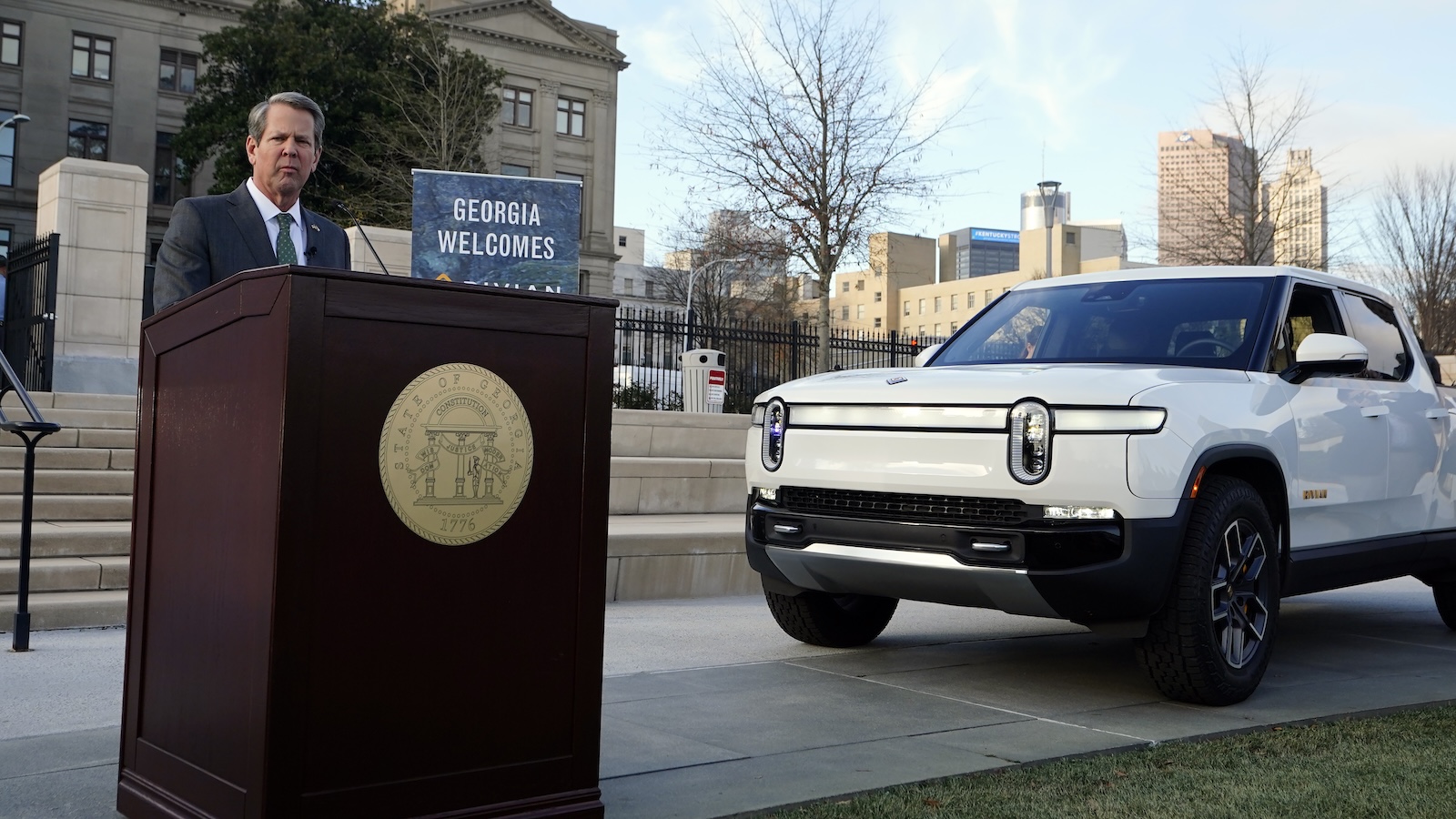
The momentum accelerated dramatically into the decade’s next major phase. In 2022, automotive giant Hyundai Motor Group announced plans to construct a massive, multi-billion-dollar Metaplant America near Savannah, designed explicitly as a dedicated EV manufacturing hub. By 2024, Kia officially began assembling electric vehicles at its established plant in West Point. Shortly thereafter, in 2025, electric truck manufacturer Rivian broke ground on its highly anticipated production facility east of Atlanta. Together, the Hyundai and Rivian endeavors stand as two of the largest economic development undertakings in modern Georgia history, accompanied by a wave of incoming battery makers, recycling facilities, and solar panel manufacturers.
This golden era of investment, heavily bolstered by the federal incentives of the Biden administration, hit a formidable wall with the transition to the second Trump administration. Federal policy adjustments abruptly destabilized the market outlook. The new administration moved swiftly to phase out consumer EV tax credits, impose steep tariffs on imported battery packs, charging hardware, and critical components, and systematically loosen emissions standards for internal combustion engine vehicles. Furthermore, the federal government officially rescinded prior mandates and funding pushes aimed at electrifying government vehicle fleets.
Compounding these regulatory hurdles were profound operational shocks. A high-profile federal immigration raid at a prominent Georgia EV battery plant resulted in the arrest of more than 400 workers, many of whom were South Korean specialists brought in to assist with facility ramp-ups and technological integration. For an industry reliant on intricate, international supply chains and specialized engineering, the event created immediate operational bottlenecks and labor anxieties.
Market Realities: The Pivot to Hybrids
Faced with vanishing federal tax credits, lingering consumer hesitations regarding vehicle pricing, and persistent gaps in public charging infrastructure, manufacturers have had to adjust their product lines to match immediate market demand.
"What we’ve seen is a transition back away from maybe full EV vehicle building to this kind of a middle-of-the-road opportunity," explained Stuart Countess, CEO of the Kia factory in West Point. While Countess maintains that electric vehicles represent the ultimate destination for the automotive industry, current consumer readiness falls short of earlier projections. "We had a tax incentive credit that did go away," Countess noted. "Sales were really moving in the right direction, but once it went away, it became a much different environment."
In response to this changing climate, Kia ramped up the production of hybrid models to capture buyers looking for fuel efficiency without the commitment of a pure battery-electric vehicle. Similarly, its sister company, Hyundai, revised its production strategy at the Savannah Metaplant, integrating hybrid powertrains alongside its initial EV offerings to buffer against market volatility.
Stephanie Valdez-Streaty, director of industry insights at Cox Automotive, describes the current environment as a transitional phase of trial and error for automakers. "It’s kind of a messy period we’re in right now," Valdez-Streaty said. "But I think the manufacturers are adjusting."
Broader Economic Impact and Investment Data
Despite the headwinds facing consumer EV adoption, the broader manufacturing ecosystem is finding alternative avenues for growth. Throughout Georgia, battery manufacturers that were initially built to supply automotive assembly lines are diversifying their operations. Many have begun retooling facilities to produce large-scale stationary storage batteries designed for electrical grid stabilization and renewable energy integration.
Stan Cross, electric vehicle program manager at the Southern Alliance for Clean Energy (SACE), emphasizes that the state’s economic health remains deeply tied to the sector. "The state continues to have a lot riding on the success of both the electric vehicle but also the battery market," Cross stated.
Data compiled by SACE illustrates the dual nature of the current landscape. While Georgia maintains its position as the regional leader in EV and battery manufacturing, growth has experienced notable stumbles, including high-profile layoffs at SK Battery operations earlier this year. Across the broader Southeastern region, more than $4 billion in clean energy and EV-related investments have been canceled, delayed, or scaled back over the past year.
However, industry analysts note that these contractions represent a fraction of the total capital committed to the region. SACE data reveals that nearly $74 billion in clean energy manufacturing investments across the Southeast continues to move forward. The central question, according to Cross, is no longer whether factories will be built, but whether local and regional consumers will ultimately purchase the vehicles rolling off the lines.
Policy Contradictions and Local Infrastructure
A unique paradox characterizes Georgia’s clean energy landscape: while the state aggressively recruits EV and battery manufacturers to secure high-paying industrial jobs, its domestic policy framework offers little incentive for local residents to purchase electric vehicles. Unlike progressive states that offer substantial point-of-sale rebates or tax credits for EV buyers, Georgia imposes an additional annual registration fee on electric vehicles—a legislative measure originally designed to offset lost motor fuel tax revenues for road maintenance.
"When it comes to electric vehicles, Georgia politics remains utterly confused," Cross observed, pointing to a disconnect between economic development goals and state-level consumer policy.
To bridge this infrastructure and market gap, private sector actors and utility providers are stepping up investment. Kia and Hyundai are active participants in IONNA, a national high-speed charging network consortium that has begun deploying rapid-charging infrastructure across the state, including a newly installed station directly at the West Point manufacturing site. Additionally, regional electric utilities have increased their EV-related investments by 14 percent over the past year.
"Though we’re not seeing a lot of activity on the legislative side, we do see potential on the regulatory side and really are encouraging Georgia Power to step up and help kind of fill the void that policymakers in the state are creating," Cross said.
Looking Ahead: Familiarity and Long-Term Stability
Industry experts remain optimistic that the physical presence of manufacturing plants within local communities will naturally cultivate domestic market adoption over the long term. As residents take on jobs at these massive facilities, their everyday exposure to the technology increases.
"It’s like that familiarity, right?" Valdez-Streaty remarked, noting that local employment creates cultural buy-in. "People have jobs at those companies and familiarity with those products."
Although the market has endured a rocky and unpredictable eighteen-month stretch, analysts suggest the turbulence is a sign of a maturing industry rather than a permanent retreat. The automotive sector’s migration toward electrification remains fundamentally intact; manufacturers are simply extending their timelines, diversifying their portfolios, and building the operational resilience required to navigate a shifting political and economic terrain.