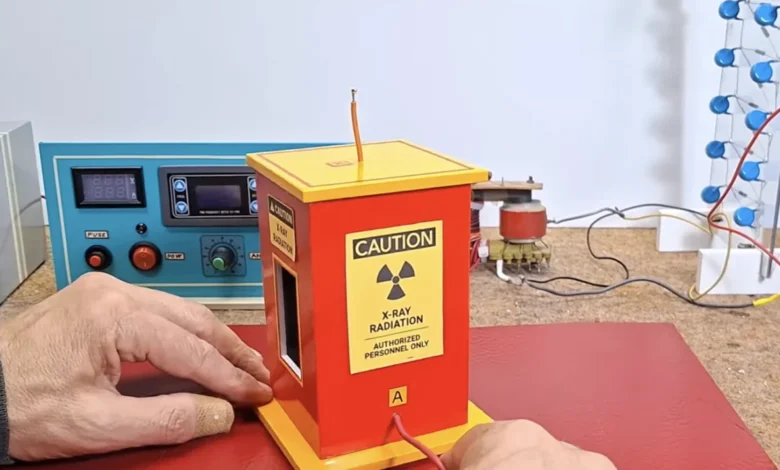
A do-it-yourself enthusiast has successfully constructed a functional X-ray generator using components salvaged from a vintage television set, highlighting both the ingenuity of makers and the inherent dangers of working with radiation. Mirko Pavleski, a YouTuber known for his complex electronics projects, documented his ambitious endeavor of building an at-home X-ray machine from scratch, utilizing a repurposed DY86 vacuum tube, a critical component from older cathode-ray tube (CRT) televisions. The project, shared on his YouTube channel, serves as a stark reminder that while X-ray technology is indispensable in various scientific and medical fields, its creation and operation are best left to qualified professionals due to the significant risks involved.
The Genesis of a Homemade X-ray Generator
The creation of an X-ray machine, even a rudimentary one, is a testament to Pavleski’s deep understanding of electronics and radiation physics. X-ray imaging, a cornerstone of modern diagnostics and scientific research, has a rich history dating back to its discovery by German physicist Wilhelm Conrad Röntgen in 1895. Röntgen’s groundbreaking work earned him the inaugural Nobel Prize in Physics that same year, solidifying X-rays as a revolutionary tool for visualizing the internal structure of objects. The fundamental principle behind X-ray imaging involves directing a beam of X-rays at a subject. Differences in density within the subject cause varying degrees of X-ray absorption. Denser materials, such as bone, absorb more X-rays and appear white on the resulting image, while softer tissues and voids like lungs appear in shades of gray and black, respectively, when captured by a specialized detector or film.
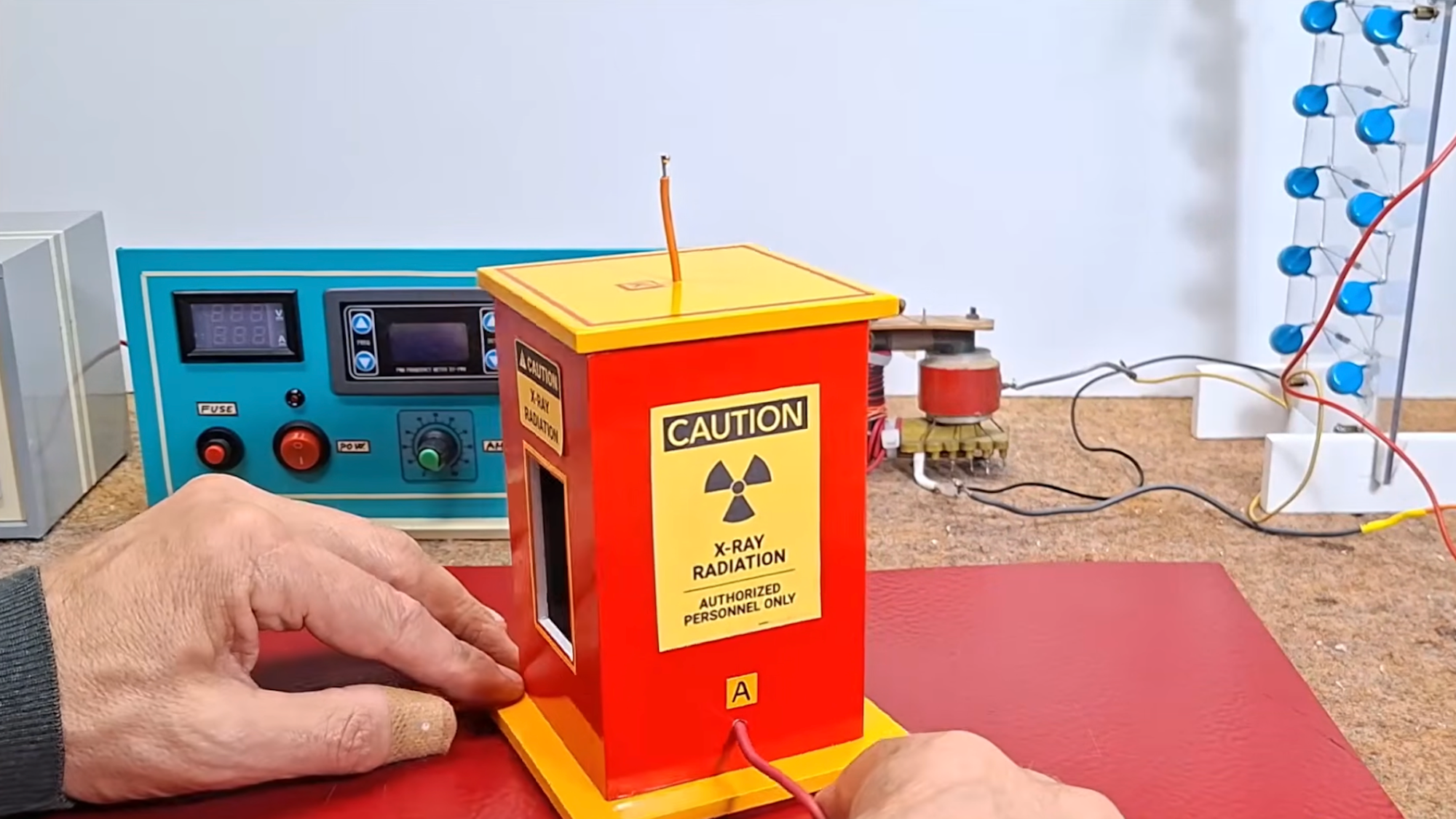
Pavleski’s project draws upon this fundamental understanding, but its execution pushes the boundaries of what is typically considered a safe or advisable DIY undertaking. The key component enabling his creation is the DY86 vacuum tube, a high-voltage rectifier tube commonly found in the flyback transformers of CRT televisions. These tubes were designed to handle substantial voltage fluctuations and generate high-frequency signals, characteristics that Pavleski ingeniously repurposed to produce X-rays. The process, as detailed in his video, involved a complex arrangement of power supplies to achieve the extremely high voltages necessary for X-ray generation, estimated to be in the tens of thousands of volts, if not hundreds of thousands, to excite electrons and produce X-ray photons.
A Perilous Power Progression
The challenge of powering a DIY X-ray generator lies in achieving the necessary voltage without destroying the delicate components or, more critically, causing harm. Pavleski’s approach involved a meticulously designed cascade of power conversion stages. This intricate system began with a low-voltage DC generator, which then fed into a high-voltage AC inverter. The output of this inverter was further channeled through a transformer, amplifying the voltage. The final and most crucial stage involved a voltage multiplier circuit. This multi-stage rectifier and capacitor network is essential for stepping up the alternating current to the extremely high DC voltages required to accelerate electrons to energies sufficient to produce X-ray radiation when they strike a target, typically a metal anode within the vacuum tube.
The inherent dangers of such a project are underscored by Pavleski’s own account of repeated failures. He revealed that the construction process was not without its setbacks, with three vacuum tubes exploding during his attempts to calibrate and stabilize the high-voltage system. These explosions are a direct consequence of exceeding the operational limits of the vacuum tubes, potentially due to uncontrolled voltage spikes or electrical arcing, and highlight the significant risk of equipment damage and fire hazards associated with such high-energy experiments.
Capturing the Invisible: The Imaging Process
Once the X-ray generator was operational, Pavleski proceeded to capture images of various objects within his workshop. For the imaging itself, he employed standard dental X-ray film, a material designed to be sensitive to X-ray radiation. The film was placed behind the object of interest, and the X-ray beam was directed at it. After exposure, the film underwent a conventional development process, involving a series of chemical baths for washing, developing, and fixing, a procedure that took approximately 30 minutes to complete.
The resulting images, showcased in his video, offer a fascinating glimpse into the internal structures of small electronic components. Among the subjects imaged were a microSD card, revealing its intricate internal layout, and tiny transistors, illustrating their delicate circuitry. This demonstrates the capability of his homemade device to penetrate and image the internal workings of non-biological materials. It is crucial to emphasize, as Pavleski himself does, that these experiments were strictly limited to inanimate objects. The deliberate avoidance of imaging living subjects is a critical safety precaution, acknowledging the known biological risks associated with ionizing radiation.
The Perils of DIY Radiation: Expert Perspectives
The construction and operation of any device that generates ionizing radiation, such as an X-ray machine, carry significant risks that extend beyond equipment failure. Medical physicists and radiation safety experts universally caution against any attempts to replicate such projects at home. Dr. Anya Sharma, a leading figure in radiation safety at the National Institute of Health, commented, "X-rays are a form of ionizing radiation, meaning they have enough energy to remove electrons from atoms and molecules. This can damage living cells and, over time, increase the risk of cancer and other health issues. While low-dose X-rays are used in medical imaging with strict safety protocols, uncontrolled exposure from a homemade device can be extremely dangerous."
The fundamental principles of radiation protection revolve around the ALARA principle: As Low As Reasonably Achievable. This means minimizing radiation exposure by controlling time, distance, and shielding. A DIY setup, by its very nature, often lacks the sophisticated shielding, interlocks, and monitoring equipment found in professional X-ray facilities. Furthermore, the precise calibration and dosimetry required to ensure safe and effective X-ray doses are complex and require specialized knowledge and equipment.
A Historical and Scientific Context
The discovery of X-rays by Röntgen was a serendipitous event that revolutionized scientific inquiry and medical diagnostics. Working with a cathode ray tube in his laboratory, Röntgen noticed a faint glow on a fluorescent screen several feet away, even though the tube was covered. He deduced that an invisible ray was being emitted from the tube, capable of passing through opaque materials. His initial experiments, including imaging the bones of his wife’s hand, captivated the world and immediately pointed towards its immense potential in medicine.
The technology has evolved dramatically since Röntgen’s time. Modern X-ray machines utilize sophisticated digital detectors, advanced image processing, and precise beam collimation to minimize radiation dose while maximizing image quality. The development of Computed Tomography (CT) scanners, which use multiple X-ray beams and sophisticated computer algorithms to create cross-sectional images, represents a significant leap forward, providing far more detailed anatomical information than conventional X-rays.

Broader Implications and Ethical Considerations
Mirko Pavleski’s project, while demonstrating impressive technical skill, raises important questions about the accessibility of advanced scientific equipment and the responsibility that comes with such capabilities. While the maker community thrives on innovation and pushing boundaries, the creation of devices that inherently involve hazardous materials or processes requires careful consideration of safety and ethical implications.
"The maker movement is fantastic for fostering creativity and problem-solving," stated Dr. Ben Carter, a professor of engineering ethics. "However, when projects involve potentially dangerous elements like radiation or highly energetic systems, there’s a crucial need for robust safety education and a clear understanding of the risks involved. Publicly sharing such projects, even with disclaimers, can inadvertently encourage unsafe practices if viewers lack the necessary background knowledge and safety precautions."
The implications of Pavleski’s work are twofold. On one hand, it showcases the power of repurposing old technology and the ingenuity of individuals in understanding complex scientific principles. On the other hand, it serves as a cautionary tale. The ability to generate X-rays, even on a small scale, demands an expert’s understanding of radiation physics, safety protocols, and regulatory compliance. The potential for misuse or accidental harm is significant, underscoring the importance of professional oversight in fields that deal with hazardous technologies.
The Future of X-ray Technology and DIY Endeavors
While DIY X-ray generators remain a hazardous endeavor, the underlying principles of X-ray generation are constantly being refined and applied in new ways. Researchers are exploring more efficient and safer methods of X-ray production, including compact X-ray sources for portable applications and advanced imaging techniques that require lower radiation doses.
For enthusiasts interested in the intersection of science and technology, engaging with X-ray principles can be achieved through safer, educational avenues. Numerous online resources, educational kits, and university programs offer opportunities to learn about radiation, physics, and imaging without the inherent dangers of building a functional X-ray generator from salvaged components. These alternatives allow for the exploration of scientific curiosity in a controlled and safe environment, fostering a deeper understanding of these powerful technologies.
In conclusion, Mirko Pavleski’s achievement in building a DIY X-ray machine is a remarkable feat of engineering. However, it also serves as a potent reminder that the pursuit of scientific knowledge and technological innovation must always be tempered with an unwavering commitment to safety, ethical responsibility, and professional expertise, especially when dealing with the invisible forces of radiation. The message remains clear: admiration for ingenuity is warranted, but replication of such hazardous projects is strongly discouraged.
Related posts: