IHG Hotels & Resorts Prepares for the AI Search Era While Betting That Direct Guest Relationships Remain King

As artificial intelligence rapidly transforms how consumers research, plan, and book travel, major hospitality brands are undertaking massive infrastructural overhauls to ensure they remain visible to automated discovery engines. Among them, IHG Hotels & Resorts is aggressively restructuring its digital architecture to make its vast portfolio of properties entirely "legible" to machine learning algorithms. Yet, even as the company pours resources into AI optimization, its top commercial leadership maintains a firm philosophical stance: while AI may serve as the modern travel industry’s front door, algorithms will never truly own the deep, long-term relationships forged between brands and their guests.
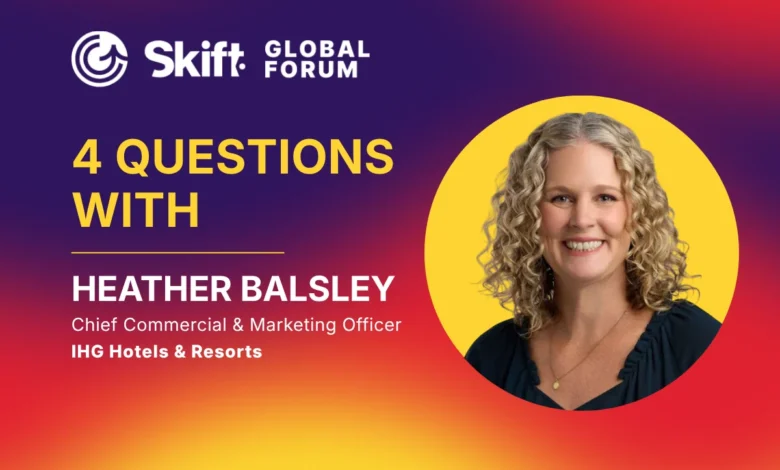
Heather Balsley, IHG’s Chief Commercial & Marketing Officer, is set to address these dual strategic imperatives at the upcoming Skift Global Forum, scheduled to take place from September 22 to 24, 2026, in New York City. Balsley’s participation highlights a critical inflection point for the global hospitality sector, which is currently navigating a delicate balancing act between adapting to automated intermediaries and preserving proprietary customer loyalty.
The Mechanics of AI Readability: Transforming Hotel Content
The fundamental mechanics of travel planning are undergoing a seismic shift. When a modern traveler prompts an artificial intelligence assistant to recommend a hotel for a specific trip, the system does not magically understand the nuances of hospitality; rather, it relies entirely on the digital text, structured data, and metadata it can efficiently parse and interpret. Properties whose content is poorly structured, outdated, or superficial risk being omitted entirely from algorithmic recommendations.
Recognizing this vulnerability, IHG is currently implementing a comprehensive overhaul of its content management systems. Later this year, the hotel giant plans to roll out a proprietary technology platform designed to completely transform how hotel properties structure, manage, and distribute their digital assets. According to company leadership, this platform will move beyond traditional, static property descriptions and basic amenity lists, introducing rich, context-aware, and highly granular data that allows AI models to precisely comprehend what makes an individual hotel unique.
This technical transformation is engineered to achieve multiple concurrent objectives. Primarily, it strengthens the digital signals that help IHG properties surface organically when users submit complex, highly specific queries—such as requests for pet-friendly accommodations with specific business amenities near particular transit hubs. Simultaneously, the platform will grant the corporate and individual property teams greater operational flexibility in tailoring content delivery across an expanding array of digital touchpoints, ensuring consistency and relevance regardless of where a traveler initiates their search.
The Evolving Fragmented Consumer Journey
The broader digital landscape in which hospitality brands operate has grown increasingly complex. Over the past decade, the consumer journey has morphed from a linear sequence of travel agency visits or direct brand website explorations into a fragmented web of mobile applications, social media inspiration channels, aggregators, and now, generative AI assistants.
Despite this fragmentation, industry experts observe a simultaneous consolidation around unified mobile ecosystems. Increasingly, travelers prefer to discover, research, compare, and execute bookings within a singular, frictionless mobile experience rather than hopping across disparate platforms and devices. For a sprawling enterprise like IHG—which encompasses a diverse portfolio ranging from luxury brands like InterContinental and Regent to mainstream staples like Holiday Inn—meeting consumers within these concentrated environments is essential.
However, the proliferation of discovery channels has not altered the core psychological drivers of consumer behavior. Travelers continue to demand absolute confidence that their financial and temporal investments will yield the desired experience. Consequently, IHG’s strategy relies heavily on leveraging its expansive loyalty ecosystem—IHG One Rewards—to inject personalization and recognition into every stage of the booking and stay lifecycle, thereby reducing decision fatigue and building enduring trust.
Historical Precedents: Why New Channels Do Not Equal New Monarchies
The anxiety surrounding AI disruption is not entirely unprecedented within the global travel and tourism sector. Over the past twenty-five years, the industry has weathered multiple technological waves that threatened to fundamentally upend established distribution models and disintermediate traditional brand-customer relationships.
In the late 1990s and early 2000s, the rapid ascent of Online Travel Agencies (OTAs) such as Expedia and Booking.com sparked widespread concern among hoteliers that third-party platforms would seize permanent control of the customer base. A decade later, the proliferation of mobile-first booking applications and the dominance of super-apps in Asian markets—such as WeChat and Alipay—fundamentally altered how consumers interacted with travel brands.
In each instance, while these technological shifts successfully redistributed power dynamics and created new operational hurdles, they ultimately failed to erode the foundational value of strong brand equity and direct consumer relationships. Major hospitality groups adapted by optimizing their distribution costs, enhancing their direct booking incentives, and utilizing loyalty programs to retain ownership of the guest relationship.
IHG’s leadership views the current AI revolution as a continuation of this historical trajectory. While artificial intelligence platforms, social discovery engines, and conversational search assistants will inevitably capture a dominant share of top-of-funnel travel inspiration, they function primarily as discovery mechanisms rather than relationship managers. The transaction may begin with an algorithmic recommendation, but the lifetime value of the customer is secured through consistent operational excellence on-property and personalized recognition through loyalty frameworks.
Strategic Decision-Making: The Core Test for Hospitality Executives
Amid relentless technological acceleration and an overwhelming array of potential investments—ranging from generative AI concierges to blockchain-based loyalty ledgers—hotel executives face constant pressure to adopt the latest industry trends. To navigate this noise, IHG relies on a straightforward, foundational evaluation metric.
The litmus test applied across IHG’s commercial strategy is deceptively simple: Does a proposed technological or operational shift simultaneously create a superior experience for the guest while delivering measurable value for hotel owners? If an innovation reduces friction, empowers travelers to make more confident decisions, fortifies loyalty, or directly enhances property performance, it warrants active investment. Conversely, initiatives that fail to meet this dual-value threshold are categorized as expensive distractions.
This disciplined approach is particularly crucial for franchise-heavy business models like IHG’s, where the vast majority of properties are independently owned and operated. Innovations must prove their economic viability not just at the corporate level, but on the bottom line of individual hotel owners who bear the capital costs of implementation.
Broader Industry Implications and the Road Ahead
As the travel industry converges on New York City for the Skift Global Forum, the discussions between IHG’s Heather Balsley and peers from Booking Holdings and Expedia Group are expected to crystallize the sector’s strategic priorities for the remainder of the decade.
The broader implications of IHG’s AI readability strategy point toward an increasingly polarized digital marketplace. Hotels and chains that fail to modernize their content architectures risk falling into a digital obscurity where automated assistants simply cannot “see” them, effectively locking them out of the modern discovery pipeline. Meanwhile, sophisticated enterprises that successfully marry semantic data optimization with robust direct-to-consumer ecosystems will likely capture an outsized share of algorithmic recommendations.
Yet, the ultimate takeaway from IHG’s commercial positioning is a reassuring affirmation of traditional hospitality fundamentals. Technology can optimize the search, streamline the booking, and personalize the digital interface, but the ultimate arbiter of success remains unchanged. Algorithms can suggest where a traveler might sleep, but only exceptional human service, consistent brand delivery, and authentic hospitality can convince them to return.