Federal Appeals Court Rules U.S. Constitution Does Not Guarantee Clean Drinking Water Amid Jackson Crisis

The federal judiciary has drawn a hard line regarding environmental rights in the United States, ruling that the U.S. Constitution does not guarantee citizens a fundamental right to clean, safe drinking water. Delivered by the Fifth U.S. Circuit Court of Appeals, the September 4 decision stems from decades of infrastructure failure, systemic neglect, and public health mismanagement in Jackson, Mississippi—a municipality where over 80% of the population is Black and where poverty rates are more than double the national average.
The appellate ruling directly impacts a civil lawsuit brought by Jackson residents who alleged that city officials and state administrators knowingly exposed them to lead-contaminated water while actively misleading the public about its safety. Beyond denying the existence of a constitutional right to potable water, the court further asserted that the Constitution does not secure a citizen’s right to truthful disclosures from government officials during a public health emergency.
Legal experts and civil rights advocates warn that the decision establishes a deeply concerning precedent. It suggests that predominantly Black communities facing environmental hazards have severely limited avenues for constitutional recourse, even when local and state governance fails catastrophically. The ruling arrives on the heels of an Environmental Protection Agency (EPA) determination that Jackson could not secure legal remedies through the Civil Rights Act of 1965, compounding the systemic hurdles faced by marginalized populations seeking environmental justice.
The Anatomy of the Lawsuit and the Court’s Rationale
The legal battle originated in 2022, when a group of Jackson residents filed a federal lawsuit against the city and former Mayor Chokwe Antar Lumumba. The plaintiffs argued that the municipal government violated their 14th Amendment right to bodily integrity by distributing brackish, impure, and lead-tainted water, and by masking the severity of the contamination. Furthermore, the complaint alleged that state authorities engaged in systemic discrimination by repeatedly channeling federal infrastructure funds away from Jackson and toward predominantly white communities.
Plaintiffs detailed how residents routinely watched discolored water trickle from their taps—or faced periods of complete water shutoffs—while officials insisted the supply was safe for consumption. They contended that these false assurances violated their fundamental right to make informed choices regarding their health and bodily autonomy.
A lower court initially dismissed the case, prompting the appeal to the Fifth Circuit. In the majority opinion, U.S. Circuit Judge Kurt Engelhardt acknowledged the gravity of the water crisis but concluded that access to safe water is not a right “deeply rooted in our Nation’s history and tradition”—the prevailing legal benchmark used to determine rights protected under the substantive due process clause of the 14th Amendment.
Addressing the claim that officials lied about lead levels to manipulate public behavior, Judge Engelhardt wrote that such deception is “a far cry from the state’s physically extracting evidence from a criminal suspect or conducting an invasive medical procedure without consent.” He summarized the court’s stance by noting that “the Constitution does not provide redress for every governmental wrongdoing.”
Dissenting from her colleagues, U.S. Circuit Judge Catharina Haynes argued that the plaintiffs had successfully established a plausible claim that city leadership violated their bodily integrity by knowingly placing them in immediate physical danger. Despite this dissent, the majority ruling stands, effectively closing federal courthouse doors to similar constitutional claims within the circuit’s jurisdiction.
A Century of Decay: The Chronology of Jackson’s Water Crisis
Jackson’s water emergency is not an isolated weather-induced anomaly, but rather the culmination of decades of deferred infrastructure maintenance, dwindling municipal tax revenues, systemic racism, and administrative failure.
Mid-20th Century to 2010s: Urban Flight and Eroding Infrastructure
Like many urban centers across the American South and Rust Belt, Jackson experienced significant white flight in the latter half of the 20th century, eroding its commercial tax base. As wealthier residents and businesses relocated to surrounding suburban counties, the city’s tax revenues plummeted. Consequently, Jackson lacked the capital necessary to maintain its aging water treatment facilities, replace crumbling cast-iron pipes, and retain skilled utility personnel. For generations, residents—particularly in lower-income Black neighborhoods—experienced intermittent water pressure drops, discolored tap water, and recurring boil-water notices.
March 2020: EPA Emergency Order
The federal government formally recognized the severity of the crisis when the EPA issued an emergency administrative order under the Safe Drinking Water Act. The agency declared that conditions at Jackson’s drinking water plants presented an “imminent and substantial endangerment” to human health, citing severe treatment failures, operator shortages, and deteriorating distribution systems.
February 2021: Winter Storm Paralysis
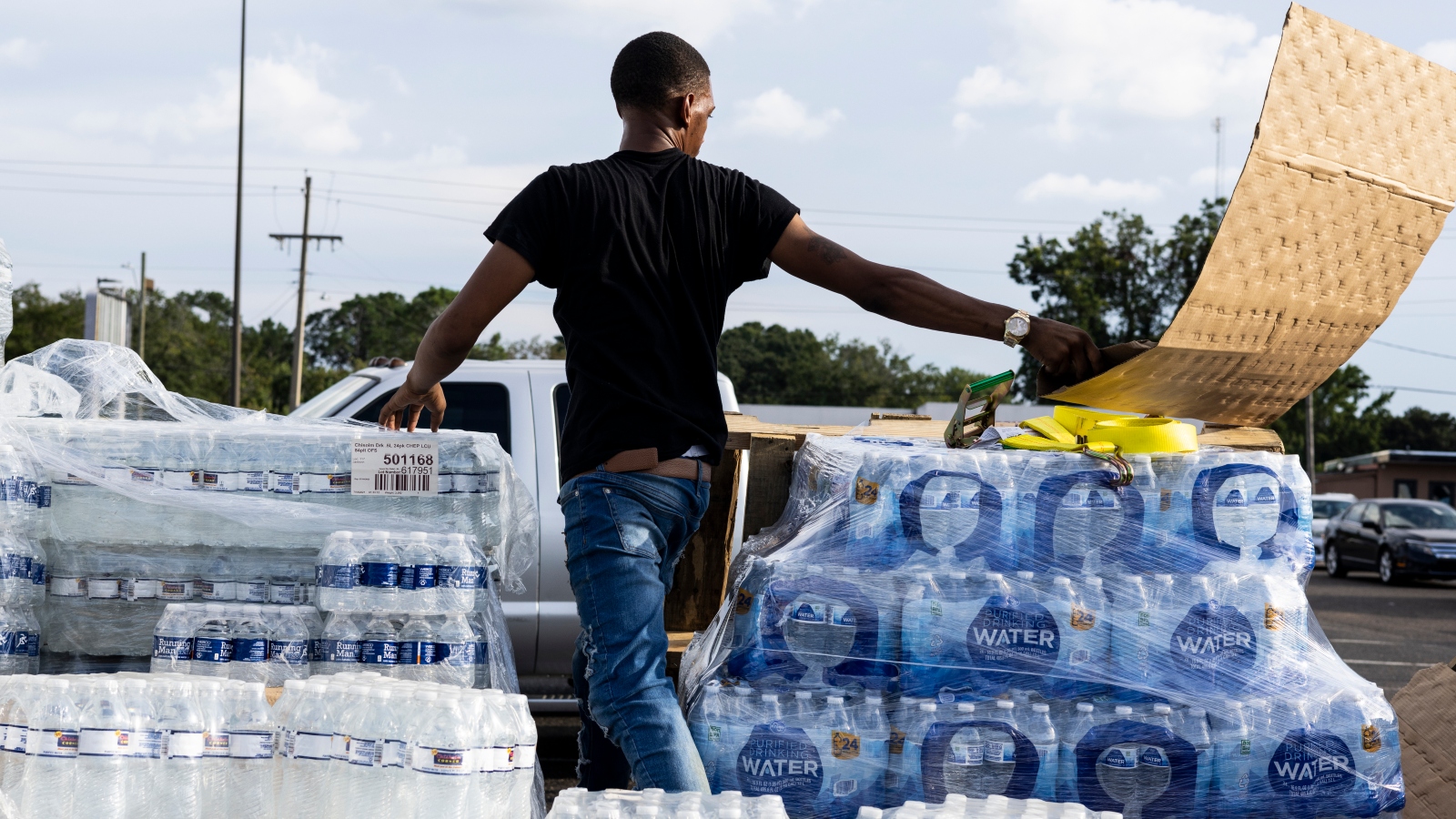
A severe winter storm swept across the South, freezing inadequately insulated equipment and rupturing water mains throughout Jackson. Tens of thousands of residents were left entirely without running water, heat, or safe drinking water for weeks, forcing communities to rely on bottled water distributions and emergency supplies.
August–September 2022: O.B. Curtis Plant Failure
Catastrophic flooding of the Pearl River exacerbated problems at the O.B. Curtis Water Treatment Plant, the city’s primary water facility. Pumps failed, leaving the entire city of roughly 150,000 residents without potable water. Schools and businesses closed, and the federal government stepped in, prompting the appointment of a third-party manager to stabilize and oversee the system.

March 2024 to Present: Federal Oversight and Rate Hikes
Under the direction of court-appointed manager JXN Water, the utility has worked to repair lines and upgrade treatment processes. However, the financial burden of these long-delayed repairs has increasingly fallen on the city’s low-income residents. In March, a court-approved 12% rate increase raised average monthly water and sewer bills by roughly $8.88 to about $88. Projections from JXN Water indicate further rate hikes of 10% in 2027, 9% in 2028, and 8% in 2029, placing severe financial strain on a populace where a large percentage of households live below the poverty line.
Broader Implications: Environmental Racism and Public Health Data
The legal setback in Jackson highlights a broader national crisis regarding environmental equity. According to extensive federal data and independent scientific research, Black and Hispanic communities across the United States are disproportionately served by public water systems that violate health-based standards under the Safe Drinking Water Act.
Furthermore, studies demonstrate that water infrastructure systems in communities with higher populations of people of color experience significantly longer delays before receiving federal or state funding for repairs compared to predominantly white municipalities.
Public health experts emphasize that the consequences of these disparities are profound. Long-term exposure to lead—frequently leached from aging service lines and corroded pipes—causes irreversible cognitive impairment, behavioral issues, and developmental delays in children. Medical researchers note that race remains a stronger predictor of childhood lead poisoning in America than household income, underscoring the racialized nature of environmental degradation.
Local residents and community organizers point to these systemic realities as evidence of institutional abandonment. Danyelle Holmes, a senior national organizer with Mississippi’s Poor People’s Campaign, criticized the appellate decision for leaving vulnerable populations without legal recourse.
“Jackson residents did everything this country tells poor people to do. They organized, they testified, they boiled their water, they filed suit, they trusted the courts. And at every step the answer has been no,” Holmes said. “What it signals is that the law has told a majority-Black capital city that its suffering is real, but its remedy does not exist.”
Official Responses and the Path Forward
Reaction to the Fifth Circuit’s decision broke sharply along institutional lines. Municipal leadership struck a measured tone regarding the dismissal of the litigation. In an official statement, Jackson Mayor John Horhn remarked, “We are pleased that the Fifth Circuit upheld the dismissal of these claims. The City remains committed to the health, safety, and well-being of every Jackson resident.”
Conversely, grassroots organizers and residents view the ruling as a systemic abdication of governmental responsibility. Brooke Floyd, a lifelong Jackson resident and community advocate whose family has endured the city’s water troubles for generations, argued that the judiciary’s standards reflect deep-seated demographic biases.
“I do think the ruling would’ve been different if the majority of our city looked different, was in a different tax bracket, and had a different ZIP code, but alas, we probably wouldn’t have had the problems to begin with,” Floyd stated. “The problem the rest of America needs to worry about is, while they were making sure not to guarantee me my rights, they were quietly taking yours, too.”
As legal avenues narrow, community networks are pivoting away from traditional litigation toward direct action, political mobilization, and legislative advocacy. Activists stress that the fight for safe drinking water transcends partisan politics, framing access to basic hydration as a fundamental human necessity rather than a negotiable constitutional privilege.
“We are organizing, we are marching to the polls, and we are not waiting on a court to tell us our lives are worth clean water,” Holmes concluded. “This is about right and wrong, and everybody knows which one Jackson has received.”