Drew Brees Publicly Calls Out Jalen Hurts For Sliding Short Of First Down During Eagles Win Over Titans

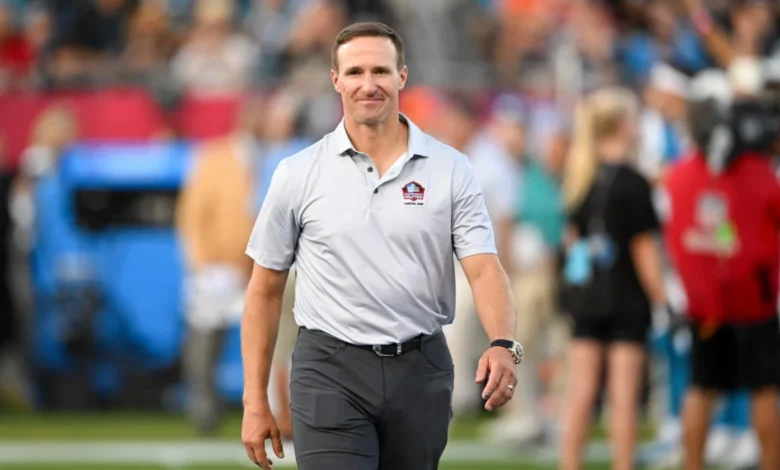
The intersection of modern player preservation and old-school football grit took center stage during the Philadelphia Eagles’ Week 2 matchup against the Tennessee Titans at Nissan Stadium. During the second quarter of the contest, former New Orleans Saints legendary quarterback and current Fox analyst Drew Brees didn’t hold back his criticism of Eagles signal-caller Jalen Hurts. Faced with a critical third-down situation, Hurts opted to slide well short of the marker to avoid impending contact from multiple converging defenders rather than lowering his shoulder to fight for the extra yardage.
The decision immediately drew the ire of Brees in the broadcast booth, sparking a broader conversation regarding quarterback running styles, risk mitigation in the National Football League, and the delicate balance between longevity and competitive urgency. While Hurts ultimately helped orchestrate a dramatic late-game comeback to secure a 24-20 victory, the polarizing play highlighted ongoing debates about quarterback accountability and aggressive play calling in high-stakes professional football.
The Incident: Breaking Down the Second-Quarter Scramble
The sequence in question unfolded midway through the second quarter at Nissan Stadium in Nashville, Tennessee. The Eagles faced a crucial 3rd-and-6 scenario, a pivotal juncture that could have extended a promising offensive drive and kept the Tennessee defense on the field.
Hurts, known for his dynamic mobility and dual-threat capabilities, dropped back to pass, encountered pressure from the Titans’ front seven, and elected to scramble out of the pocket. As he advanced upfield, Titans linebacker Cedric Gray and defensive end Jermaine Johnson II converged rapidly to close the running lane. Rather than lowering his shoulder pad to challenge the defenders and push past the line to gain, Hurts initiated a deliberate slide.
The slide safely protected the quarterback from a heavy, multi-player collision, but it also cut the play short significantly. Because NFL officiating rules dictate that a sliding runner is marked at the exact spot where the slide begins—rather than where the momentum carries their feet or the ball at the conclusion of the motion—Hurts was ruled down well short of the first-down marker. The premature termination of the run turned what could have been a manageable 4th-and-1 or a converted first down into a much longer 4th-and-3, forcing Philadelphia to alter its strategic approach on fourth down.

Watching the replay unfold in the Fox broadcast booth, Brees expressed immediate frustration with the sequence.
"I was hyping up Jalen Hurts, and now, I’m going to get on him," Brees declared live on air. "Lower your shoulder and go get the first down."
As the television broadcast transitioned from the slow-motion replay back to the live action on the field, Brees underscored the tactical consequences of the play.
"They’re going to mark the ball at the start of the slide, not where you end the slide," Brees noted, emphasizing the strict application of NFL officiating rules. "It’s not a 4th-and-1; it’s a 4th-and-3."
Chronology of the Game: From Early Struggles to Late Heroics
The friction point in the second quarter was just one chapter in a hard-fought, tightly contested game that ultimately tested the resilience of the Philadelphia roster. The Eagles entered the matchup looking to establish early dominance on the road, while the underdog Titans sought to protect their home turf and secure an early-season statement win.
Throughout the first half, the Eagles’ offense experienced intermittent struggles finding a rhythm against a disciplined Tennessee defensive scheme. Hurts, while displaying flashes of his trademark athleticism, faced heavy pressure and made uncharacteristic mistakes. By the end of the afternoon, Hurts completed 26 of 37 passing attempts for 264 yards, throwing two touchdowns while also committing two interceptions. His rushing output reflected a cautious approach throughout the game, totaling 16 yards across five carries as he routinely prioritized avoiding heavy hits over extending plays with his legs.

Despite the offensive friction and the missed opportunities in the middle quarters, the contest culminated in high drama during the final minute of regulation. Trailing late in the fourth quarter, Hurts engineered a signature, game-winning drive. With the clock winding down and the Eagles needing a touchdown to avert an upset loss, Hurts located wide receiver Darius Cooper in the final seconds of the game. Cooper hauled in the clutch reception for a score, capping off a resilient 24-20 come-from-behind victory that improved Philadelphia’s record to 2-0 on the young season and marked their first successful road trip of the campaign.
Contextualizing the Debate: Modern Safety vs. Traditional Toughness
Brees’ on-air critique taps into a broader, ongoing philosophical debate within professional football: how modern quarterbacks should manage the inherent risks of running the football in an era heavily focused on player safety and concussion protocol.
Over the last decade, league rules have shifted dramatically to protect quarterbacks outside the pocket. Referees are instructed to heavily penalize defenders for late hits, hits to the head, and forceful collisions once a quarterback initiates a slide. Consequently, contemporary signal-callers—particularly mobile threats like Hurts, Josh Allen, and Lamar Jackson—are frequently coached to protect themselves by sliding early to avoid devastating injuries that could derail a franchise’s championship aspirations.
However, legendary figures from previous generations of football often voice a competing perspective. They argue that calculated aggressiveness is a vital component of competitive success, particularly in short-yardage or third-down conversion scenarios.
This tension is not entirely new for Hurts, whose playing style has previously drawn scrutiny from football purists. Last season, former legendary Eagles head coach Dick Vermeil publicly weighed in on Hurts’ approach, offering a nuanced assessment of the quarterback’s offensive aggressiveness.
"I would say be who you are and not restrict him from running, because defensive line pressure can create good quarterback draws," Vermeil remarked last season. "I really believe the more time he touches it, the less man-to-man coverage you get the next time around."

While Vermeil championed allowing Hurts the freedom to use his legs, the debate among analysts often centers on how he utilizes that freedom. Critics argue that sliding too early yields valuable yards and stalls drives, while supporters and medical staff contend that a single extra yard gained in the second quarter is not worth risking a multi-week injury to a franchise cornerstone.
Broader Implications for Philadelphia and the NFL
The commentary from Brees and the subsequent public discussion carry several key implications for both the Philadelphia Eagles and the broader landscape of NFL quarterback evaluation:
- The Evolution of the Dual-Threat Quarterback: As teams increasingly rely on quarterbacks who can threaten defenses both through the air and on the ground, coaching staffs must continuously calibrate the risk-reward ratio of designed runs and scrambles. Teams invest hundreds of millions of dollars into their starting signal-callers, making long-term health the ultimate priority over short-term yardage gains.
- Scrutiny on Officiating Rules: Brees’ on-air reminder regarding the precise mechanics of the slide rule serves as an educational moment for viewers and players alike. Understanding that momentum cannot carry a sliding runner forward past the initial point of the descent remains a vital aspect of situational awareness for modern offensive players.
- The Psychology of Winning: Despite the second-quarter miscue and the analytical debate it generated, Hurts and the Eagles ultimately achieved the primary objective: securing a victory. In the National Football League, late-game heroics and resilient finishes often overshadow early-game strategic disagreements. Hurts’ ability to bounce back from mistakes and orchestrate a game-winning drive in the final seconds demonstrates the mental fortitude that has made him a Super Bowl participant and a fixture of Philadelphia’s championship ambitions.
As the 2026 NFL season progresses, the balance between self-preservation and competitive grit will continue to define how Jalen Hurts and his peers navigate the physical demands of professional football. Whether analysts and former players approve of every tactical decision or not, the ultimate measure of success for the Eagles remains anchored in their win-loss column—a column that currently reflects an unblemished 2-0 record.
Related posts: