Macklemore Defies Tour Cancellation with Global Solidarity Concerts Following Controversial Pro-Palestine Advocacy

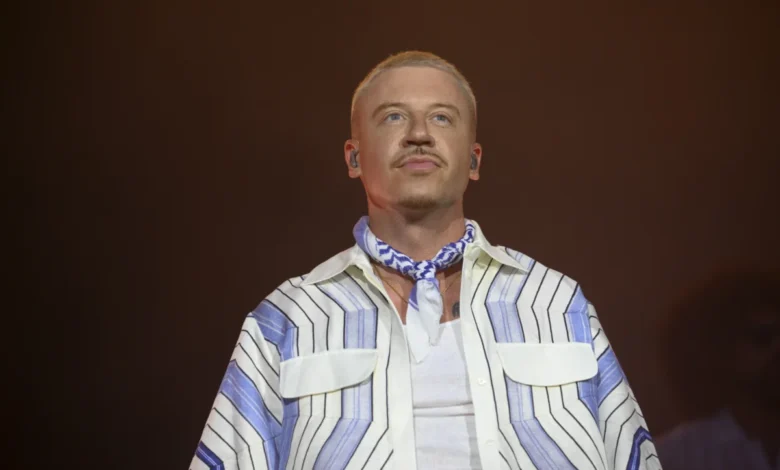
The intersection of celebrity activism and the business of live entertainment has reached a volatile flashpoint, exemplified by the recent fallout between rapper Macklemore and the promotional apparatus surrounding Ed Sheeran’s global stadium tour. Following his removal from the U.S. "Loop" tour—a decision prompted by his outspoken commentary regarding the conflict in Gaza—Macklemore has launched a defiant three-show series in Europe. Kicking off in Dublin, Ireland, the artist utilized the stage not merely for a musical performance, but as a platform to double down on the rhetoric that cost him his position as a high-profile supporting act.
The Dublin Kick-off: A Platform for Resistance
At his recent Dublin performance, Macklemore, accompanied by surprise guests Hozier and the Irish hip-hop group Kneecap, addressed the audience with an intensity that reflected the six weeks of controversy he has navigated since mid-September. The rapper framed his vocal support for Palestine as a moral imperative rather than a political provocation. "Six weeks ago, it was two words," he stated to a receptive crowd. "Two words that are rooted in love and liberation. Not against anybody, not divisive. Not a call for hatred. But a call to recognize our shared humanity."
The Dublin concert is the first of a trio of performances that includes dates in Paris and London. In a move designed to align his professional activities with his ideological stance, Macklemore has pledged that all proceeds from these shows will be donated to humanitarian organizations providing aid to Palestine. This follows his earlier decision to donate his entire $1 million salary earned from the Sheeran tour to charitable causes, signaling a commitment that transcends traditional PR posturing.
Chronology of a Tour Fallout
The sequence of events leading to this rupture began in early September. On September 4 and 5, during two performances at New Jersey’s MetLife Stadium, Macklemore delivered impassioned speeches from the stage. During these sets, he explicitly stated, "Free Palestine," emphasizing that his intent was to ensure that people from Gaza to the occupied West Bank were not forgotten by the international community.
The reaction was swift and multifaceted. The Israeli American Council (IAC) launched a formal campaign advocating for his removal from the tour, characterizing his stage time as a misuse of a global platform for a "one-sided political agenda." Simultaneously, other high-profile figures in the music industry, including pop star Pink, expressed public dissent regarding his rhetoric.
By September 12, the situation reached a breaking point. The Messina Touring Group (MTG), the promoter behind Sheeran’s tour, issued a statement confirming that Macklemore would no longer be performing on the remaining support dates. The decision was framed by the promoters as a logistical necessity: "We were notified by venues that they will not allow a concert to take place with Macklemore on the lineup, which would result in the cancellation of the tour and impact hundreds of thousands of fans."
The fallout extended beyond the individual artist. In an act of solidarity with the rapper, several other supporting acts—including Finneas, Lukas Graham, and Aaron Rowe—as well as a significant portion of Sheeran’s backing band, chose to withdraw from the tour. This mass departure underscored the growing tension between artists and the corporate stakeholders who manage large-scale concert infrastructure.
The Role of Venue Stakeholders and Political Pressure
A critical component of this controversy involved the influence of venue owners. Macklemore explicitly alleged that Robert Kraft, the owner of Gillette Stadium, played a decisive role in pressuring for his removal, suggesting that Kraft had lobbied other stadium owners to adopt a similar exclusionary stance.
Robert Kraft’s response was to pivot toward humanitarian diplomacy. Alongside Ed Sheeran, Kraft announced a $2 million contribution to aid the humanitarian crisis in the region. This move served to highlight the divide between those who believe the concert stage should be a neutral ground and those who view it as an essential venue for addressing global injustices.
Ed Sheeran, for his part, initially attempted to maintain a position of neutrality. In a lengthy public statement, he explained his philosophy regarding the stage: "There is a reason I do not use my professional platform for politics—my audience includes young people, often children, of all backgrounds. Those who come to my shows do not expect a political forum." He maintained that he valued diplomacy and sought to create a "place of safety and sanctuary."
However, the pressure of the moment proved difficult to ignore. By September 19, during a performance in Philadelphia, Sheeran adjusted his approach. He issued a public statement condemning both the October 7 attacks in Israel and the subsequent humanitarian catastrophe in Gaza. His remarks, which categorized the situation in the West Bank as a systemic injustice, marked a notable shift in the discourse surrounding the tour’s broader political context.
The Business of Activism: Implications for the Industry
The "Macklemore incident" serves as a case study in the modern limits of celebrity influence. As artists become increasingly vocal about their political stances, concert promoters, stadium operators, and corporate sponsors are finding it difficult to reconcile the "neutral" brand image required for mass-market appeal with the increasingly polarizing nature of global geopolitical conflicts.
Industry data suggests that the financial stakes are higher than ever. With stadium tours representing a multi-billion dollar sector of the music economy, the threat of venue cancellation is a potent tool for stakeholders looking to mitigate reputational risk. When a venue owner or promoter fears that a specific artist’s speech will result in protests, security concerns, or loss of future bookings, the contract-termination clause becomes a mechanism of political control.
However, the "Macklemore effect"—where other artists and band members withdraw in protest—suggests that the industry is also witnessing a shift in labor power. Artists are increasingly viewing their performance slots as a unified front, where the removal of one peer on ideological grounds triggers a collective response. This creates a new variable in the touring ecosystem: the possibility that ideological cohesion among performers may dictate the viability of a tour as much as ticket sales or logistical feasibility.
Fact-Based Analysis: The "Two Words" Debate
The central tension in this narrative revolves around the phrase "Free Palestine." For supporters, the phrase is a non-negotiable call for human rights, dignity, and the right to self-determination for a stateless population. For critics, the phrase is often interpreted as an existential threat or a dog-whistle for the dissolution of the State of Israel.
This semantic battle has forced artists into a precarious position. The history of music as a vehicle for social change—from the civil rights movement in the United States to the anti-apartheid movement in South Africa—is well-documented. Yet, in the age of social media, the speed at which a single soundbite can mobilize a global audience has made the concert stage an increasingly high-stakes environment.
Macklemore’s persistence, as evidenced by his continued tour and direct funding of Palestinian relief efforts, suggests that he is not merely an artist using a platform for marketing, but an activist willing to incur significant financial and professional losses for his convictions. Whether this will lead to a new standard of "political vetting" in music contracts or, conversely, a new era of emboldened artist activism remains to be seen.
Conclusion
As Macklemore continues his tour through Paris and London, the industry remains focused on the broader implications of his displacement. The episode has effectively split the entertainment world into two camps: those who believe the concert experience must remain a sanctuary from the world’s harsher realities, and those who believe that music, by its very nature, is a catalyst for engagement with the human condition.
Regardless of where one stands on the political spectrum, the removal of a high-profile artist from a global tour for the expression of personal views represents a significant shift in the relationship between creative talent and the corporate structures that facilitate their work. For the fans, the debate continues to rage, but for the industry, the lesson is clear: in an era of hyper-connectivity, no stage is truly isolated from the political tides of the world. The events surrounding the "Loop" tour have proven that the microphone is, and will likely remain, the most contested instrument in the stadium.
Related posts: