A Journey Through the Culinary Heartland An Essential Guide to the Diverse Gastronomy of China

China possesses one of the world’s most sophisticated and diverse food cultures, characterized by a vast array of flavors, techniques, and regional identities that make the assembly of a definitive "best" list an almost impossible task. For the international traveler or the domestic gourmand, navigating this culinary landscape requires an understanding of the essential "gateway" dishes that define the nation’s gastronomic soul. From the imperial kitchens of the north to the steam-filled tea houses of the south, these dishes represent more than mere sustenance; they are a living record of China’s history, geography, and social evolution.
The Imperial Legacy and Northern Traditions
The story of Chinese cuisine often begins with the migration of power and the refinement of palace recipes. Peking Duck (Beijing Kaoya) stands as the preeminent example of this transition. While synonymous with the capital today, historical records suggest the art of roasting ducks began more than 1,500 years ago in Nanjing, the former seat of imperial power. When the Ming Dynasty relocated the capital to Beijing in the 1400s, the imperial chefs brought their specialized techniques with them. The dish has since evolved into a high-precision art form. The duck is traditionally prized for its thin, crispy skin, which is served with minimal meat, accompanied by scallions, cucumber, and sweet bean sauce wrapped in a delicate pancake. Culinary historians note that the "closed oven" and "hung oven" roasting methods remain a point of contention among traditionalists, reflecting the deep-seated pride in regional preparation styles.

Further west in the ancient city of Xi’an, the Rou Jia Mo offers a glimpse into the culinary history of the Silk Road. Often described as the world’s oldest hamburger, this street staple consists of shredded pork belly braised for hours in a complex "master stock" of star anise, cinnamon, and ginger, tucked into a toasted flatbread known as Mo. Authentic Rou Jia Mo is judged by the "chrysanthemum" pattern on the bread, a sign of perfect hand-toasting.
In the coastal city of Tianjin, the morning ritual is defined by Jianbing Guozi. This savory crepe, made from a mung bean batter and filled with eggs, deep-fried crackers (Guozi), and fermented bean paste, represents the quintessential northern Chinese breakfast. The dish has recently seen a global resurgence, with Jianbing stalls appearing in major metropolitan centers like New York and London, acting as a vehicle for Chinese "soft power" through street food.
The Scintillating Heat of the Southwest
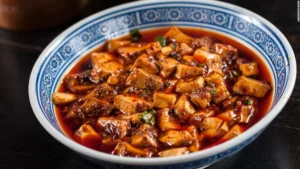
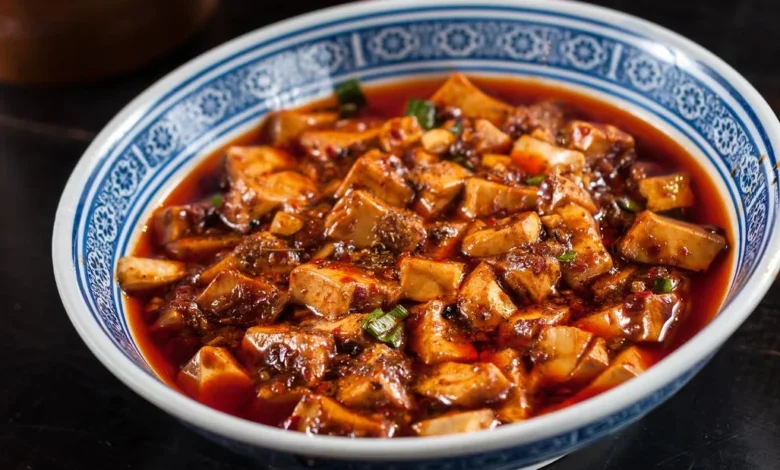
The provinces of Sichuan and Hunan offer a masterclass in the use of spice, though their philosophies differ fundamentally. Sichuan cuisine is defined by "Ma La"—the combination of numbing Sichuan peppercorns and fiery chilies. Mapo Tofu, perhaps the most famous export from this region, embodies this balance. Legend attributes the dish to a pockmarked woman (Ma Po) who lived in Chengdu during the Qing Dynasty. A truly authentic Mapo Tofu requires Hanyuan peppercorns and Doubanjiang (fermented broad bean paste) from the Pidu district. The result is a dish that is salty, peppery, and intensely aromatic.

Similarly, Dan Dan Noodles (Dan Dan Mian) reflect the province’s history of street commerce. Named after the "Dan Dan" carrying poles used by 19th-century vendors, the dish varies from a dry, nutty mix to a soupy, spicy bowl. Regardless of the version, the inclusion of "Rou Saozi"—minced pork fried in lard until crispy—is considered non-negotiable by local gourmets.
In contrast, Hunan cuisine (Xiang cuisine) eschews the numbing sensation of Sichuan for a "dry spicy" or "sour spicy" profile. The province’s signature dish, Steamed Fish Head with Chopped Salted Chilies (Duo Jiao Yu Tou), utilizes fermented chilies to provide a sharp, salty kick that cuts through the richness of the fish. This dish is deeply rooted in the province’s humid climate; local folk songs suggest that chilies are essential for health, helping to expel internal moisture and heat.
Cantonese Precision and the Art of Dim Sum
The southern province of Guangdong, particularly the Pearl River Delta, is the birthplace of Cantonese cuisine, which emphasizes the "original flavor" of fresh ingredients. This philosophy is most evident in Cantonese Steamed Fish. The dish is a test of a chef’s timing; a few seconds too long can ruin the delicate texture of the flesh. Served with nothing more than sweetened soy sauce, ginger, and scallions, it represents the height of culinary minimalism.

Guangdong is also the home of Dim Sum, a cultural institution rather than a single dish. Meaning "to touch the heart," Dim Sum involves a variety of small plates—ranging from Char Siu (barbecue pork) to Har Gow (prawn dumplings). Char Siu, characterized by its maltose glaze and charred exterior, is a staple of the "Siulap" (roast meat) shops that line the streets of Guangzhou and Hong Kong. The versatility of Char Siu allows it to appear in everything from breakfast macaroni to steamed buns (Char Siu Bao).
In the Shunde district, a UNESCO City of Gastronomy, the Chencun Noodle (Chencun Fen) showcases the regional mastery of rice-based textures. Thinner and silkier than standard flat noodles, they act as a sponge for the juices of steamed meats. Further south, the roast goose of Guangdong is celebrated for its rendered fat and smoky skin, often achieved by burning camphor or lychee wood in traditional stone ovens.
Coastal Umami and Eastern Delicacies
The eastern provinces, including the areas surrounding Shanghai and Fujian, offer a different palette. Shanghai’s Xiaolongbao (soup dumplings) are a global phenomenon. These delicate parcels contain a pork filling and a rich broth that is solid at room temperature (as aspic) but melts upon steaming. The suspense of moving the dumpling from the basket to the spoon without breaking the thin wrapper is a hallmark of the dining experience.

Fujian province contributes unique textures, such as Rouyan—a type of dumpling where the wrapper itself is made from pounded pork mixed with flour. The province is also known for its Lychee Pork, a sweet and sour dish where the meat is scored to resemble the bumpy skin of the lychee fruit. In the coastal city of Chaozhou, the focus is on "cold seafood," where crabs and fish are salted and steamed, then served at room temperature to preserve their natural sweetness. Chaozhou is also famous for its hand-beaten beef balls, which are so elastic they are said to be able to bounce off a table.
The Philosophy of Health and Comfort
Chinese cuisine is inextricably linked to Traditional Chinese Medicine (TCM). This is most apparent in Cantonese Herbal Soups (Laohuo Liangtang). These soups are simmered for hours with ingredients like snow fungus, goji berries, and dried dates, intended to balance the body’s "Yin" and "Yang." Depending on the season, a soup might be designed to hydrate during the dry autumn or cool the body during the humid summer.
Congee (rice porridge) serves as the ultimate comfort food across the country. Whether served plain in the north or flavored with century eggs and pork floss in the south, congee is the standard remedy for illness and a staple of the Chinese breakfast. It represents the "slow food" movement in its most traditional form, requiring patient simmering to achieve the perfect consistency.

Finally, desserts like Tangyuan (sweet rice balls) from Ningbo provide a symbolic end to many meals. Filled with black sesame and lard, these round dumplings represent family unity and wholeness. The use of lard in the filling is a traditional technique that provides a glossy sheen and a rich, nutty aroma that modern substitutes struggle to replicate.
Broader Impact and Global Implications
The global spread of Chinese cuisine has often resulted in the simplification of these complex regional dishes. However, as international travel to China increases and the diaspora brings more authentic techniques abroad, there is a growing appreciation for the specificities of regional cooking. The "Eight Great Traditions" (Chuan, Lu, Yue, Min, Su, Zhe, Xiang, and Hui) are now recognized by culinary historians as distinct entities, each with its own history and methodology.
The economic impact of food tourism in China is significant. Cities like Chengdu, Shunde, and Yangzhou have leveraged their UNESCO Gastronomy status to draw millions of visitors annually. This culinary heritage is also a key component of China’s cultural diplomacy. From the state banquets featuring Dongpo Pork—named after the Song Dynasty poet Su Dongpo—to the humble street-side Jianbing, food remains China’s most effective and enduring cultural ambassador.

As the nation continues to modernize, there is a concerted effort among chefs and historians to preserve these "intangible cultural heritages." The meticulous preparation of Peking Duck or the hand-beating of Chaozhou beef balls are increasingly viewed not just as cooking, but as essential cultural practices that must be protected against the encroachment of industrial food production. For the diner, each bite of these essential dishes offers a connection to a civilization that has spent millennia perfecting the art of the table.