The automotive landscape has shifted dramatically over the past decade, with high-performance marques traditionally tethered to low-slung coupes and roadsters forced to reconcile their heritage with the surging global demand for SUVs. Ferrari, the crown jewel of Maranello, has navigated this transition with the Purosangue, a vehicle that rejects the "SUV" label in favor of its own performance-oriented identity. As the 2026 iteration continues to make waves, the Purosangue stands as a testament to Ferrari’s commitment to internal combustion—specifically the naturally aspirated V12—in an era increasingly dominated by electrification.
The Evolution of the Maranello Utility Concept
The journey to the Purosangue was not a sudden pivot but a decade-long consideration of how to expand the brand’s reach without compromising its core performance DNA. The project, internally code-named F175, began in earnest around 2017, when Ferrari leadership realized that a significant portion of its clientele was already turning to competitors like the Lamborghini Urus or the Aston Martin DBX for their daily driving requirements.
By 2022, the official unveiling of the Purosangue sent ripples through the industry. Unlike traditional luxury SUVs that share platforms with more mundane corporate counterparts, the Purosangue was built on a dedicated, high-rigidity chassis architecture designed to handle the unique physics of a front-mid-mounted V12 engine. The timeline of its production saw the first deliveries commencing in 2023, and by 2026, the vehicle has cemented its status as a cornerstone of the brand’s diversified portfolio.
Ergonomics and the User Interface Challenge
One of the most notable aspects of the Purosangue’s interior is its departure from the trend of screen-heavy cabin design. While many manufacturers have moved toward massive, singular glass interfaces that govern every function, Ferrari has maintained a degree of analog tactile satisfaction.
The multifunction steering wheel is a prime example of this philosophy. Unlike the capacitive touch surfaces found in the Ferrari 296 GTB—which have faced criticism for being difficult to operate while navigating high-speed turns—the Purosangue retains physical buttons. These controls allow the driver to manage Apple CarPlay and other vital systems without averting their gaze from the road. This integration displays information directly in the instrument cluster, effectively turning the digital dash into a primary infotainment hub.
However, the experience becomes more complex when addressing secondary controls, such as climate management and seat adjustments. Ferrari has opted for a pop-out rotating controller integrated into the dashboard. While this mechanism is a triumph of industrial design, it presents operational challenges. Selecting specific parameters—such as fan speed or seat massage intensity—requires precise interaction with a small touchscreen interface. For a driver in motion, the precision required to hit these small digital targets can prove distracting. A secondary, similarly functioning dial is positioned between the rear seats, ensuring that passengers have individual control over their environment, a nod to the vehicle’s intended role as a legitimate four-passenger experience.
Cabin Technology and Passenger Experience
The Purosangue notably lacks a centralized infotainment touchscreen for the driver, a design choice that prioritizes the visceral act of driving. Instead, the front-seat passenger is provided with a dedicated display. This screen allows passengers to engage with media and vehicle data independently.
A significant point of contention for some is the display’s heavy polarization. While this filter effectively prevents the driver from seeing what the passenger is viewing, it also limits the shared experience. Furthermore, the inability to project Apple CarPlay onto the passenger screen reinforces the idea that the Purosangue is a driver-centric machine. Even with four doors and a spacious interior, the hierarchy of control remains firmly with the person behind the wheel.
Performance and Aesthetics in the Rosso Portofino Era
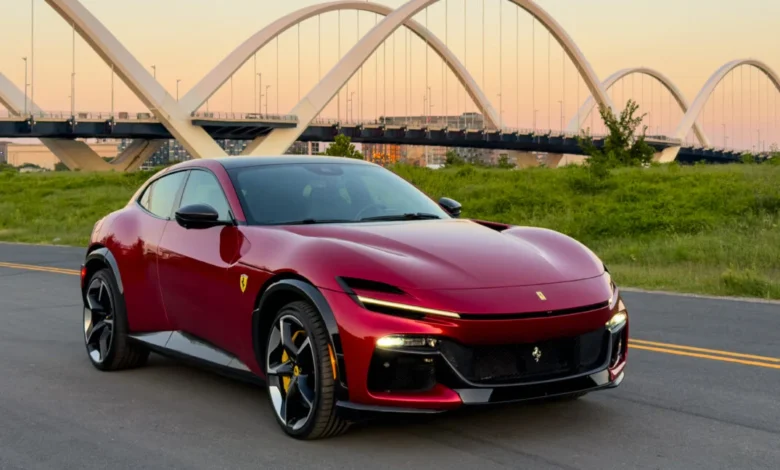
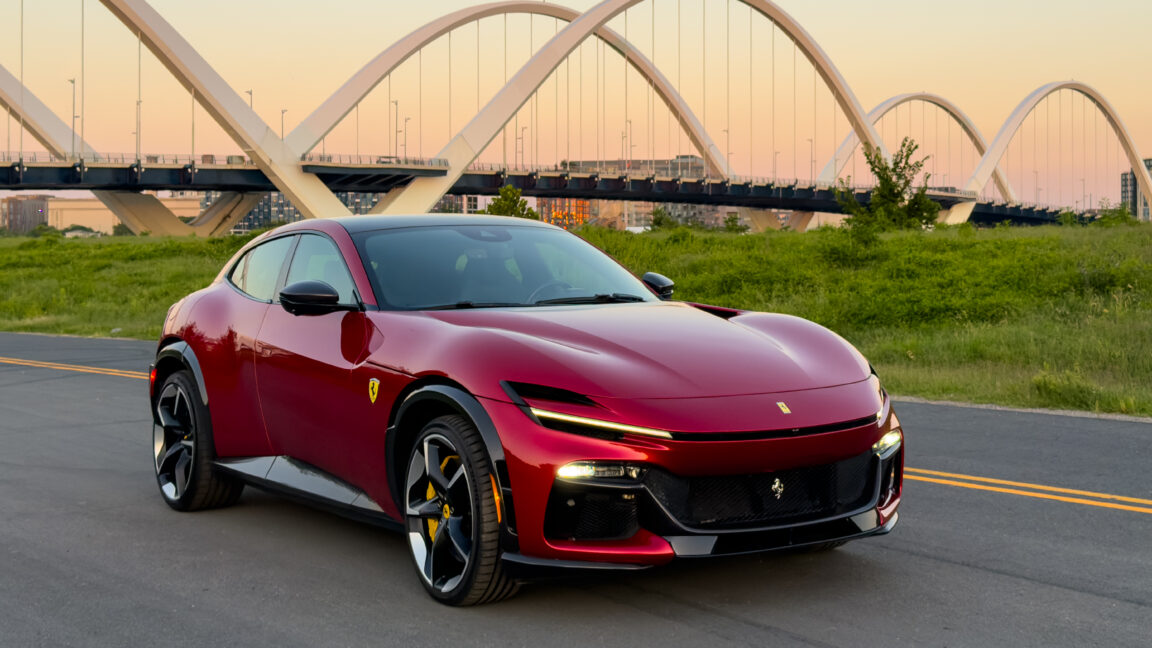
The Purosangue’s visual presence is defined by its dramatic proportions and the meticulous craftsmanship of its finishes. The test model, finished in "Rosso Portofino," highlights the complex surfacing of the bodywork. The way the paint interacts with sunlight underscores the vehicle’s sophisticated aerodynamics, which are achieved without the need for intrusive spoilers or wings.
Customization is a fundamental component of the Ferrari ownership experience. Through the Atelier and Tailor Made programs, clients can select from an almost infinite palette of colors and materials. This level of personalization is expected at the Purosangue’s price point, which starts at approximately $393,350. However, the average delivered price often sits significantly higher; the test unit in question reached $576,544, illustrating the impact of the extensive optional equipment list.
Market Context and Economic Implications
When compared to its direct rivals, the Purosangue occupies a unique fiscal and performance space. The Lamborghini Urus SE and the Aston Martin DBX offer high-performance utility, but they utilize different powertrain philosophies, often relying on forced induction to achieve their output. The Purosangue, by contrast, relies on a naturally aspirated V12 that produces 715 horsepower and 528 lb-ft of torque.
This performance comes with a trade-off in efficiency. At 12 mpg combined, the Purosangue is objectively thirsty by modern standards. For those seeking the Ferrari badge with greater efficiency, the company’s burgeoning battery-electric (BEV) offerings, such as the upcoming Luce, serve as a bridge to a greener future. Nevertheless, the Purosangue remains a triumph for those who prioritize the acoustic and mechanical purity of a naturally aspirated V12.
Analytical Outlook: Is the Purosangue a Daily Driver?
The debate regarding the "daily drivability" of a V12 Ferrari is largely settled by the Purosangue’s adaptive suspension system. With active roll stabilization, the vehicle is capable of neutralizing the typical body lean associated with taller vehicles, making it remarkably stable during spirited driving.
From a practical standpoint, the vehicle is designed to be usable in a variety of climates. When equipped with appropriate winter tires, the Purosangue’s all-wheel-drive system provides a level of capability that would be unthinkable in a traditional mid-engine Ferrari. It is a vehicle that succeeds in broadening the Ferrari experience, allowing owners to transport four adults in comfort while maintaining the ability to traverse winding roads with the agility of a much lighter car.
Official Stance and Industry Reception
Ferrari has consistently stated that the Purosangue is not an SUV, but rather a "four-door, four-seater" sports car. This distinction is vital to the brand’s identity. By refusing to follow the design cues of traditional luxury SUVs, Ferrari has maintained its premium pricing and exclusivity. Industry analysts note that the Purosangue has been a runaway success, with order books remaining full despite the vehicle’s high entry cost.
The broader impact of the Purosangue on the luxury market cannot be overstated. It has proven that even the most conservative heritage brands can adapt to changing consumer preferences without losing their soul. As Ferrari continues to balance its V12 legacy with the inevitable march toward electrification, the Purosangue serves as a defining moment in the company’s history. It is a bridge between the analog past and a technologically integrated future, offering a rare blend of utility and, more importantly, the unmistakable sensation of a Ferrari driving experience.
For the prospective buyer, the Purosangue is less about the technical specifications of its infotainment system and more about the holistic engineering that makes it feel "special." Whether navigating urban traffic or traversing a mountain pass, the vehicle succeeds in delivering on the promise of the Ferrari badge, regardless of its seating capacity or its four-door configuration. As production continues to scale, the Purosangue remains a standard-bearer for performance in the utility segment, challenging other luxury manufacturers to raise their game.