Blasting the Sacred: The Border Wall Extension on Mount Cristo Rey Sparks Conflict Over Religious Heritage and Environmental Preservation

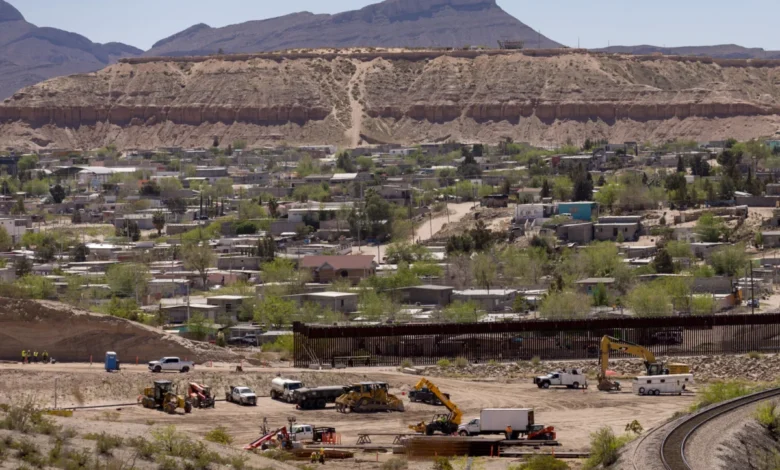
The rugged slopes of Mount Cristo Rey, a peak that serves as a spiritual and geographical cornerstone for the binational community of El Paso, Texas, Sunland Park, New Mexico, and Ciudad Juárez, Mexico, have become the latest flashpoint in the renewed effort to seal the United States’ southern border. On a typical Saturday morning, the mountain’s winding trails are populated by a diverse cross-section of the region: high school students on weekend hikes, mountain bikers navigating the rocky terrain, and soldiers from nearby Fort Bliss. From the summit, visitors stand in the shadow of a massive limestone statue of Christ the King, looking out over a metropolitan area of 2.5 million people where three states and two nations converge. However, the serenity of this shared space was shattered on a recent Monday morning when contractors began using explosives to blast the mountain’s southern face, clearing a path for a 30-foot-high steel bollard wall.
The construction is part of a broader, multi-million-dollar initiative by the second Trump administration to close the remaining gaps in the border barrier system. While walls have long existed in the urban corridors of El Paso and Sunland Park, the steep, unforgiving terrain of Mount Cristo Rey was historically considered a natural barrier. In recent years, however, the Department of Homeland Security (DHS) has prioritized this 1.3-mile stretch, citing high volumes of unauthorized crossings and a spike in migrant deaths in the surrounding desert. The project has ignited a fierce debate involving federal agencies, environmentalists, the Catholic Church, and local residents, pitting national security mandates against religious freedom and ecological preservation.

The Scope and Mechanics of the Anapra 16-4 Wall Project
The current construction on Mount Cristo Rey is categorized under the U.S. Customs and Border Protection (CBP) El Paso Anapra 16-4 Wall Project. The contract for this specific segment, along with two other nearby barriers, was awarded to SLSCO, a Galveston-based construction firm, for approximately $95 million. The project involves the installation of 30-foot steel bollards, spaced four inches apart, designed to provide both a physical deterrent and visual transparency for Border Patrol agents.
To facilitate the construction in such "historically challenging terrain," as CBP officials described it, the government has authorized the use of heavy machinery and explosives to "shave off" sections of the mountainside. This engineering feat requires the creation of new access roads and the leveling of steep inclines to accommodate the heavy equipment needed to sink the steel bollards deep into the rock. Funding for this project traces back to the 2020 DHS border wall appropriations, which were paused during the Biden administration but have been aggressively reactivated under current executive orders.
A Chronology of Conflict and Construction
The history of barriers on Mount Cristo Rey is marked by both private and federal interventions. In 2019, during the first Trump administration, a private organization known as "We Build the Wall" used crowd-funded donations to construct a half-mile section of wall on the mountain’s eastern flank. That project, which involved figures like Steve Bannon and the construction firm Fisher Sand and Gravel, was mired in controversy and legal battles. Bannon eventually faced federal charges for defrauding donors, and the private wall’s lights were extinguished after the organization’s accounts were frozen.

While federal construction largely stalled between 2021 and 2024, the administrative groundwork for the current project was laid in mid-2025. In June 2025, then-Homeland Security Secretary Kristi Noem exercised authority granted under the REAL ID Act of 2005 to waive more than two dozen federal laws. These waivers cleared the legal path for construction by bypassing the National Environmental Policy Act (NEPA), the National Historic Preservation Act, and the Endangered Species Act. By January of the following year, heavy equipment arrived at the site, and by March, the blasting of the Roosevelt Reservation—a 60-foot strip of federal land along the border—began in earnest.
Religious Significance and the Diocese’s Opposition
For the local Catholic community, Mount Cristo Rey is more than a landmark; it is a consecrated site. The mountain, originally known as Cerro de los Muleros (Mule Driver’s Mountain), was renamed after the 29-foot limestone statue of Christ the King was dedicated in 1939. The statue was the vision of a local priest from Smeltertown, a nearby company town that once housed Mexican-American workers. Today, the Mount Cristo Rey Restoration Committee, composed largely of descendants of those workers, maintains the site.
The Roman Catholic Diocese of Las Cruces, which owns a significant portion of the mountain, has emerged as one of the project’s most vocal opponents. Kathryn Brack Morrow, general counsel for the diocese, has argued that the wall’s presence transforms a "place of hope, faith, and communion" into a "place of fear, exclusion, and division." The diocese has repeatedly denied the Department of Justice’s requests for land access, leading to a potential legal showdown over eminent domain.

Church officials contend that the construction violates the Religious Freedom Restoration Act (RFRA). They argue that the presence of an active construction zone and a looming military-style barrier substantially burdens the religious exercise of thousands of pilgrims who participate in the annual Good Friday climb. Despite these objections, the federal government has utilized its control over the Roosevelt Reservation to proceed, effectively encircling the diocese’s property with a construction zone.
Environmental and Geological Treasure at Risk
Beyond its spiritual value, Mount Cristo Rey is a site of immense scientific importance. Geologists, including Eric Kappus, who discovered dinosaur footprints on the mountain in 2002, consider the site a "giant chalkboard" for Earth’s history. The footprints, left by Iguanodons and theropods approximately 80 to 100 million years ago, were preserved in sandstone when the area was the edge of a vast inland sea. While the primary track site is currently outside the immediate wall footprint, scientists fear that the seismic vibrations from blasting and the alteration of drainage patterns could cause irreparable damage to undiscovered fossils.
Biologically, the mountain serves as a critical wildlife corridor. Myles Traphagen of the Wildlands Network notes that the mountain connects the ranges of Northern Mexico with those in New Mexico and Texas. This corridor is essential for the genetic diversity of species such as the Mexican gray wolf. In 2017, GPS tracking showed a Mexican gray wolf moving from Chihuahua through Mount Cristo Rey into the United States. The completion of the wall would effectively sever this migration route.

Local residents also point to the displacement of smaller species. Robert Ardovino, a Sunland Park business owner, noted that the increased activity of Border Patrol vehicles and construction crews has already decimated local populations of burrowing owls. "Concern for the environment is last on their list," Ardovino remarked, echoing the frustrations of many who feel the biological surveys conducted by CBP—which found "low to moderate" suitability for wildlife—were insufficient.
Legal Waivers and the Absence of Oversight
The speed of the construction is largely attributable to the 2005 REAL ID Act, which gives the DHS Secretary unprecedented power to waive any law that might impede the "expeditious construction" of border barriers. By waiving NEPA, the government was not required to produce a full Environmental Impact Statement (EIS), which would have mandated public hearings and a detailed study of alternatives. Instead, a brief "environmental summary report" was prepared, which remains unavailable to the general public.
This lack of transparency has extended to the blasting protocols. Residents of the Anapra neighborhood in Ciudad Juárez, located just feet from the blast sites, reported receiving minimal warning before the explosions began. Similarly, local landowners and the Mount Cristo Rey Restoration Committee claimed they were not notified of the specific blasting schedule, raising concerns about safety during public visiting hours on the mountain.

Broader Implications and Future Outlook
The transformation of Mount Cristo Rey into a "National Defense Area"—a designation that allows for trespassing charges against those who enter construction zones—signals a shift toward a more militarized border landscape. While CBP maintains that the wall is necessary to "secure historically challenging terrain," the project’s critics see it as a symbolic and physical scar on a culturally unified region.
As the Department of Justice prepares for potential eminent domain filings to seize the remaining diocesan land, the battle over Mount Cristo Rey is likely to move from the mountainside to the federal courts. The outcome will set a significant precedent for how the U.S. government balances national security mandates against the protections of the First Amendment and the preservation of irreplaceable natural history. For now, as the dust from the latest round of blasting settles, the "Northern Pass" remains a landscape in transition, where the echoes of ancient dinosaurs and modern construction crews collide in the high desert air.