Arizona Corporation Commission Elections Spark Fierce Debate Over Skyrocketing Utility Costs and Consumer Accountability

The dream of small business ownership in Arizona is increasingly colliding with the harsh reality of soaring operational costs, turning a typically obscure state regulatory race into a central battleground for the upcoming election cycle. At the heart of this conflict is the Arizona Corporation Commission (ACC), a powerful five-member body tasked with overseeing the state’s water and electric utilities. With Arizona’s utility bills among the most volatile in the region, the commission has become the focal point of a heated debate over corporate oversight, consumer protection, and the future of the state’s energy grid.
The urgency of the situation was recently highlighted by Koral Casillas, a Phoenix-based entrepreneur who transitioned from corporate life to small business ownership five years ago. Casillas, co-owner of Monsoon Market and the coffee and wine shop Strip Mall, recently shared a sobering financial reality: her August utility bill spiked to $1,500, followed by a $1,700 charge in September. For a small business, such unpredictable and ballooning overhead costs represent a systemic threat to viability. Casillas’s experience is not an anomaly; it is part of a broader trend of rising energy costs that has galvanized voters and placed the ACC at the center of political scrutiny.
The Constitutional Role of the ACC
Established in 1912 as part of the state’s founding documents, the Arizona Corporation Commission occupies a unique position in American governance. Unlike many other state agencies that answer to a governor or legislature, the ACC is an independent body whose commissioners are elected by the public. Its mandate is expansive, covering the regulation of public service corporations, including water, gas, and electric utilities.
The commission holds the authority to set the rates that utilities charge, determine the allowable rate of return for shareholders, and dictate the infrastructure investment strategies that define how power is generated and distributed across the state. Because the commission functions as a quasi-judicial body, its members are tasked with balancing the financial health of utility companies with the economic well-being of the ratepayers. Critics argue, however, that the current composition of the commission—which saw Republicans win all five seats in 2024—has skewed this balance heavily in favor of utility profits at the expense of consumer interests.
A Timeline of Regulatory Shifts
To understand the current tension, one must look at the recent trajectory of commission policies. Since the 2024 election, the ACC has implemented a series of deregulatory measures that have fundamentally altered the landscape for Arizona ratepayers.
- July 2026: The commission voted to repeal long-standing energy efficiency standards. These rules had historically required utilities to help customers reduce energy consumption, a move that advocates claim saved consumers over $1.7 billion in cumulative costs.
- Late 2026: The commission approved the implementation of "formula rate plans." This policy allows utilities to bypass the traditional, rigorous public hearing process for certain rate hikes, instead adjusting prices annually based on a pre-determined formula.
- Ongoing: The ACC is currently evaluating a request from Arizona Public Service (APS) for a 14 percent rate increase. If approved, this would mark the third price hike for APS customers in just four years, further exacerbating the financial strain on households and local businesses.
Data Centers and the Large Load Debate
A significant point of contention in the current election cycle is the burden of infrastructure costs associated with "large load" customers, specifically the proliferation of data centers in the Phoenix metropolitan area. These facilities consume massive amounts of electricity, requiring significant investments in grid infrastructure.
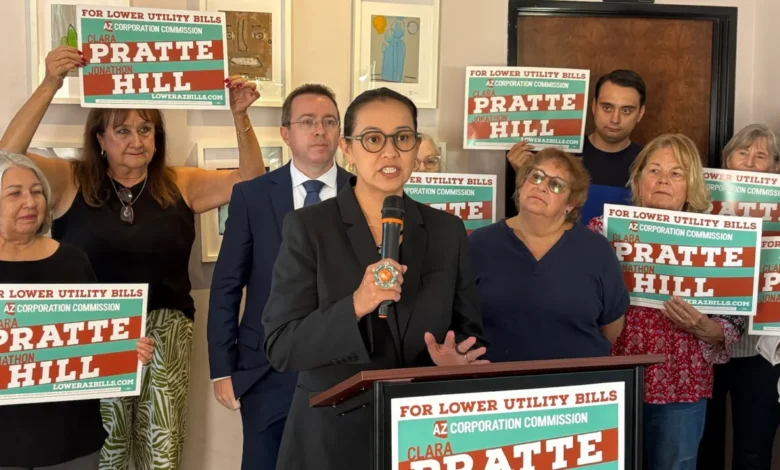
Democratic candidates Clara Pratte and Jonathon Hill have campaigned on the premise that the costs for these grid upgrades are being unfairly shifted onto residential and small-business ratepayers. Citing a recent independent analysis, the candidates pointed to data suggesting that between 2023 and 2025, everyday customers subsidized $587 million in infrastructure costs attributed to the large-load sector.
Pratte, a member of the Navajo Nation and a former clean energy developer, argues that this dynamic is unsustainable. "Arizonans are paying attention to these issues like they never have before, because it’s affecting them so much," Pratte said during a recent press conference. Her campaign, alongside Hill’s, is demanding a comprehensive, transparent audit of utility books to determine the extent of these cross-subsidies. They have pledged that, if elected, they would push for an immediate investigation and potential reimbursement for ratepayers if the findings confirm that residential bills have been artificially inflated to support industrial expansion.
Official Responses and Counter-Arguments
The utility companies, particularly APS, have pushed back against these allegations. In a formal statement regarding the analysis of data center costs, APS dismissed the figures as "false conclusions" that oversimplify the complex technical and economic realities of utility grid management. The utility maintains that its rate structures are designed to comply with commission-approved guidelines and that the integration of large-scale industrial users can, in the long term, help stabilize the grid by providing consistent demand.
However, the incumbent Republican commissioners—Kevin Thompson and Ralph Heap—have remained largely silent on the specific criticisms raised by their opponents. Heap, currently embroiled in a separate campaign finance investigation, has declined to comment on the allegations regarding ratepayer transparency. The lack of direct engagement from the incumbents has provided further fuel for the opposition, who frame the silence as a dereliction of duty.
The Broader Impact on Arizona’s Economy
The economic implications of the ACC’s decisions extend far beyond individual utility bills. Polling data from the Arizona Public Interest Research Group (PIRG) Education Fund and The Nature Conservancy indicates that approximately 80 percent of Arizonans have experienced an increase in their electricity bills over the past two years. More concerning is the behavioral change forced by these costs: over 60 percent of respondents reported that they keep their thermostats at uncomfortable levels during the state’s extreme summer months to avoid unmanageable bills.
This "heat poverty" has significant public health and economic consequences. When small businesses like those owned by Koral Casillas are forced to allocate thousands of dollars more to utility companies, those funds are pulled away from payroll, inventory, and community investment. Furthermore, the repeal of energy efficiency standards—which the commission argued were outdated—has removed a critical tool for consumers to mitigate their own costs through weatherization and appliance upgrades.
Conclusion and Outlook
As the election approaches, the Arizona Corporation Commission finds itself at a crossroads. The central question for voters is whether the commission will return to a more interventionist, consumer-protective model of regulation or continue with the current path of deregulation and utility-friendly policy.
The arguments presented by candidates like Pratte and Hill suggest a shift toward greater accountability, emphasizing the need for renewable energy development to lower long-term costs and a more transparent rate-setting process. Conversely, the incumbents advocate for a model that prioritizes the financial stability of the utilities to ensure grid reliability.
For the residents of Arizona, the outcome of this race will likely have a direct impact on their household budgets for years to come. With the state’s population continuing to grow and the demand for energy—driven by both residential expansion and the booming tech sector—the next set of commissioners will face an increasingly difficult task in balancing the competing interests of a modern, energy-hungry economy and the families and businesses that form its backbone.