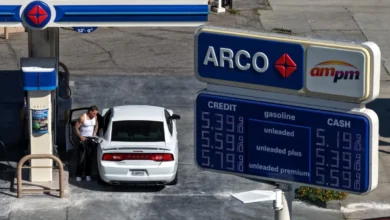
Record-Breaking Diesel Prices Threaten U.S. Economy as Geopolitical Crises Converge


The American economic landscape is facing an unprecedented strain as diesel fuel prices shatter historic records, driven by a volatile cocktail of compounding global conflicts, constrained refinery capacities, and acute supply chain vulnerabilities. According to data released by the American Automobile Association (AAA), the national average price for a gallon of diesel reached a staggering $5.98 as of September 10. This figure marks an extraordinary $2.31 surge since late February, when the United States and Israel initiated military actions against Iran. While the national average paints a grim picture, regional disparities have pushed the financial burden to even more alarming heights; in states like California, consumers are grappling with retail prices as high as $7.91 per gallon.
Although the average motorist does not pump diesel directly into a personal passenger vehicle, the commodity serves as the literal lifeblood of the modern commercial economy. Diesel powers the heavy-duty semi-trucks, freight trains, cargo ships, and agricultural machinery responsible for transporting nearly every consumer good from production sites to store shelves—spanning everything from fresh dairy products and household essentials to raw lumber and construction materials. Consequently, the exorbitant cost of diesel is rapidly embedding itself into the final price tags of everyday goods, threatening to trigger a fresh wave of inflationary pressures just as the nation approaches a critical political and seasonal juncture.
The Chronology of a Fuel Crisis: From Regional Conflicts to Global Shockwaves
To understand the severity of the current market disruption, one must examine the timeline of geopolitical events that have systematically dismantled global energy supply chains. The roots of the present crisis extend back to the prolonged disruptions sparked by the 2022 Russian invasion of Ukraine, an event that previously pushed U.S. diesel prices to a record high of $5.82 per gallon. However, the current crisis has been exponentially exacerbated by the outbreak of hostilities involving Iran in late February.
The military campaign involving the United States, Israel, and Iran has resulted in the de facto closure of the Strait of Hormuz—a crucial maritime chokepoint through which approximately 10 percent of all globally traded seaborne diesel once flowed. The sudden constriction of this vital artery sent shockwaves through international petroleum markets. Compounding the issue further, ongoing and increasingly sophisticated military operations by Ukraine targeting Russian domestic oil refineries have successfully curtailed Moscow’s capacity to export refined products. As a result, Russia has effectively been excised as a major supplier to the global market, removing a critical cushion of international supply.
Domestically, the timing could hardly be worse. U.S. refineries are currently operating near absolute maximum capacity, leaving domestic producers virtually incapable of ramping up output to offset the loss of foreign imports. According to recent data from the Energy Information Administration (EIA), domestic distillate inventories have plummeted to their lowest levels since 1982, leaving the nation exceptionally vulnerable as it transitions into periods of peak seasonal demand.
Analyzing the Financial Toll on American Households and Supply Chains
The macroeconomic repercussions of this fuel crisis are already quantified in staggering monetary terms. Research compiled by a specialized tracking project at Brown University indicates that the skyrocketing cost of diesel has imposed an additional $46 billion financial burden on U.S. consumers, translating to roughly $350 per household. While rising gasoline prices have extracted an even heavier toll—totaling approximately $55 billion—the percentage spike in diesel has been markedly steeper. Over the course of the crisis, diesel prices have leaped by an astonishing 61 percent, far outpacing the 41 percent increase recorded for standard gasoline.
Experts note that the lag time between wholesale fuel spikes and retail price increases is a structural reality of modern supply chains. David Ortega, a professor of food economics and policy at Michigan State University, explained to the press that the initial shock of rising fuel costs is frequently absorbed temporarily along distribution networks via existing freight contracts and retailer profit margins. However, as those long-term contracts expire and are renegotiated at higher rates, and as mandatory carrier fuel surcharges take effect, the cumulative costs inevitably cascade down to the consumer level, ultimately manifesting as higher prices at grocery stores and retail outlets.
Patrick De Haan, head of petroleum analysis for the fuel-tracking application GasBuddy, emphasized the unique vulnerability of the diesel market compared to standard gasoline. "Diesel right now is caught up in more of a geopolitical turmoil than gasoline," De Haan noted, pointing to the dual pressures exerted by the Middle East conflict and the crippling of Russian refining infrastructure.
The Looming Threat of Autumn Demand and Winter Heating Crises
As the calendar turns toward autumn, energy analysts warn that the situation could deteriorate further before any relief materializes. David Russell, global head of market strategy at brokerage firm TradeStation, highlighted the precarious baseline from which the market is currently operating. "We’re entering a key period for diesel consumption with the lowest inventories on record for early September," Russell cautioned. He pointed out that the agricultural and logistics sectors traditionally demand significantly higher volumes of diesel during the fall harvest and pre-holiday shipping surge, raising the stakes for the current crisis and increasing the statistical probability of even sharper price spikes.
Furthermore, the impending winter season introduces a perilous overlap between transportation fuels and residential heating needs. Home heating oil is chemically and physically nearly identical to diesel fuel. Consequently, the millions of American households—predominantly concentrated in the Northeastern United States—that rely on heating oil for warmth during the colder months are facing the prospect of unprecedented utility bills.
This financial squeeze arrives simultaneously with political controversy surrounding federal assistance. The administration of President Donald J. Trump has proposed the complete elimination of the Low Income Home Energy Assistance Program (LIHEAP), a federal initiative designed to help vulnerable, low-income families afford their home energy and fuel bills.
Mark Wolfe, executive director of the National Energy Assistance Directors Association, underscored the regional inequality of the burden in statements to media outlets. "If you’re in the Northeast, then this is much more burdensome than anywhere else in the country," Wolfe said. "Families are getting hit by both gasoline and heating oil."
Political Implications and the Midterm Election Calculus
The convergence of economic hardship and essential energy needs is casting a long shadow over the political landscape. These surging costs are punishing consumers at a sensitive moment: immediately preceding the midterm elections, when economic stewardship and the cost of living invariably dominate voter priorities.
While fuel prices are traditionally considered secondary factors in electoral decision-making, energy analysts suggest this cycle may prove to be an exception. Kevin Book, head of research at the energy consulting firm ClearView Energy Partners, observed that in cold-weather states and regions heavily dependent on alternative home heating fuels rather than natural gas, the pain at the pump and the home furnace could become a decisive ballot-box issue.
Pathways to Recovery: A Slow and Complex Road Ahead
For consumers and policymakers desperate for relief, energy experts offer a sobering assessment: even if diplomatic breakthroughs were to miraculously resolve the conflicts in Iran and Ukraine immediately, the restoration of normal pricing and inventory levels will be a protracted, multi-week or multi-month process.
De Haan of GasBuddy outlined the necessary sequence for market normalization, explaining that physical trade flows must first stabilize and international shipping lanes must reopen before global inventories can realistically begin to rebuild. "Only after inventories have recovered do diesel prices really see a full decline," De Haan concluded. Until that arduous recovery process runs its course, American consumers, freight operators, farmers, and homeowners will continue to bear the heavy financial weight of a deeply disrupted global energy market.