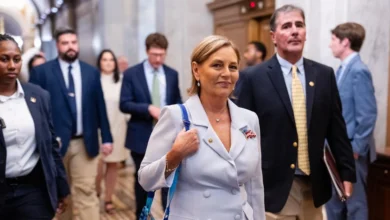
The debate surrounding the rapid expansion of data centers in Pennsylvania has reached a fever pitch, placing Congressman Rob Bresnahan in the center of a political crossfire. As the Republican representative for the state’s Eighth District, Bresnahan is currently championing legislation that would grant municipalities more stringent control over the siting and construction of these massive, energy-intensive facilities. The move, underscored by a high-profile television advertising campaign in the Scranton and Wilkes-Barre markets, portrays him as a defender of local communities against the encroachment of "big data."
However, this recent pivot toward skepticism stands in stark contrast to his public remarks from just last year, when he lauded the industry as a vital engine for economic revitalization. This shift has prompted renewed focus on his extensive financial portfolio, which contains millions of dollars in investments directly linked to the very companies leading the charge in data center development and artificial intelligence infrastructure.
A Chronology of Changing Priorities
The narrative surrounding data centers in Northeastern Pennsylvania has evolved rapidly since early 2025. In April 2025, during the nascent stages of the regional AI-driven development boom, Representative Bresnahan offered an optimistic outlook on the industry. At the time, he identified data centers as essential "catalysts for economic growth and technological innovation," framing them as a pathway to establishing a 22nd-century workforce for the region.
By the summer of 2026, the political climate had shifted dramatically. According to an August 2026 poll conducted by Franklin & Marshall College, nearly 80% of Pennsylvania voters expressed opposition to the construction of data centers within their local communities. This surge in public apprehension is tied to concerns over land use, environmental impact, and the massive electricity demands these facilities place on local grids.
Responding to this shift in voter sentiment, Bresnahan introduced federal legislation in June 2026 designed to empower local municipal boards to veto or regulate data center projects more aggressively. His recent television ads emphasize this legislative action, with the congressman stating, "Northeastern Pennsylvania is our land and our home, but to big data, we’re just land and dollar signs."
The Complexity of the Congressman’s Portfolio
While the congressman’s legislative rhetoric has hardened against large-scale developers, his personal financial disclosures paint a picture of deep integration with the sector. A review of his August 2026 financial disclosure filing reveals that Bresnahan holds between $19,005 and $110,000 in equity in firms such as Equinix, Digital Realty Trust, and Iron Mountain—all of which are major players in the operation of large-scale data centers.
Beyond the facilities themselves, the representative holds between $804,024 and $2.04 million in companies that provide the essential building blocks of the AI revolution. This list includes industry titans like NVIDIA, Advanced Micro Devices, Micron Technology, and Taiwan Semiconductor Manufacturing Company. Furthermore, he retains between $777,000 and $1.78 million in major technology corporations—including Amazon, Alphabet, Meta, and Oracle—that serve as the primary drivers of global data center capacity expansion.
Perhaps most notably, the disclosure indicates a stake of between $15,001 and $50,000 in Blackstone Inc. In July 2025, Blackstone made headlines by announcing significant energy infrastructure investments in Northeastern Pennsylvania, specifically aimed at supporting the region’s burgeoning data center market.
Campaign Response and Ethical Considerations
The Bresnahan campaign has maintained that the congressman’s financial portfolio is managed by independent professional advisers and that he has no direct input regarding specific stock trades. Spokesperson Samantha Bullock defended the congressman’s legislative record, arguing that the push for local control is not synonymous with an anti-investment stance.
"Favoring local control over data center development does not make someone anti-investment," Bullock stated. "It shows that they support the will of the people, and in fact it is important and responsible to consider the blue-collar jobs and economic development that might benefit a region like Northeastern Pennsylvania when addressing and legislating this issue."
Despite this, the congressman’s history on stock trading transparency remains a point of contention. During his 2024 campaign, Bresnahan made a vocal pledge to support a ban on congressional stock trading, arguing that lawmakers should not be permitted to influence legislation that could impact their own holdings. Although he introduced a bill to this effect upon entering office, the measure has failed to gain traction. Meanwhile, his own active trading behavior has placed him among the most prolific stock traders in Congress, with over 500 transactions reported since his swearing-in, according to data from Capitol Trader.
The Broader Political Landscape
The local political stakes are high as Bresnahan faces a challenge from Scranton Mayor Paige Cognetti. The race has increasingly focused on which candidate offers a more pragmatic and transparent approach to managing the influx of industrial tech developers.
Cognetti’s campaign has faced its own scrutiny regarding the management of local zoning. During a July 2026 Scranton City Council meeting, Councilman Sean McAndrew noted that an ordinance proposed by the mayor’s administration to regulate data centers had stalled in the legislative process for months. The Cognetti campaign, in turn, has highlighted the lack of transparency in Bresnahan’s own investments. Unlike the congressman, Cognetti’s most recent disclosures indicate that she holds no individual stocks, maintaining her assets primarily in diversified mutual funds and retirement accounts.
Analysis: The Conflict of Interest Dilemma
The situation involving Representative Bresnahan underscores a persistent tension in American politics: the intersection of personal wealth management and legislative authority. When a member of Congress holds significant positions in sectors that are the direct subject of their legislative work, the appearance of a conflict of interest can undermine public trust, regardless of whether the lawmaker’s intent is purely focused on constituent needs.
The data center industry is currently at a unique juncture. With approximately 29 projects reportedly in the planning or consideration stages in Northeastern Pennsylvania alone, the legislative framework governing these projects will have long-term consequences for the region’s economic trajectory, environmental health, and energy pricing.
The primary implication of Bresnahan’s legislative push is a shift in the balance of power from state and federal regulators to local municipalities. While this aligns with the current grassroots sentiment in his district, it also creates a fragmented regulatory environment that could complicate the operations of the very firms in which the congressman is heavily invested. Whether this represents a genuine attempt at constituent advocacy or a political maneuver to manage conflicting interests remains a central question for voters in the district.
As the election approaches, the dual reality of Bresnahan’s legislative efforts and his investment portfolio will likely remain a focal point. The challenge for the congressman is to reconcile his public call for limiting the influence of "big data" with his continued financial participation in the growth of the global AI and technology infrastructure sector. Until federal standards regarding congressional stock ownership are reformed, these types of disclosures will continue to serve as a critical barometer for public confidence in the integrity of the legislative process.