Record Global Temperatures and Marine Heatwaves Signal a Climate System in Crisis as El Niño Intensifies


The northern hemisphere is currently grappling with a summer of unprecedented thermal extremes, as a dual assault of land-based heatwaves and record-breaking marine temperatures reshapes the global climate landscape. From the urban corridors of the United States to the historic capitals of Western Europe, the month of June and the early weeks of July have rewritten the meteorological record books, signaling a transition into a more volatile climate era. This escalation is being driven by a combination of long-term anthropogenic global warming and the emergence of a "super" El Niño event, which scientists warn could make 2024 the hottest year in human history.
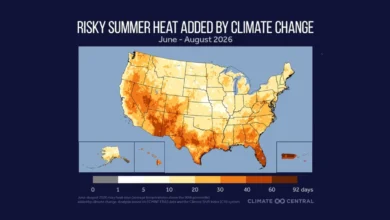
In the United States, the Fourth of July holiday served as a grim milestone for the climate crisis. Dozens of cities reported their hottest Independence Day celebrations on record, with thermometers frequently crossing the 100-degree Fahrenheit threshold. The human toll has been immediate and severe; in New Jersey alone, state authorities reported dozens of heat-related fatalities over the holiday weekend. Meanwhile, across the Atlantic, the European Union’s Copernicus Climate Change Service confirmed that Western Europe experienced its hottest June since records began. In some regions, the mortality rate associated with extreme heat has begun to eclipse traditional public safety concerns. Data scientist Ruth Engel of the World Resources Institute noted that in the past year, heat-related deaths in Europe have surpassed those caused by traffic accidents, underscoring the growing lethality of the summer season.
The Warming of the World’s Oceans
While the heat on land has captured headlines, a more profound and potentially more dangerous shift is occurring beneath the waves. The world’s oceans are currently experiencing what scientists describe as a "fever." According to data from the Copernicus Service, June 2024 was the hottest month ever recorded for global sea surface temperatures. Currently, nearly 40 percent of the global ocean surface is experiencing a marine heatwave. These are not minor fluctuations; intense "hot patches" in the Mediterranean Sea and parts of the Pacific Ocean are recording temperatures more than 10 degrees Fahrenheit above historical averages.
This marine warming is part of a sustained trend that began in early 2023. The implications for the planet are systemic. The oceans act as the Earth’s primary heat sink, absorbing more than 90 percent of the excess heat trapped in the atmosphere by greenhouse gas emissions. However, the capacity of the oceans to buffer this heat is being pushed to its limit. As surface waters warm, they exchange increased levels of heat and moisture with the atmosphere, creating a feedback loop that intensifies weather patterns on land. A recent study published in the journal ScienceDirect highlighted this connectivity, finding that at least 20 percent of land-based heatwaves now originate as marine heatwaves.
Chronology of a Warming Crisis
The current spike in global temperatures is the culmination of a multi-year acceleration in climate indicators. In early 2023, oceanographers began noticing an anomalous rise in North Atlantic temperatures that defied standard seasonal models. By mid-2023, global average temperatures had begun to break daily records with alarming frequency.
The timeline of the current crisis includes:
- June 2023: Global sea surface temperatures hit record highs, a trend that has continued for 12 consecutive months.
- January 2024: The World Meteorological Organization confirms 2023 as the warmest year on record, but warns that 2024 could be worse due to El Niño.
- June 2024: Western Europe and the global oceans set new monthly temperature records.
- July 2024: Record-breaking heat domes settle over the United States and Canada, while Super Typhoon Bavi forms in the Pacific, fueled by abnormally warm waters.
The Role of the "Super El Niño"
Central to the current meteorological instability is the arrival of El Niño, a naturally occurring climate pattern characterized by the warming of surface waters in the central and eastern Pacific Ocean. While El Niño is a periodic event, its current iteration is being supercharged by the underlying baseline of global warming. The National Oceanic and Atmospheric Administration (NOAA) recently issued a forecast suggesting an 81 percent probability that this year’s event will qualify as a "super El Niño," placing it among the strongest in recorded history.
Matthew England, a professor of physical oceanography at the University of New South Wales, explains that the second year of an El Niño cycle is typically when the most significant temperature records are shattered. "The first year tends to be on the warm side, but the true peak of the atmospheric response usually follows the initial ocean warming," England stated. This suggests that the extreme conditions witnessed in the first half of 2024 may only be a prelude to even higher temperatures in late 2024 and early 2025.
The mechanics of El Niño involve the redistribution of heat from the deep ocean to the surface. This heat then interacts with the atmosphere, altering the path of jet streams and reshaping weather patterns globally. While El Niño typically suppresses hurricane activity in the Atlantic, it significantly increases the intensity of cyclones in the Pacific and leads to heavier-than-normal rainfall in regions like California and the southern United States.
Meteorological Feedback Loops and Atmospheric "Sponginess"
The rise in temperature is also fundamentally changing the physics of the Earth’s atmosphere. Scientists point to the Clausius-Clapeyron relation, a basic principle of thermodynamics which dictates that for every 1 degree Celsius (1.8 degrees Fahrenheit) of warming, the atmosphere can hold approximately 7 percent more moisture.
This increased "sponginess" of the air has two primary consequences. First, it allows the atmosphere to hold onto water for longer periods, leading to more prolonged and intense droughts. Second, when the atmosphere finally releases that moisture, it does so in massive, concentrated deluges. This was evidenced by the catastrophic flooding in Central Texas last year and the recent intensity of Super Typhoon Bavi in the Western Pacific. Bavi is the second super typhoon in just a few months to show the clear "fingerprint of climate change," characterized by rapid intensification fueled by deep pools of warm ocean water.
Furthermore, ocean warming contributes directly to sea-level rise through thermal expansion. As water molecules heat up, they expand, physically increasing the volume of the world’s oceans. This process, combined with the melting of polar ice sheets, is pushing coastal water levels higher, making storm surges from events like Typhoon Bavi more destructive than they would have been in previous decades.
Official Responses and Expert Analysis
The scientific community is expressing increasing urgency regarding the need for adaptation and infrastructure resilience. Zachary Labe, a scientist at Climate Central, notes that while the "heat domes" creating current conditions are familiar meteorological phenomena, climate change is "acting to boost everything." According to Labe, the baseline temperature is now so high that even "normal" weather patterns result in extreme outcomes.
In Florida, the impact is being felt in both the environment and the economy. Water temperatures off the state’s Gulf coast have hovered near 90 degrees Fahrenheit, a level more typical of a hot bath than a natural marine ecosystem. This has forced residents to increase air-conditioning usage to unprecedented levels, straining the power grid and increasing energy costs. Experts believe these local conditions are directly linked to the broader marine heatwaves in the Mediterranean and the Pacific.
Environmental health advocates are also calling for a shift in how governments perceive heat. Ruth Engel of the World Resources Institute argues that heat should no longer be viewed as a future threat but as a current public health emergency. "It’s not something we need to prepare for 25 years from now," Engel said. "It’s already a deadly health issue now."
Broader Implications for Biodiversity and the Economy
The persistent warming of the oceans is also precipitating a biological catastrophe. Coral reefs, which support a quarter of all marine life, are currently undergoing a global bleaching event. When water temperatures remain too high for too long, corals expel the algae living in their tissues, turning white and eventually dying if the heat does not subside. This loss of biodiversity has direct economic consequences for fisheries and tourism industries worldwide.
In the agricultural sector, the shift between extreme El Niño and La Niña years is becoming more erratic. Some researchers hypothesize that the "swings" between these two states are becoming more frequent and intense. For farmers, this means a decrease in predictability, with years of extreme drought followed immediately by years of extreme flooding, complicating food security efforts globally.
As the northern hemisphere moves deeper into the summer of 2024, the convergence of record ocean heat and a strengthening El Niño suggests that the period of relative climatic stability is over. The data from Copernicus and NOAA serves as a stark reminder that the global climate system is in a state of flux, necessitating a rapid reevaluation of urban planning, public health protocols, and international environmental policy. The records being broken today are likely to become the benchmarks for tomorrow, as the planet adjusts to a new, hotter reality.
Related posts: