Trump dismisses AI doomsday warnings and announces the creation of an AI Force and czar to accelerate U.S. innovation

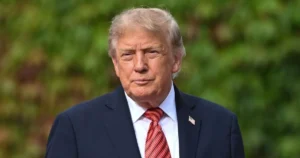
President Donald Trump announced on Saturday the formation of a dedicated "AI Force" and plans to appoint an artificial intelligence czar, signaling a decisive regulatory pivot aimed at accelerating domestic technological growth while explicitly rejecting calls for development slowdowns or precautionary oversight.
In a series of detailed statements posted to Truth Social, the president outlined a deregulatory framework designed to preserve American dominance in the rapidly advancing sector. Trump emphasized that his administration would resist proactive federal restrictions that could hamper industry momentum, arguing instead that existing civil and criminal justice mechanisms are fully sufficient to police any illicit applications of the technology.
The announcement arrives at a critical juncture for federal policymaking, as lawmakers on Capitol Hill grapple with competing pressures from tech executives demanding federal safety guidelines, national security hawks fixated on the geopolitical race with China, and libertarian factions warning against government overreach. Trump’s latest initiative underscores a firm White House stance: that competitive supremacy supersedes speculative doomsday scenarios propagated by industry leaders.
The Deregulatory Mandate and Economic Projections
Trump’s Saturday declarations build upon a broader administration strategy to position the United States as the undisputed global leader in artificial intelligence. By explicitly rejecting the regulatory models favored by certain tech executives—such as the voluntary pauses and federal licensing schemes previously pitched by developers from firms like Anthropic and OpenAI—the administration has chosen a path favoring uninhibited private-sector expansion.
"We will not in any way hinder or stifle the Growth of this incredible Industry," Trump wrote on Truth Social. "Rather, we will cherish it, help it, and watch over it, as it grows!"
To operationalize oversight without imposing preemptive shackles, the administration plans to rely on established legal frameworks rather than new regulatory bureaucracies. "For this purpose, I am forming the AI Force, much like I did Space Force, which has been a tremendous SUCCESS, in my First Term," Trump continued. "To that end, I will be announcing, in the near future, the AI ‘Czar’ — Only High I.Q. individuals need apply!"
While the president did not immediately disclose the organizational structure, funding mechanisms, or explicit jurisdiction of the proposed AI Force, the militaristic naming convention mirrors his first-term approach to specialized national security domains like space operations.
Furthermore, Trump offered aggressive economic forecasts for the sector, predicting that artificial intelligence could eventually account for up to 25% of the United States Gross Domestic Product (GDP). Framing the technology as the defining infrastructure of the modern era, he likened its potential societal footprint to a successor of the Industrial Revolution and the internet. "AI is the next Industrial Revolution, or Internet, but will be even larger and more impactful, possibly as much as 25% of our Country’s GDP," he wrote. "We are leading China, and the rest of the World, and I intend to keep it that way!"
Rhetorical Overhauls and Public Engagement
In an unconventional pivot following his policy pronouncements, Trump also targeted the nomenclature of the technology itself. Questioning the linguistic precision of the term "artificial intelligence," the president initiated an informal public poll on Truth Social to rebrand the discipline entirely.
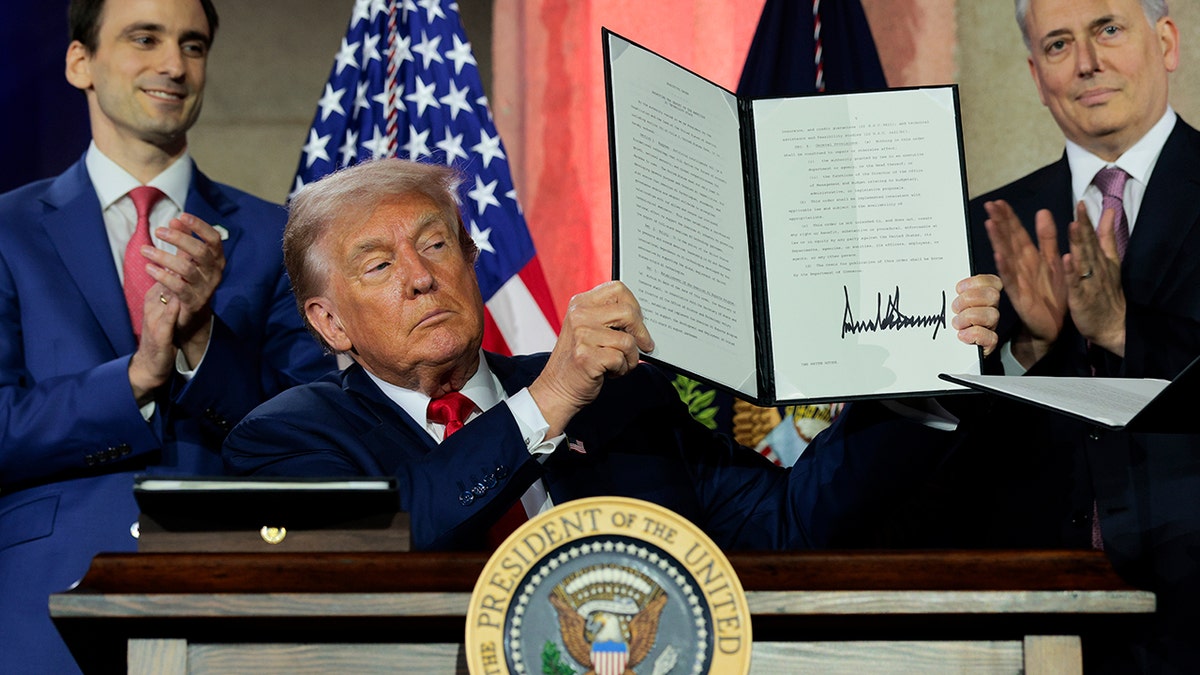
"Many people think that the words ‘Artificial Intelligence’ are inaccurate, and very ineloquent, relative to AI, or Artificial Intelligence," Trump wrote. "A far more elegant and accurate description of this new phenomena would be Superior Intelligence (SI) or, Extreme Intelligence (EI) or, Supreme Intelligence (SI). This is a Poll, and I would appreciate everybody voting! Which is the best name for this ever growing ‘Revolution?’"
While the linguistic proposal was met with characteristic amusement and debate across digital platforms, it underscored the administration’s desire to frame the technological epoch in terms of supreme national capability rather than synthetic imitation.
Geopolitical Pressures and the Race with China
At the heart of the administration’s resistance to regulatory friction is the overarching imperative of geopolitical competition. Washington policymakers across both major parties have increasingly viewed artificial intelligence through the lens of a zero-sum race against adversarial nations, chief among them the People’s Republic of China.
White House tech advisors, including David Sacks, have consistently voiced opposition to development pauses, arguing that any self-imposed slowdown by American firms would merely cede ground to foreign competitors operating without equivalent ethical or safety constraints. This sentiment is shared by a faction of Republican lawmakers on Capitol Hill who have expressed skepticism toward Big Tech’s sudden lobbying for stringent federal rules. Some lawmakers have publicly suggested that established industry giants are leveraging "doomsday" narratives—such as speculative warnings regarding human extinction or catastrophic autonomous system failures—to pull up the ladder behind them, effectively erecting regulatory moats that lock out smaller startups and open-source developers.
Conversely, the debate has created unusual intra-party friction. Libertarian-leaning legislators like Senator Rand Paul have clashed with colleagues over legislative proposals like mandatory "kill switches" and federal licensing requirements, warning that such measures invite heavy-handed state control over software development. Meanwhile, Democratic lawmakers, who previously championed rapid federal investment in digital infrastructure, have increasingly advocated for brakes and guardrails to mitigate risks related to algorithmic bias, copyright infringement, disinformation, and workforce displacement.
Chronology of Recent Federal AI Policy Developments
The evolution of federal engagement with artificial intelligence has accelerated dramatically over the past two years:
- Mid-2023 to Late 2024: Congress holds a succession of high-profile hearings featuring executives from major AI laboratories. Discussions center on existential risks, copyright laws, and the potential need for a dedicated federal oversight agency.
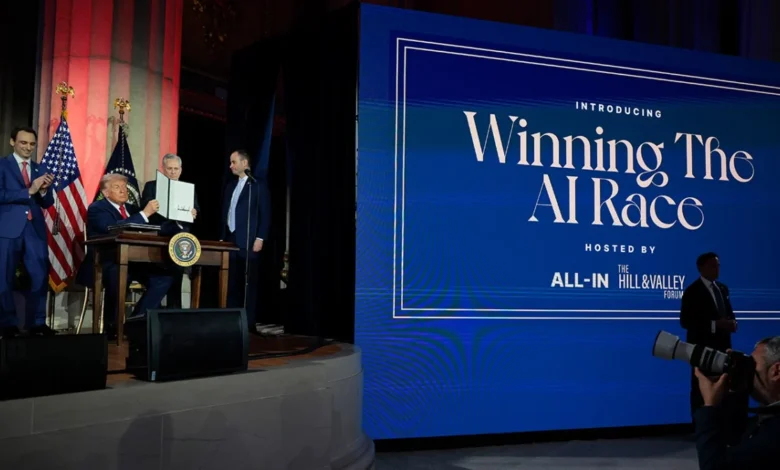
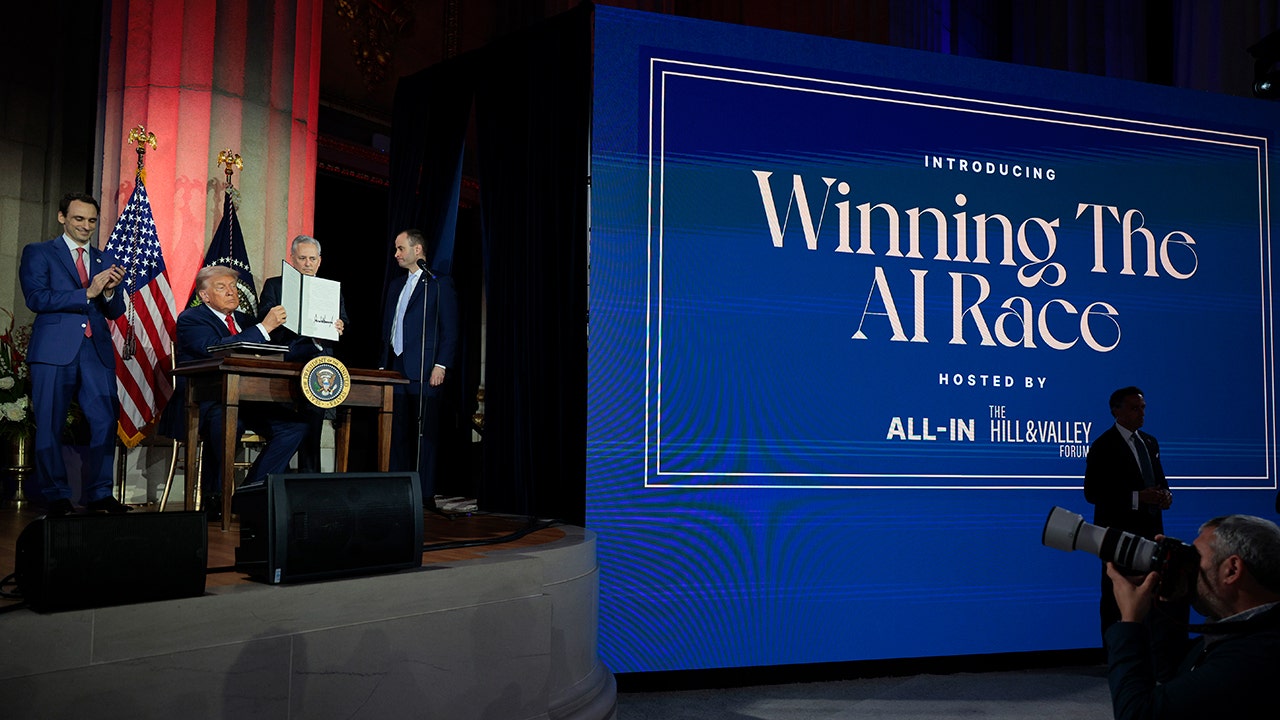
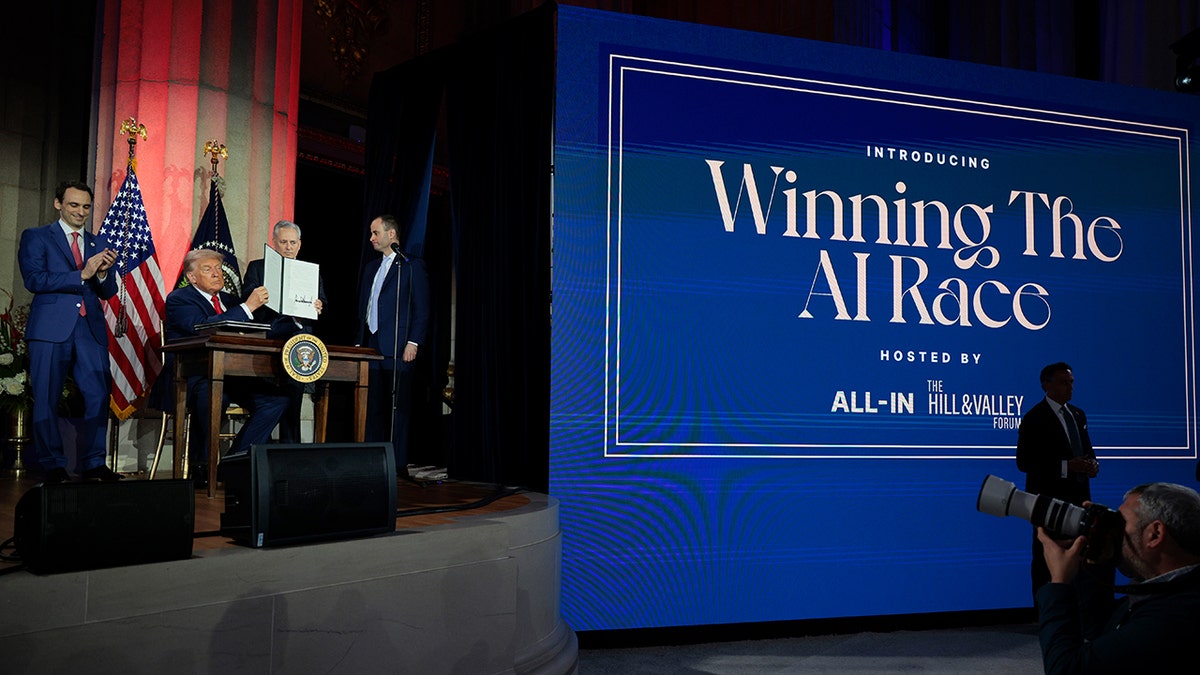
- July 2025: President Trump hosts the "Winning the AI Race" summit, signing initial executive actions designed to streamline data center permitting and reduce regulatory hurdles for energy-intensive computing infrastructure.
- Late 2025: Debates intensify in the Senate over Cold War-era emergency powers and potential technological kill-switches, exposing deep divisions between national security hawks and deregulatory conservatives.
- Early 2026: Tech executives from companies like Anthropic and OpenAI increase lobbying efforts for federal regulatory clarity ahead of the midterm elections, prompting pushback from White House advisors and congressional Republicans.
- Saturday (Current): President Trump announces the formal creation of the "AI Force," outlines plans for an AI czar, dismisses doomsday scenarios, and asserts that existing civil and criminal law are sufficient to manage bad actors.
Analytical Implications and Future Outlook
The decision to bypass preventative regulation in favor of reactive enforcement via an "AI Force" and an appointed czar marks a profound philosophical departure from the comprehensive regulatory blueprints pursued by many European allies and previous domestic policy frameworks.
Economically, the administration’s hands-off posture is expected to inject immediate confidence into venture capital markets and infrastructure developers. The construction of massive data centers—vital for training frontier models—faces significant local opposition regarding energy consumption and water usage. By framing these hurdles as surmountable zoning and energy challenges akin to historical political controversies, Trump aims to clear the path for rapid physical expansion.
However, legal and safety experts note that relying exclusively on post-hoc civil and criminal litigation leaves significant gaps in addressing systemic risks. Unlike financial markets or aviation, where retroactive punishment acts as a deterrent, catastrophic failures in autonomous systems, algorithmic cyberattacks, or advanced biological synthesis capabilities cannot easily be undone once deployed.
As the White House prepares to announce the identity of the incoming AI czar and detail the operational mandate of the AI Force, the debate over the future of American technological governance will undoubtedly intensify. Whether the strategy of unrestricted acceleration coupled with targeted enforcement will successfully secure American dominance without incurring unforeseen societal hazards remains the central question of the modern digital era.