Norse Atlantic Airways Suspends All Flights and Warns of Imminent Bankruptcy as Long-Haul Low-Cost Model Crumbles

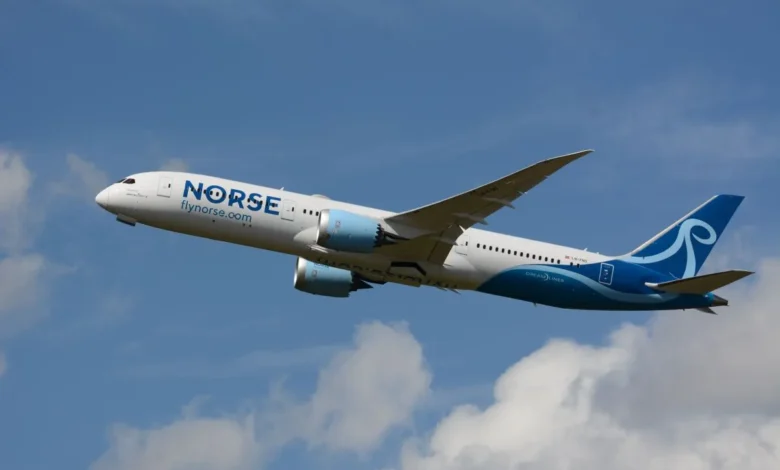
Norse Atlantic Airways has formally suspended its entire global flight network, plunging thousands of international passengers into uncertainty and casting a harsh spotlight on the viability of the long-haul, low-cost aviation model. The Oslo-headquartered carrier announced on Thursday that it was grounding its fleet immediately, issuing a grave warning that its board of directors intends to file for bankruptcy unless an eleventh-hour financial rescue package can be secured.
The abrupt suspension follows a catastrophic deterioration of the airline’s financial standing. Just a day prior to the grounding, Norse Atlantic management formally characterized the company’s liquidity status as critical. In a regulatory filing submitted to the Oslo Stock Exchange on Thursday morning, the airline confirmed that it was actively engaged in high-stakes discussions with prospective investors regarding a potential corporate takeover. This hypothetical transaction hinges upon an immediate infusion of fresh capital designed to stabilize the business.
Compounding these pressures, the airline held an emergency meeting on Wednesday with holders of its $52 million senior secured bonds to negotiate potential debt restructuring or bridge financing. However, these talks have thus far failed to yield a concrete agreement. "If a short-term financing solution is not secured urgently, it is the Board’s intention to file for bankruptcy," the company stated in its official release.
Management cautioned the market that there is no guarantee a viable rescue solution will materialize. In the wake of the suspension, Norse issued a brief statement apologizing to stranded passengers for the severe disruption to their travel plans. Notably, the airline’s initial announcements provided sparse details regarding compensation, ticket refunds, or logistical support for repatriation, leaving travelers scrambling to find alternative arrangements on competing carriers. Eivind Roald, the newly appointed Chief Executive Officer of Norse Atlantic Airways, spoke with Norwegian business newspaper Finansavisen, highlighting the unprecedented speed at which the airline’s financial runway evaporated.
The Rapid Descent: A Chronology of Crisis
The collapse of Norse Atlantic Airways did not happen in a vacuum; rather, it represents the culmination of years of structural headwinds, macroeconomic pressures, and operational miscalculations that ultimately proved fatal to the carrier’s balance sheet.
The genesis of Norse Atlantic dates back to the pandemic-era aviation landscape. Founded in 2021 by aviation entrepreneur Bjørn Tore Larsen—who sought to capitalize on the ashes of Norwegian Air Shuttle’s defunct long-haul operation—Norse positioned itself as a low-cost savior for trans-Atlantic travelers. Armed with a fleet of fuel-efficient Boeing 787 Dreamliners acquired at depressed market rates, the airline promised low fares between Europe and North America.
- March 2021: Norse Atlantic Airways is officially established, drawing heavily on former executives and operational philosophies from Norwegian Air.
- June 2022: The airline operates its inaugural commercial flight, connecting Oslo to New York. Over the subsequent months, the network expands rapidly to include secondary gateways such as London Gatwick, Paris Charles de Gaulle, Berlin, Fort Lauderdale, Los Angeles, and Orlando.
- 2023–2024: As global travel demand rebounds post-pandemic, Norse attempts to scale operations. However, high inflation, skyrocketing jet fuel prices, and unfavorable foreign exchange rates begin eroding profit margins. To mitigate seasonal slumps in trans-Atlantic travel, the airline increasingly relies on wet-leasing its aircraft to other carriers—a stopgap measure that highlights underlying core revenue weaknesses.
- Late 2024: Financial reports reveal mounting net losses. The airline’s cash reserves dwindle as seasonal winter demand plummets faster than anticipated. Management initiates cost-cutting measures and explores strategic partnerships, but debt obligations, including the $52 million senior secured bond, loom large.
- Early 2025: Liquidity pressures intensify. Despite attempts to optimize route profitability and reduce overhead, suppliers begin demanding cash-on-delivery terms, severely constraining daily operational cash flow.
- Wednesday, February (Current Year): Norse Atlantic management convenes an emergency meeting with holders of its $52 million senior secured bonds, labeling the corporate financial situation as critical and initiating talks regarding a potential takeover.
- Thursday, February (Current Year): The airline formally suspends all flight operations worldwide, files a critical disclosure with the Oslo Stock Exchange, and warns of an imminent bankruptcy filing unless emergency financing is secured.
Macroeconomic Headwinds and Structural Vulnerabilities
The downfall of Norse Atlantic highlights the enduring curse of the long-haul, low-cost business model. For decades, aviation analysts have debated whether low-cost carriers (LCCs) can successfully replicate short-haul efficiency on intercontinental routes. While airlines like Ryanair and EasyJet mastered the art of point-to-point, high-frequency, low-turnaround short-haul flying, trans-Atlantic routes present fundamentally different economic realities.
Long-haul operations require massive capital outlays, particularly for widebody aircraft like the Boeing 787. Unlike narrowbody aircraft, which can be easily repurposed or redeployed, widebody jets carry high fixed lease or ownership costs regardless of whether they are flying full or empty. Furthermore, aircraft utilization rates are inherently lower on long-haul routes due to time-zone jumps and mandatory crew rest periods.
Compounding these structural hurdles are external macroeconomic shocks. In the years following its launch, Norse Atlantic faced a triecta of financial pressures:
- Volatile Jet Fuel Prices: Fuel remains one of the largest variable costs for any airline. Geopolitical instability in the Middle East and Eastern Europe caused extreme price spikes throughout 2022, 2023, and 2024, squeezing low-margin carriers that rely on rock-bottom ticket prices to stimulate demand.
- Inflationary Pressures: Inflation drove up airport handling fees, navigation charges, labor costs, and maintenance expenses across global hubs.
- Foreign Exchange Volatility: Operating across multiple currencies—predominantly earning in Norwegian Krone, Euros, and British Pounds while paying for aircraft leases, maintenance, and fuel in U.S. Dollars—exposed Norse to severe currency depreciation risks.
Moreover, competition on primary trans-Atlantic corridors is fierce. Legacy network carriers—such as Delta Air Lines, United Airlines, American Airlines, Air France-KLM, and Lufthansa—utilize massive immunised joint ventures and alliance networks. These legacy giants can easily absorb minor yield drops on competitive routes by leveraging their lucrative corporate travel contracts, robust loyalty programs, and connecting traffic from domestic feeder networks. LCCs like Norse, by contrast, rely almost entirely on price-sensitive leisure travelers who book far in advance and offer little ancillary revenue upside during economic downturns.
Industry and Consumer Implications
The sudden grounding of Norse Atlantic sends shockwaves through the international aviation sector, carrying immediate consequences for passengers, airports, and rival airlines.
Impact on Travelers
Thousands of passengers holding tickets for upcoming flights find themselves stranded or facing canceled itineraries. Unlike major flag carriers that are bound by strict regulatory frameworks—such as European Union Regulation 261/2004, which mandates passenger care, re-routing, and compensation—financially distressed airlines entering bankruptcy often struggle to fulfill these legal obligations immediately.
Consumer advocacy groups have urged national aviation authorities to step in and ensure that travelers are provided with accurate guidance. Passengers who booked tickets using credit cards may be able to secure chargebacks through their financial institutions, but those who used debit cards or third-party travel aggregators may face protracted battles to recover their funds. Competitors on key routes, including British Airways, Norse’s former mentor airline Norwegian Air, and various transatlantic network carriers, are expected to see a surge in last-minute booking demand, though ticket prices on routes previously served by Norse will likely spike in the short term.
Airport Partners and Creditors
Airports in key focus cities—such as London Gatwick, Oslo Gardermoen, Paris Charles de Gaulle, and New York JFK—now face sudden revenue losses and uncollected landing and parking fees. The $52 million bondholders, alongside aircraft lessors, will be first in line to assess the remaining asset value of the grounded Boeing 787 fleet. Because widebody aircraft remain in relatively high demand globally due to ongoing supply chain bottlenecks at Boeing and Airbus, lessors may choose to repossess the Dreamliners swiftly and place them with more financially stable international operators.
Broader Outlook for the Long-Haul Low-Cost Sector
Norse Atlantic’s collapse serves as the latest cautionary tale in a graveyard of long-haul low-cost ventures. Over the past two decades, predecessors such as Oasis Hong Kong Airlines, Zoom Airlines, Primera Air, WOW air, and Norwegian’s own long-haul subsidiary all attempted and ultimately failed to conquer the trans-Atlantic low-fare market.
Industry analysts suggest that Norse’s demise may permanently alter investor sentiment toward the segment, making it exceedingly difficult for any future startup to secure capital for widebody aircraft operations. As the board of Norse Atlantic evaluates its final options ahead of a potential bankruptcy filing, the aviation world watches closely, marking the end of another ambitious chapter in the history of low-cost international travel.