Justice Samuel Alito Recusal from Suncor v. Boulder Highlights Lingering Ethical Questions Regarding Supreme Court Stock Ownership

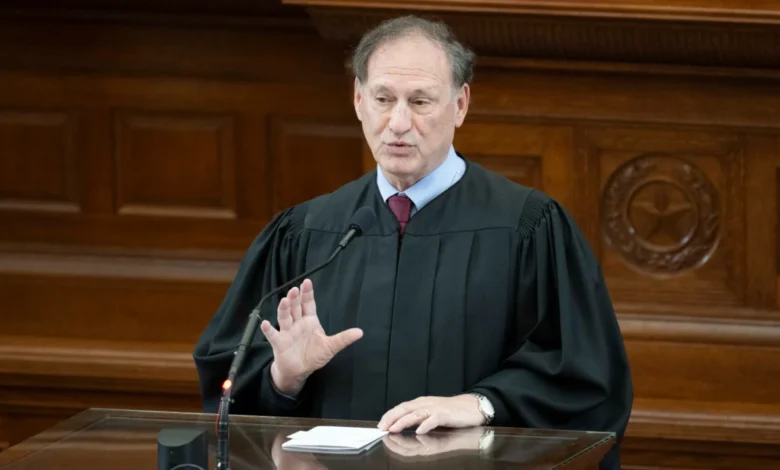
In a move that has drawn significant scrutiny to the internal ethics protocols of the nation’s highest court, Supreme Court Justice Samuel Alito announced on Monday his decision to recuse himself from a pivotal climate change case, Suncor v. Boulder. The decision, delivered via a brief letter from the clerk of the court, arrives just one week before the Supreme Court is scheduled to open its new term. The case, which pits the city and county of Boulder, Colorado, against energy giants ExxonMobil and Suncor, seeks to hold the fossil fuel industry financially liable for damages incurred from climate-related disasters. While the recusal resolves the immediate question of Alito’s participation, legal experts and ethics watchdogs argue that the development underscores a deeper, unresolved tension regarding the propriety of individual stock ownership among justices of the Supreme Court.
The case in question, Suncor v. Boulder, stems from a 2018 lawsuit filed by local governments in Colorado. Boulder’s legal team argues that major oil companies should bear the financial burden for infrastructure repairs and disaster recovery costs associated with climate change, asserting that these corporations were aware of the catastrophic potential of their products for decades yet intentionally misled the public to protect their business models. The stakes are immense: a ruling in favor of the industry could effectively grant oil companies a shield of immunity from a wave of similar litigation currently moving through state courts across the United States.
A Chronology of Climate Litigation and Ethics Concerns
The path to this moment has been paved with years of legal maneuvering and growing public pressure. The following timeline illustrates the evolution of the dispute:
- 2013: Historic flooding in Colorado destroys approximately 1,800 homes and inflicts billions of dollars in infrastructure damage, serving as a catalyst for future litigation.
- 2018: Boulder files its landmark lawsuit against ExxonMobil and Suncor.
- 2021: The Marshall Fire, the most destructive wildfire in Colorado history, ravages the region. Scientists and local officials increasingly link such events to the worsening climate crisis.
- 2022: ExxonMobil petitions the Supreme Court to intervene, explicitly labeling the Boulder case as an "ideal vehicle" for resolving preemption issues that could halt state-level climate litigation.
- 2023: The Supreme Court adopts its first formal code of conduct, though it lacks an enforcement mechanism.
- 2023–2025: The Supreme Court denies multiple petitions from oil companies seeking to block climate suits in state courts. Justice Alito recuses himself from several of these, though his reasoning remains opaque.
- February 2026: The Supreme Court agrees to hear the Suncor case. Alito participates in the conference, sparking immediate concerns about his potential influence on the decision to grant the writ of certiorari.
- September 2026: One week before the case is set to be heard, Alito officially recuses himself.
The Problem of Financial Exposure
At the heart of the controversy is Justice Alito’s extensive portfolio of individual corporate stocks. According to his most recent financial disclosure, filed in August 2026, Alito holds shares in more than 25 corporations, including seven within the fossil fuel industry. Furthermore, he maintains a mineral interest in Oklahoma valued at up to $250,000.
Critics point out that the companies in Alito’s portfolio are not merely abstract investments; they are entities with a direct material interest in the legal precedents set by the Supreme Court. For example, industry research indicates that firms like ConocoPhillips and Phillips 66—both of which have appeared in Alito’s portfolio—have explicitly warned investors that climate-related litigation poses a "material risk" to their bottom lines. By maintaining these holdings, Alito occupies a position where a ruling that limits the liability of the fossil fuel industry could theoretically benefit his own financial interests.
The issue is compounded by the lack of transparency regarding the Supreme Court’s internal decision-making process. When the Court decided in February to take up the Suncor case, Alito participated in the deliberations. Because the Court requires at least four justices to agree to hear a case, there is a persistent question regarding whether Alito’s vote was the deciding factor in bringing the case to the docket.
Official Responses and the Ethics Gap
The Supreme Court’s approach to ethics has historically been one of self-regulation. Chief Justice John Roberts has long defended the right of individual justices to determine their own recusal, citing the need to ensure a full bench for every case. In a 2011 year-end report, Roberts stated, "I have complete confidence in the capability of my colleagues to determine when recusal is warranted."
However, this reliance on personal judgment is increasingly being challenged. A coalition of 30 environmental and watchdog groups, including the League of Conservation Voters and the Revolving Door Project, petitioned the Senate Judiciary Committee in May 2026 to investigate whether Alito’s stock holdings violate existing judicial ethics codes. These groups argue that the public’s trust in the judiciary is being eroded by the appearance of a conflict of interest.
Justice Alito’s defenders, including biographer Mollie Hemingway, have suggested that the stock holdings are a matter of personal and sentimental value, inherited by his wife, Martha-Ann, from her parents. This argument, however, has failed to satisfy legal ethicists who contend that judicial duty must supersede private sentiment. Arthur Hellman, a professor emeritus at the University of Pittsburgh and an expert on judicial ethics, noted that Alito’s defense—that recusal causes "disruption" to the Court’s work—does not outweigh the ethical necessity of impartiality. "Justice Alito will no longer be open to criticism for participating in the Suncor case," Hellman remarked, "but his recusal does nothing to address the concerns about disruption of the Court’s work that he voiced in his memorandum."
Broader Implications for the Judiciary
The Suncor case is just one of many currently stayed in lower courts, waiting on the Supreme Court’s final word. Cases in California, New Jersey, and Delaware, among others, hinge on whether state-level climate lawsuits can proceed. If the Supreme Court rules in a way that provides broad immunity to the oil industry, it could fundamentally alter the legal landscape of climate change accountability for decades to come.
Legal scholars suggest that the controversy surrounding Justice Alito’s recusal may serve as a turning point for the Supreme Court. The adoption of the 2023 Code of Conduct was an acknowledgment of rising public dissatisfaction, yet it failed to address the core issue of individual stock ownership. Louis Virelli, a law professor at Stetson University, argues that the conversation needs to shift from technical compliance to fundamental ethics. "We spend too much time talking about what is required of the justices," Virelli said. "We should be talking about the right thing to do, because the justices owe us all an ethical duty and they owe us an institutional duty."
As the term begins, the focus will remain on the remaining justices and the potential for a split decision in the absence of one of the Court’s most conservative voices. Meanwhile, the incident has invigorated calls for legislation that would mandate stricter financial disclosures and potentially prohibit Supreme Court justices from holding individual stocks in companies that frequently litigate in federal courts. Whether the Court will take internal steps to reform its practices remains an open question, but the shadow cast by the Suncor recusal suggests that the status quo may no longer be sustainable in an era of heightened public oversight. For now, the legal community is left to observe how the Court navigates these high-stakes environmental cases while simultaneously attempting to repair its own institutional reputation.
Related posts: