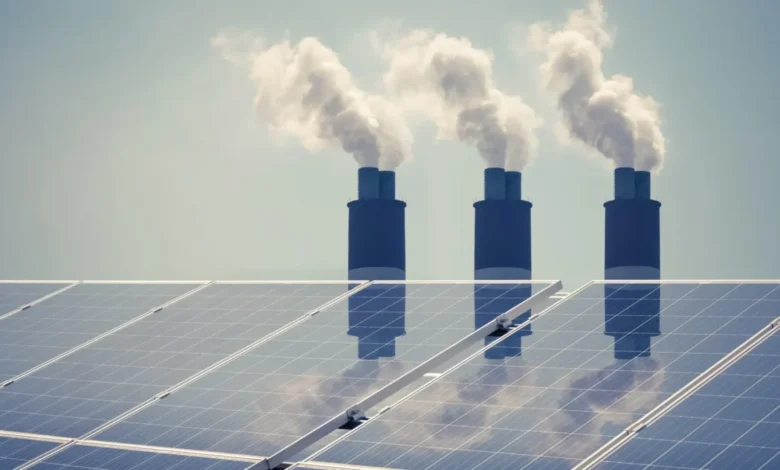
In a transformative moment for the American energy landscape, solar energy provided more electricity to the United States power grid than coal for the first time in history during the month of May 2026. This milestone, long predicted by energy economists but accelerated by rapid technological deployment, marks a symbolic and functional shift in the nation’s transition away from fossil fuels. According to a comprehensive analysis of federal energy data by Ember, an international energy think tank, solar arrays across the country contributed 12.8 percent of the nation’s total electricity generation in May. During the same period, coal-fired power plants—the former backbone of American industrial might—slipped to 12.2 percent.
The data reveals a stark reversal of fortunes for the two energy sources. Only five years ago, solar energy accounted for less than 6 percent of the national energy mix, while coal maintained a steady, albeit declining, 20 percent share. The May figures represent the culmination of a decade-long trend driven by falling costs for photovoltaic panels, state-level renewable mandates, and a surge in utility-scale solar installations in states such as Texas, California, and Florida. Nicolas Fulghum, a senior data analyst at Ember, noted that the transition highlights solar’s evolution from a niche supplemental source to a primary pillar of the American grid. Fulghum observed that markets across the United States are increasingly prioritizing solar to meet the surging power demands of the modern economy.
A Decadelong Trajectory: The Rise of Solar and the Retreat of Coal
The path to this historic crossover has been defined by two distinct trajectories: the relentless economic decline of coal and the exponential scaling of solar infrastructure. In the mid-2000s, coal was responsible for nearly 50 percent of all electricity generated in the United States. However, the "shale gale"—a massive increase in domestic natural gas production—began to erode coal’s dominance by offering a cheaper, more flexible alternative. By the early 2020s, environmental regulations and the aging of the national coal fleet further accelerated plant retirements.
Simultaneously, the solar industry benefited from the "learning curve" of manufacturing, which saw the cost of solar modules drop by nearly 90 percent over the last decade. Even as global supply chains faced volatility, the fundamental economics of solar remained attractive to utilities. In 2024 and 2025, solar accounted for more than half of all new electricity capacity added to the U.S. grid. While natural gas remains the largest single source of American electricity, followed by nuclear power, solar has now officially claimed the third-place spot, leapfrogging coal and wind during the peak spring generation months.
The timing of this milestone is particularly noteworthy as it occurs during a period of significant political flux. The transition persists despite a dramatic shift in federal energy policy following the passage of the "One Big Beautiful Bill Act" last summer. This legislation effectively rolled back many of the climate-centric provisions of the 2022 Inflation Reduction Act (IRA), which had provided the initial financial tailwinds for the solar surge. The current administration has pivoted toward a "pro-extraction" stance, yet the momentum of existing solar projects and the inherent cost-competitiveness of renewable energy appear to be resisting a full reversal of the green energy transition.
Policy Counterwinds and the Federal Pivot to Coal
While the May data celebrates a renewable energy victory, the broader political environment in Washington D.C. tells a different story. The Trump administration has moved aggressively to revitalize the domestic coal industry, viewing it as a matter of national security and economic stability. In May 2026, the same month solar eclipsed coal, the administration announced a $700 million investment package intended to modernize existing coal infrastructure and break ground on the first new coal-fired power plants the United States has seen in thirteen years.
These funds, repurposed from accounts originally intended for carbon sequestration and renewable research, are part of the "dig, baby, dig" campaign strategy. President Donald Trump, speaking at a rally in West Virginia, characterized the move as a return to "clean, beautiful coal" that would lower energy costs for American families. The administration argues that the intermittent nature of solar and wind energy threatens the reliability of the grid, particularly as artificial intelligence (AI) and data centers drive up baseline electricity demand.
However, many energy experts argue that these federal interventions may be too little, too late to save the coal industry from market forces. The $700 million bailout has been characterized by environmental advocates as an attempt to revive a "sinking ship." Lena Moffitt, executive director of the environmental group Evergreen Action, argued that funneling taxpayer money into coal is an inefficient use of resources given that solar and wind are now the cheapest forms of new energy generation in most parts of the country.
Regional Drivers: Texas and California Lead the Charge
The shift in the national energy mix is largely driven by localized booms in solar adoption. Texas, historically the heart of the American oil and gas industry, has emerged as a surprising leader in solar generation. The state’s independent grid operator, ERCOT, has integrated massive amounts of solar capacity to meet the demands of a growing population and an expanding industrial sector. In Texas, solar has proven to be a vital asset during summer heatwaves, providing peak power when air conditioning demand is at its highest.
California continues to lead in total solar penetration, often generating more solar power than its grid can consume during midday hours, leading to a surge in battery storage investments. The "duck curve"—a phenomenon where net load drops significantly during the day when solar is active—has forced California to become a pioneer in grid management and long-duration storage.
Even in states traditionally aligned with the Republican platform, solar adoption is rising. Influencers within the "Make America Great Again" (MAGA) movement have begun promoting solar energy as a means of "energy independence" and "off-grid resilience," framing it not as a climate solution but as a tool for personal and national sovereignty. This cultural shift has helped insulate the solar industry from some of the more polarized aspects of the climate debate.
Industry Perspectives and Grid Reliability
The National Mining Association (NMA) has pushed back against the narrative of coal’s obsolescence. Rich Nolan, president and CEO of the NMA, emphasized that coal remains a critical "baseload" power source that provides stability when the sun isn’t shining or the wind isn’t blowing. Nolan pointed to the rapid expansion of AI data centers—which require constant, high-intensity power—as a reason to maintain and expand the coal fleet. According to the NMA, the volatility of energy prices in markets heavily dependent on renewables can be mitigated by the steady supply of coal.
Conversely, proponents of the renewable transition argue that the combination of solar and battery storage is becoming more reliable and cost-effective than coal. Patrick Drupp, director of climate policy at the Sierra Club, stated that the continued rise of renewables is an inevitability of the modern market. Drupp noted that the transition is not only beneficial for the environment but also for public health and consumer wallets, as solar power avoids the fuel price volatility associated with fossil fuels.
Economic and Environmental Implications
The environmental impact of solar overtaking coal is significant. Coal is the most carbon-intensive fossil fuel, and its decline is the primary reason U.S. power sector emissions have dropped over the last two decades. While the current administration’s support for coal may slow this decline, the sheer volume of solar capacity already in the "interconnection queue"—the list of projects waiting to be hooked up to the grid—suggests that solar’s share will only grow.
Economically, the solar industry has become a major employer. According to the Solar Energy Industries Association (SEIA), while installation rates saw a slight dip in 2025 due to policy uncertainty and the repeal of certain tax credits, the industry remains a powerhouse of domestic job creation. More Americans now work in solar energy than in coal mining, a trend that is unlikely to reverse regardless of federal funding shifts.
The milestone reached in May 2026 serves as a proof of concept for the energy transition. It demonstrates that despite legislative rollbacks and a federal pivot toward traditional fuels, the technological and economic momentum of solar energy has reached a tipping point. As the United States moves toward the end of the decade, the competition between market-driven renewable growth and policy-driven fossil fuel support will likely define the future of the American utility sector. For now, the "sun is shining" on the American grid, casting a long shadow over the future of coal.