Three Frontier Airlines passengers arrested following unauthorized boarding attempt in Miami over unpaid baggage fees

The aviation industry is built upon a rigid framework of safety, security, and administrative protocols that govern the movement of passengers from terminal gates to cruising altitudes. When these protocols are breached, the consequences are swift and often disruptive to the broader operation. On March 29, a routine boarding procedure for Frontier Airlines Flight 1204 at Miami International Airport devolved into a significant security incident when three passengers, having been denied boarding due to an unpaid baggage fee, bypassed gate staff to force their way onto the aircraft. The ensuing confrontation, which involved police intervention, physical restraint, and subsequent criminal charges, has brought renewed scrutiny to the tensions often found at the intersection of low-cost carrier fee structures and passenger compliance.
Chronology of the Disruption
The incident began at the boarding gate, where the three passengers presented for their flight to Philadelphia. According to reports and internal documentation from the incident, the travelers were checking two carry-on bags but had only secured payment for one. Frontier Airlines, which operates on an "a la carte" business model, requires payment for carry-on luggage that exceeds the dimensions of a personal item. When informed of the necessity to pay for the second bag, the passengers engaged in a verbal dispute with the gate agent.
As the argument escalated, airline personnel determined that the passengers were not in compliance with boarding requirements and subsequently voided their boarding passes, effectively denying them passage on the flight. Despite this explicit instruction, one member of the trio was captured on video urging her companions to ignore the staff, stating, "We don’t have to listen; let’s just go." The group then bypassed the gate staff, proceeding down the jetbridge and entering the aircraft cabin in defiance of company policy and safety protocols.
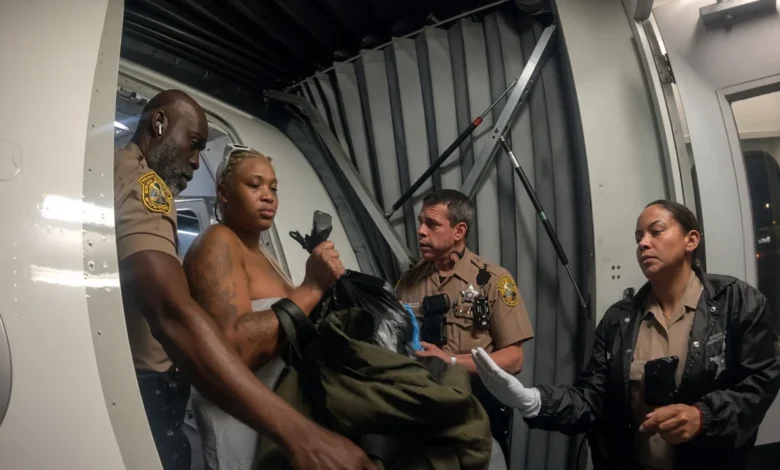
Airline staff immediately contacted law enforcement. Before deputies arrived, an airline representative notified them that they wished to have all three individuals removed from the premises and that no rebooking would be permitted. Furthermore, staff reported a potential concern regarding the sobriety of the passengers, citing the odor of alcohol. Upon entering the aircraft, law enforcement officers informed the women they would not be permitted to fly. The situation escalated upon their exit from the aircraft, resulting in a physical struggle on the jetbridge, the use of handcuffs, and a scene in which the women were removed from the terminal to the cheers of other passengers.
Legal Ramifications and Charges
The aftermath of the confrontation resulted in formal criminal charges filed by the Miami-Dade Police Department. All three individuals were charged with trespassing and resisting an officer without violence. In addition to these counts, one of the passengers faced an additional charge of battery, stemming from allegations that she spat on a Frontier Airlines employee during the altercation. All three defendants entered pleas of not guilty to the charges.
The body camera footage, which has since circulated widely on social media platforms and news outlets, highlights a contentious moment of interaction between law enforcement and the suspects. During the arrest, an officer is heard stating, "We’re going to put cuffs on you whenever we want. We’re not going to tell you anything. You’re going to do what you’re told." This specific exchange has drawn criticism from legal observers, who argue that the standard for detaining and handcuffing individuals must be grounded in objective reasonable suspicion or probable cause rather than arbitrary authority. While the passengers’ behavior was clearly disruptive and illegal, the conduct of law enforcement remains a point of analysis regarding the appropriate use of force in airport settings.
Broader Industry Context: The Low-Cost Carrier Model
The incident at Miami International Airport is not an isolated event in the landscape of ultra-low-cost carrier (ULCC) travel. Frontier Airlines, along with other carriers like Spirit and Allegiant, has frequently found itself at the center of passenger-staff conflicts, often linked to the strict enforcement of ancillary fees.

Historically, aviation industry experts have noted that the "unbundled" pricing model—where base fares are low but every additional service, including carry-on bags and seat selection, carries a fee—creates a high-pressure environment at the gate. For many passengers, the realization that their total travel cost is significantly higher than the advertised base fare can lead to frustration. When this frustration is met with the rigid, non-negotiable operational policies of gate agents, the potential for verbal altercations increases.
Data from the Federal Aviation Administration (FAA) shows a significant spike in unruly passenger reports over the last four years. While many of these incidents are related to mask mandates or intoxication, a growing percentage of gate-level disturbances are tied to luggage policies and seating assignments. The frequency of these incidents has forced airlines to invest more heavily in airport security and training for gate staff to de-escalate volatile situations before they require police intervention.
Comparative Analysis of Airport Disruptions
This incident is one of several documented cases of passenger non-compliance at Miami International Airport. In previous instances, passengers have refused to vacate seats or follow flight crew instructions, leading to delays that impact dozens, if not hundreds, of other travelers. In one notable case, a passenger went as far as biting a responding officer after being removed from a flight.
The legal implications of boarding an aircraft without authorization are severe. Under federal law, interference with flight crew members or flight attendants is a felony offense. While this specific incident involved a gate-level breach, the act of entering an aircraft after being explicitly denied boarding constitutes a breach of airport security, which can lead to placement on an airline’s permanent "no-fly" list and potential federal prosecution under Transportation Security Administration (TSA) guidelines.
Policy Implications and Operational Security
The incident raises questions regarding the security of the boarding process. Modern jetbridges are designed to be secure zones, and unauthorized entry represents a failure in the flow control of the terminal. Airlines and airports are currently evaluating whether increased security presence at the gate is necessary to prevent passengers from bypassing staff.
Furthermore, the tension between airline employees and customers highlights a critical need for enhanced conflict resolution training. While gate agents are tasked with enforcing company policy, they are also the first line of defense in maintaining a safe environment for all passengers. When an interaction turns into a public altercation, it creates a "chilling effect" on the travel experience for the remaining passengers on the flight, who often face significant delays while the situation is resolved.
Conclusion
The confrontation on Frontier Flight 1204 serves as a stark reminder of the limitations of the passenger-airline relationship. While consumers may disagree with the fee structures of modern airlines, the established protocol requires adherence to instructions from authorized personnel. The transition from a customer service dispute to a criminal arrest highlights the zero-tolerance policy that airlines now adopt toward unauthorized behavior. As the industry continues to manage the balance between profitability through ancillary fees and the necessity of maintaining order in a high-traffic environment, the consequences for failing to comply—ranging from lost ticket revenue to criminal prosecution—remain a cautionary tale for all travelers. The case of the three passengers in Miami will likely continue to be cited as an example of the legal boundaries of airport behavior and the importance of adhering to the authority of gate staff in the interest of public and aviation safety.