Legal Battle Intensifies Over Alligator Alcatraz as Appeals Court Permits Continued Operation of Everglades Migrant Detention Center

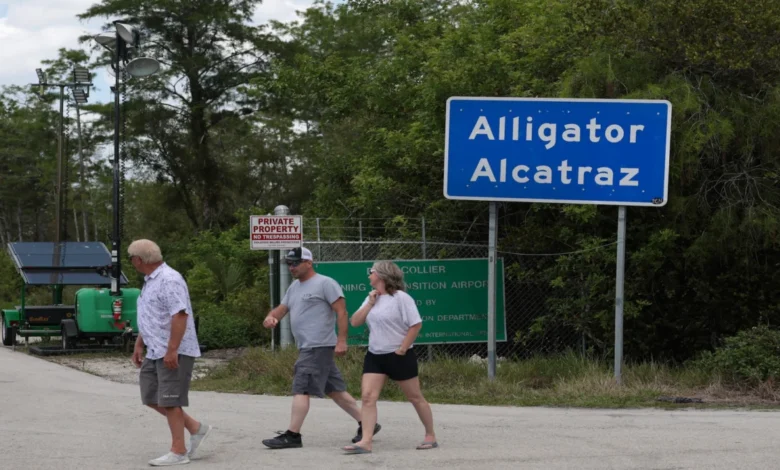
The fragile ecosystem of the Florida Everglades and the sacred traditions of the Miccosukee Tribe of Indians are at the center of a deepening legal and cultural conflict following a pivotal ruling by the 11th U.S. Circuit Court of Appeals. The court has cleared the way for the continued operation of "Alligator Alcatraz," a controversial migrant detention facility located deep within the Florida wilderness, by invalidating a preliminary injunction that had previously ordered the site to wind down its operations. This decision marks a significant setback for a coalition of tribal leaders and environmental advocates who argue that the facility was established in violation of federal environmental laws and represents a direct assault on the spiritual and ecological integrity of one of the world’s most unique landscapes.
The facility, which has been housing thousands of undocumented migrants since its opening last summer, was a cornerstone of the Trump administration’s intensified immigration enforcement strategy. However, its location—surrounded by sawgrass prairies and cypress marshes—has drawn fierce opposition. The Miccosukee Tribe, alongside the Center for Biological Diversity and Friends of the Everglades, has spearheaded a legal challenge asserting that the federal government bypassed the National Environmental Policy Act (NEPA). They contend that the facility was rushed to completion without a comprehensive assessment of its impact on endangered species, water quality, and tribal lands.
The 11th Circuit Ruling and Judicial Dissent
The recent decision by the 11th U.S. Circuit Court of Appeals hinged on the complex jurisdictional relationship between state and federal authorities. In a 2-1 decision, Judges William Pryor and Andrew Brasher ruled that the plaintiffs had failed to demonstrate that the federal government exercised sufficient control over the site to trigger NEPA requirements. The majority argued that the facility is technically a state-run entity, despite its role in federal immigration enforcement.
To illustrate their point, the judges compared the situation to a private office building owner who must comply with the Americans with Disabilities Act (ADA). They reasoned that just as federal compliance does not turn a private building into a federal one, the state’s adherence to federal immigration standards does not transform a state facility into a federal project. Furthermore, the court found that the previous injunction issued by District Judge Kathleen Williams violated statutory prohibitions against judicial interference in immigration enforcement.
However, the ruling was far from unanimous. Judge Nancy Abudu issued a sharp dissent, characterizing the partnership between Florida and the federal government as one where the state acts as a "deputy" of the federal government. She argued that the facility exists solely to serve the interests of the Department of Homeland Security (DHS) and Immigration and Customs Enforcement (ICE). "The state cannot detain a non-citizen without the proper authority to do so," Abudu wrote, suggesting that without the federal mandate, the detention of individuals in such a secluded area would border on human trafficking. She criticized her colleagues’ ADA analogy as a fundamental misunderstanding of the level of federal entanglement involved in the operation of Alligator Alcatraz.
Cultural Erasure and the Miccosukee Sacred Lands
For the Miccosukee Tribe, the legal battle is about more than administrative procedures; it is a fight for the survival of their religious and cultural identity. The facility is situated in an area the tribe holds as sacred, a region that served as a sanctuary for their ancestors during the First and Second Seminole Wars of the 19th century. The tribe credits the "river of grass" with saving them from annihilation, creating a profound spiritual bond between the people and the land.
During the current spring corn dance season, tribal members have found their traditional ceremonies disrupted. A primary concern is light pollution. The detention center, which operates 24 hours a day with high-intensity security lighting, casts a glow that can be seen for miles across the flat Everglades landscape. This "skyglow" obscures the stars, which are essential for the Miccosukee’s religious orientation and celestial navigation during sacred rites.
Curtis Osceola, the Miccosukee Tribe’s chief operating officer, described the facility as a desecration. He likened the construction of the detention center to razing a church to build a prison. The proximity of the site is particularly jarring; there are ten Miccosukee villages within a three-mile radius of Alligator Alcatraz, with one village located just 1,000 feet from the facility’s perimeter. For a community that relies on the tranquility and natural state of the Big Cypress National Preserve and the surrounding marshes, the presence of a high-security prison is an existential threat.
Environmental Risks to the "River of Grass"
The Everglades is not only a cultural landmark but also a critical environmental resource. It provides the drinking water for more than eight million Florida residents and is the site of a $27 billion restoration effort—the largest and most expensive ecosystem restoration project in human history. Environmentalists argue that the introduction of a massive detention facility, with its associated sewage, waste, and infrastructure, poses a significant risk to water quality.
The Center for Biological Diversity has highlighted the threat to specific endangered species that call this region home. The Florida panther, one of the most endangered mammals in North America, and the Florida bonneted bat are known to inhabit the areas surrounding the facility. The noise, light, and human activity associated with thousands of detainees and staff can disrupt the migratory and hunting patterns of these species.
Elise Bennett, the Florida and Caribbean director for the Center for Biological Diversity, emphasized that the harm is "irreparable and ongoing." The environmental groups argue that the government’s claim that the impact is "minimal" is unsupported by data, precisely because no formal environmental review was ever conducted. They point to the delicate balance of the Everglades ecosystem, where even minor changes in water chemistry or light levels can have cascading effects on the flora and fauna.
A Chronology of the Alligator Alcatraz Conflict
The timeline of the facility’s development reveals a rapid push to establish the site amidst a shifting political landscape:
- Early 2024: The Trump administration identifies a site in Miami-Dade County, within the Everglades, for a "rapid-response" migrant detention center.
- June 2025: Friends of the Everglades and the Center for Biological Diversity file a lawsuit in the U.S. District Court for the Southern District of Florida, seeking to halt construction.
- July 2025: The facility, dubbed "Alligator Alcatraz" by locals and advocates, officially opens and begins receiving detainees.
- August 2025: District Judge Kathleen Williams issues a preliminary injunction, ordering a gradual wind-down of the facility, citing likely violations of NEPA.
- Late 2025: The federal and state governments appeal the injunction to the 11th Circuit.
- April 2026: The 11th Circuit Court of Appeals vacates the injunction, allowing the facility to remain fully operational while the broader litigation continues.
Financial and Political Entanglements
New evidence brought forward by Friends of the Everglades suggests that the "state-run" nature of the facility may be a legal facade. Public records obtained through litigation indicate that the Federal Emergency Management Agency (FEMA) promised hundreds of millions of dollars to the state of Florida specifically for the construction and operation of Alligator Alcatraz.
This financial trail is a key component of the plaintiffs’ argument that the facility is a federal project in all but name. By funneling federal funds through state agencies like the Florida Division of Emergency Management, the plaintiffs argue the government attempted to bypass the rigorous environmental scrutiny required for federal infrastructure projects. The defendants in the case include high-ranking officials from DHS, ICE, and the Florida state government, as well as Miami-Dade County, which owns the land upon which the facility sits.
Implications for Environmental Law and Tribal Sovereignty
The outcome of this case, which now returns to Judge Williams’ court for further proceedings, could have far-reaching implications for how environmental laws are applied to immigration infrastructure. If the courts ultimately decide that state-run facilities used for federal purposes are exempt from NEPA, it could create a blueprint for the government to bypass environmental regulations in other sensitive areas across the country.
Furthermore, the case underscores the ongoing struggle for tribal sovereignty. The Miccosukee Tribe’s involvement highlights the lack of consultation with Indigenous communities when large-scale projects are placed on or near their ancestral lands. For the Miccosukee, the fight is a continuation of their 200-year history of resisting encroachment.
As the litigation moves forward, the facility remains active. Buses continue to transport detainees into the heart of the swamp, and the bright security lights continue to mask the stars over the Miccosukee villages. While the government maintains that the facility is a necessary component of national security and immigration management, the plaintiffs remain resolute. "We were prepared for any potential outcome," said Elise Bennett. "Now we’re reinvigorated to get back in there and win."
The case of Alligator Alcatraz stands as a stark reminder of the tension between modern policy objectives and the preservation of natural and cultural heritage. Whether the "river of grass" will be protected or further transformed by the needs of the state remains a question that the federal courts will have to answer in the months to come.
Related posts: