Hilton CEO Forecasts 2026 Growth Surge Driven by U.S. Midmarket Resilience and Middle East Recovery

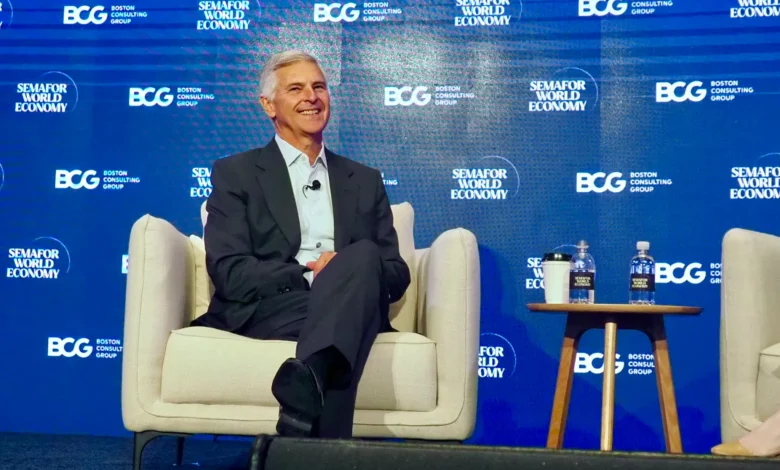
Christopher Nassetta, the President and CEO of Hilton Worldwide Holdings Inc., has issued a robust defense of his optimistic long-term outlook for the global hospitality sector, identifying 2026 as a pivotal year for industry-wide outperformance. Speaking at the Semafor World Economy Summit in Washington, D.C., Nassetta doubled down on a prediction he first made a year ago, asserting that the convergence of a stabilized U.S. macroeconomic environment and a revitalized Middle Eastern market will propel the industry to new heights. Despite immediate concerns regarding geopolitical instability in the Levant and fluctuating performance metrics surrounding major international sporting events like the World Cup, Nassetta’s "bullish" stance suggests that the structural foundations of the travel industry are stronger than current market volatility might indicate.
The CEO’s confidence is rooted in a belief that the U.S. midmarket—a segment that serves as the backbone of Hilton’s domestic portfolio—is undergoing a significant demand rebound. This recovery, according to Nassetta, is supported by "hard evidence" gathered over the first half of 2024, indicating that the U.S. consumer remains resilient despite inflationary pressures and higher interest rates. By positioning 2026 as a year that will outperform 2025, Nassetta is signaling to investors and stakeholders that the current cooling period in some leisure segments is a temporary correction rather than a long-term downturn.
The Strategic Importance of the U.S. Midmarket Rebound
Central to Nassetta’s forecast is the performance of the American midmarket, which includes brands such as Hampton by Hilton, Tru by Hilton, and the recently launched Spark by Hilton. This segment is often viewed as a bellwether for the broader economy because it captures the spending habits of both middle-class leisure travelers and small-to-medium enterprise (SME) business travelers.
During the summit, Nassetta noted that the macroeconomic picture in the United States has improved sufficiently to vindicate his aggressive growth targets. While the luxury and "bleisure" (combined business and leisure) segments saw a massive post-pandemic surge in 2022 and 2023, the midmarket had been slower to normalize. However, internal data from Hilton suggests a shift. As corporate travel budgets for SMEs stabilize and domestic road-trip culture remains a staple of American leisure, the midmarket is seeing a steady increase in Revenue Per Available Room (RevPAR).
Analysts suggest that Hilton’s focus on the "premium economy" and "midscale" segments is a defensive play against economic uncertainty. If the U.S. economy enters a soft landing, these brands benefit from steady demand. If the economy weakens further, travelers often "trade down" from luxury or upscale hotels to midmarket options, maintaining Hilton’s occupancy levels across its 7,500-property global portfolio.
Geopolitical Realities and the Middle East Outlook
Perhaps the most surprising aspect of Nassetta’s address was his long-term optimism regarding the Middle East. The region has faced significant headwinds over the past year due to the escalating conflict in Gaza and regional tensions involving various state and non-state actors. These events have led to a temporary cooling of tourism in neighboring countries such as Jordan and Egypt, and have raised concerns about the stability of the broader Gulf region.
However, Nassetta offered a five-year horizon for the Middle East, predicting the region would be "fine" and potentially even more prosperous than before. He specifically alluded to the shifting geopolitical dynamics involving Iran, suggesting that a "different state" of regional relations could eventually lead to a more integrated and stable tourism market. For Hilton, the Middle East represents one of the highest-growth pipelines in the world, particularly in Saudi Arabia under the "Vision 2030" initiative.
The Saudi government’s commitment to investing $1 trillion in its tourism sector is a primary driver for Hilton’s expansion. The company has dozens of properties in development across the Kingdom, ranging from luxury Waldorf Astoria sites to midmarket brands in emerging secondary cities. Nassetta’s comments imply that while short-term volatility is unavoidable, the long-term capital commitments from regional governments ensure that the infrastructure for a massive tourism boom will be ready by the mid-2020s.
Analyzing the 2026 North American World Cup Catalyst
The CEO’s focus on 2026 is also inextricably linked to the FIFA World Cup, which will be hosted across the United States, Canada, and Mexico. While Nassetta acknowledged that some recent international events—likely referring to the immediate logistics and booking patterns seen during the Qatar World Cup or the lead-up to the Paris Olympics—have seen "disappointing" booking windows or localized displacement, the 2026 event is of a different scale.
The 2026 World Cup will be the largest in history, featuring 48 teams and matches in 16 host cities. Unlike the 2022 event in Qatar, which was concentrated in a single metropolitan area, the 2026 tournament will distribute demand across the entire North American continent. This geographic spread is ideal for a company like Hilton, which has an extensive footprint in nearly every major and secondary U.S. market.
Nassetta’s prediction that 2026 will outperform 2025 is largely based on this "mega-event" effect. The tournament is expected to draw millions of international visitors, many of whom will stay for extended periods and travel between host cities. This creates a "halo effect" for the entire industry, driving up Average Daily Rates (ADR) not just in host cities, but in regional hubs and transit gateways.
Chronology of the 2026 Forecast
The evolution of Nassetta’s 2026 prediction follows a specific timeline of economic and industry shifts:
- Early 2023: Hilton leadership first identifies 2026 as a peak year, citing the normalization of supply chains and the completion of a massive wave of post-pandemic hotel constructions.
- Late 2023: Amid rising interest rates, Nassetta maintains his bullish stance, arguing that the "unmet demand" for travel remains the primary driver of the industry, outweighing the cost of capital.
- Early 2024: The launch of "Spark by Hilton" targets the budget-conscious traveler, filling a gap in the portfolio and providing a new engine for domestic growth.
- April 2024: At the Semafor World Economy Summit, Nassetta confirms that "hard evidence"—specifically improving U.S. employment data and consumer spending patterns—has strengthened his conviction in the 2026 surge.
Supporting Data and Industry Context
The broader hotel industry is currently navigating a period of "normalization." Following the "revenge travel" era of 2022, RevPAR growth has slowed to more sustainable levels. According to industry data provider STR, U.S. RevPAR is projected to grow by approximately 2% to 4% in 2024 and 2025. Nassetta’s suggestion that 2026 will see an acceleration suggests a break from this trend.
Hilton’s development pipeline serves as a key indicator of this confidence. As of the end of 2023, Hilton had the largest pipeline in its history, with approximately 462,000 rooms under development globally. Nearly half of these rooms are already under construction. This aggressive expansion is timed specifically to hit the market in late 2025 and early 2026, coinciding with the anticipated economic upswing Nassetta described.
Furthermore, the recovery of business travel—specifically group and convention business—is a critical component of the 2026 outlook. While individual business travel has changed permanently due to remote work, large-scale conventions and corporate events have returned to 2019 levels. Hilton’s data suggests that bookings for major conferences in 2025 and 2026 are pacing ahead of historical averages, providing a solid "base" of occupancy that allows hotels to yield-manage their remaining rooms at higher prices.
Official Responses and Market Reaction
Market analysts have reacted to Nassetta’s comments with a mixture of cautious optimism and scrutiny. Financial analysts at firms like Jefferies and Morningstar have noted that while Hilton’s asset-light business model (which focuses on management and franchising rather than owning real estate) makes it resilient, the 2026 forecast depends heavily on the absence of a major global recession.
"Chris Nassetta has a track record of being ahead of the curve regarding consumer sentiment," noted one hospitality analyst following the summit. "His focus on the midmarket is a recognition that the ‘top 1%’ cannot sustain the entire industry. By betting on 2026, he is essentially betting on the continued health of the global middle class."
Competitors such as Marriott International and IHG Hotels & Resorts have similarly focused on midmarket expansion and the Middle Eastern market, though few CEOs have been as specific as Nassetta in pinpointing 2026 as the standout year for the sector.
Broader Impact and Implications for the Travel Sector
The implications of Nassetta’s forecast extend beyond Hilton’s shareholders. If his "bullish" outlook proves accurate, it suggests that the global travel industry has successfully decoupled from some of the traditional cyclical pressures of the broader economy. It would indicate that travel has shifted from a discretionary "luxury" expense to a prioritized "essential" experience for a significant portion of the global population.
Moreover, the emphasis on the Middle East as a high-growth engine suggests that the center of gravity for global tourism continues to shift eastward. While the U.S. midmarket provides the stability, the Middle East and Asia-Pacific regions provide the "alpha" or high-growth potential that drives total system growth.
As 2026 approaches, the industry will be watching several key indicators to see if Nassetta’s bet pays off:
- Interest Rate Trajectory: A decline in rates would lower the cost of debt for hotel developers, further accelerating the pipeline.
- Geopolitical De-escalation: Any movement toward stability in the Middle East would immediately unlock suppressed demand for regional travel.
- World Cup Logistics: The ability of North American infrastructure to handle the 2026 World Cup will determine if the event meets the high financial expectations set by industry leaders.
For now, Chris Nassetta remains the industry’s most prominent optimist. By leaning into the midmarket and looking past current geopolitical strife, he is positioning Hilton to capitalize on a world that he believes will be more mobile, more connected, and more eager to travel by 2026 than ever before.